
Ketamine Therapy for Depression: A New Path When Nothing Else Has Worked
If you've spent years trying to feel better, you know how demoralizing that journey can be. You followed your doctor's advice. You tried one antidepressant, then another. Maybe you added therapy on top of medication and still found yourself stuck in the same heavy, relentless fog. We hear this from clients all the time, and we want you to know that experience doesn't mean you're out of options. It means you may not have found the right one yet.
Ketamine therapy for depression is one of those options, and it works in a fundamentally different way than anything you've likely tried before. It's not a magic cure. But for many people living with severe or treatment-resistant depression, it has offered something they hadn't felt in years: real relief, and the neurological change to start building something new.
This article is for those who have tried multiple paths toward healing and are looking for a different approach. We will explain the science behind ketamine therapy, what the process involves, and how we offer this work at Wellness Space Counseling.
Wondering if this could be right for you? Learn about our ketamine-assisted psychotherapy program or reach out to schedule a consultation.
What Is Ketamine Therapy for Depression?
Ketamine is a medication that has been used as an anesthetic in medical settings for decades. More recently, research has supported ketamine as a treatment, particularly for people whose symptoms have not improved with traditional antidepressant medications.
There are several delivery methods used in psychiatric care today, and the differences between them matter, both for how the medication works in your body and for the kind of therapeutic experience that surrounds it.
IV ketamine infusion: Intravenous ketamine delivered in low doses at a certified ketamine clinic. This is the most researched delivery method for depression and is used off-label.
Esketamine (Spravato): A nasal spray formulation approved by the FDA in 2019 specifically for treatment-resistant depression. It is administered under the direct supervision of a health care provider, who monitors your vital signs throughout the session.
Oral ketamine lozenges: Compounded ketamine taken sublingually, dissolved under the tongue, in a home or clinical setting under a prescriber's protocol. This is the delivery method we use at Wellness Space Counseling. (More on this below.)
Rather than working on the serotonin system like most antidepressants, ketamine works through the glutamate system—one of the brain’s main pathways involved in learning, flexibility, and healing. Because it works differently, ketamine can offer a new path for people who haven’t found enough relief with traditional medications. It is not simply a stronger version of what you may have already tried, but a fundamentally different approach that can create new opportunities for change.
What is the difference between ketamine and esketamine?
Ketamine is the original form of the medication, traditionally used in IV infusions, administered off-label for depression. Esketamine (Spravato) is a nasal spray version approved by the FDA specifically for treatment-resistant depression. Oral lozenges are a compounded form that can be taken sublingually. All three target the glutamate system, but they differ in how they are given, how they are approved or used, how the body absorbs them, and what kind of care setting they require.
Oral Ketamine Lozenges: What We Use at Wellness Space Counseling
When many people think of ketamine therapy, they picture an IV infusion administered in a medical office. While this is one established approach, it represents just one of several ways ketamine can be incorporated into treatment. At our practice, we use a different model designed to integrate ketamine with the therapeutic process.
Our ketamine-assisted psychotherapy program uses oral ketamine lozenges, a compounded form of the medication that dissolves under your tongue. This delivery method was chosen intentionally, and we think it's worth explaining why.
How oral ketamine lozenges work
Oral lozenges are placed under the tongue and held there for about 10 to 15 minutes, allowing the medication to absorb through the mucous membrane and enter the bloodstream. The experience is gentler in onset than an IV infusion, which can be important for clients who are new to psychedelic-assisted therapies, who carry trauma, or who simply need a slower, more gradual introduction to the altered state that ketamine can produce.
While these treatments are psychedelic in nature, the experience does not have to feel intense or disorienting. In our work, there are generally two paths.
A psychedelic approach may involve a deeper altered state and can create more significant biochemical shifts related to depression. For some clients, this can open a powerful window where long-held patterns feel less fixed and new perspectives become easier to access. Because this experience can be more intense, it is held with care, preparation, and support before, during, and after the session.
A psycholytic approach, which we primarily use, involves a much lower dose. Clients typically remain fully present and aware, but may feel more relaxed, emotionally open, and able to explore hard topics with greater ease. Instead of feeling “out of body,” many people describe the experience as feeling more connected to themselves, with a little more room to think, feel, and process.
Why we chose lozenges over IV infusion
This was not an arbitrary choice. The reason oral lozenges fit our model comes down to one core belief: the medication is the beginning, not the treatment.
IV infusion clinics are primarily designed around the administration of the drug itself. You arrive, receive the infusion in a medically supervised setting, and leave. Some offer minimal follow-up. The therapeutic work: the preparation, the integration, the processing of what arose during the experience, often happens elsewhere, if it happens at all.
We are therapists first. Our entire program is built around surrounding each ketamine session with the clinical support that makes change last. Oral lozenges allow us to do that in a way that is deeply integrated with therapy: your sessions can be structured so the medicine and the therapeutic relationship work in tandem, in an environment you're already comfortable in, with a clinician you already trust.
With psychedelic dosing (KAP Experiential), sessions usually alternate between dosing and integration. Psychedelic dosing involves higher doses of ketamine that create a more immersive altered state of consciousness. Clients may experience vivid imagery, shifts in perception, reduced awareness of their surroundings, or a strong sense of psychological distance from everyday thought patterns. During the dosing session, clients lie down with an eye mask and headphones and have more of an internal experience. The next session is spent with the therapist, talking through what came up and connecting it back to the work of healing.
With the psycholytic approach (KAP Healing), the dose is much lower, so the medicine and therapy happen in the same session. Clients stay present and engaged, while feeling more open, relaxed, and able to talk through trauma or uncomfortable topics with support. This lower-dose model allows the therapist to guide the conversation in real time, gently steering toward what feels most relevant as it surfaces, rather than waiting until a later session to process it. Because the effects are milder, clients can also engage in active techniques like EMDR, IFS/parts work, somatic therapy, mindfulness, and attachment-focused work during the session itself, rather than purely reflective talk therapy.
This is not a lesser version of ketamine therapy. Research supports oral and sublingual ketamine as clinically effective for depression. Clinical evidence, including case series, chart reviews, and randomized controlled trials, supports oral and sublingual ketamine as effective for severe depression and treatment-resistant depression. A 2022 study published in Frontiers in Psychiatry found that nearly half of patients receiving sublingual ketamine lozenges showed significant reductions in depression scores after just three doses. What differs from IV infusion is the delivery context, and for us, the context is everything.
What this means for you as a client
When you work with us, you are not going to a ketamine clinic that happens to have a therapist on staff. You are working with a therapy practice that has built a clinically rigorous program around this treatment. Preparation sessions help you arrive with intention. Integration sessions help you make meaning of what emerged. And your ongoing therapeutic relationship is there to support the longer arc of healing that ketamine can initiate but not complete on its own.
Curious about whether lozenges are the right fit for your situation? Learn more about how our KAP program works or reach out to talk with our team.
Is Ketamine Prescribed for Depression? Understanding FDA Status
This is one of the questions we hear most often, and it deserves a clear answer.
Esketamine (Spravato) is FDA-approved for treatment-resistant depression and for major depressive disorder with suicidal thoughts. It must be administered in a certified clinical setting where your clinical team monitors you for at least two hours after each dose.
IV ketamine infusion therapy is used off-label for depression. While originally approved by the FDA as an anesthetic, it carries substantial clinical evidence for use in psychiatry and is widely accepted in mental health care. A psychiatrist or MD can help determine which form is most appropriate for your situation.
Compounded oral ketamine lozenges, the form used in our program, are also prescribed off-label. A prescribing clinician evaluates your history, determines appropriate dosing, and monitors your response over the course of treatment. This is not a gray area; it is a well-established pathway for accessing ketamine therapy in an outpatient setting with qualified clinical oversight.
Ketamine for Treatment-Resistant Depression: Who This Treatment Is For
Ketamine therapy is not a first-line treatment. It is for people who have already tried other approaches without adequate relief. Treatment-resistant depression is typically defined as depression that hasn't responded to at least two adequate courses of antidepressant medications. Many of our clients arrive feeling like they've exhausted every option. Often, they've exhausted the most common ones. Ketamine treatment for depression opens a different door.
Signs you might be a candidate for ketamine depression treatment
You've tried multiple antidepressants without meaningful improvement
Your depression is severe enough to significantly impact daily functioning
You experience frequent suicidal thoughts that require urgent intervention
You have a diagnosis of major depressive disorder, bipolar depression, or PTSD with depressive features
Who may not be appropriate for ketamine treatment
People with a history of psychosis or a diagnosis of schizophrenia
Those with active substance misuse or a history of recreational ketamine use
Individuals with certain uncontrolled medical conditions
People with bipolar disorder without proper mood stabilization (this requires careful evaluation)
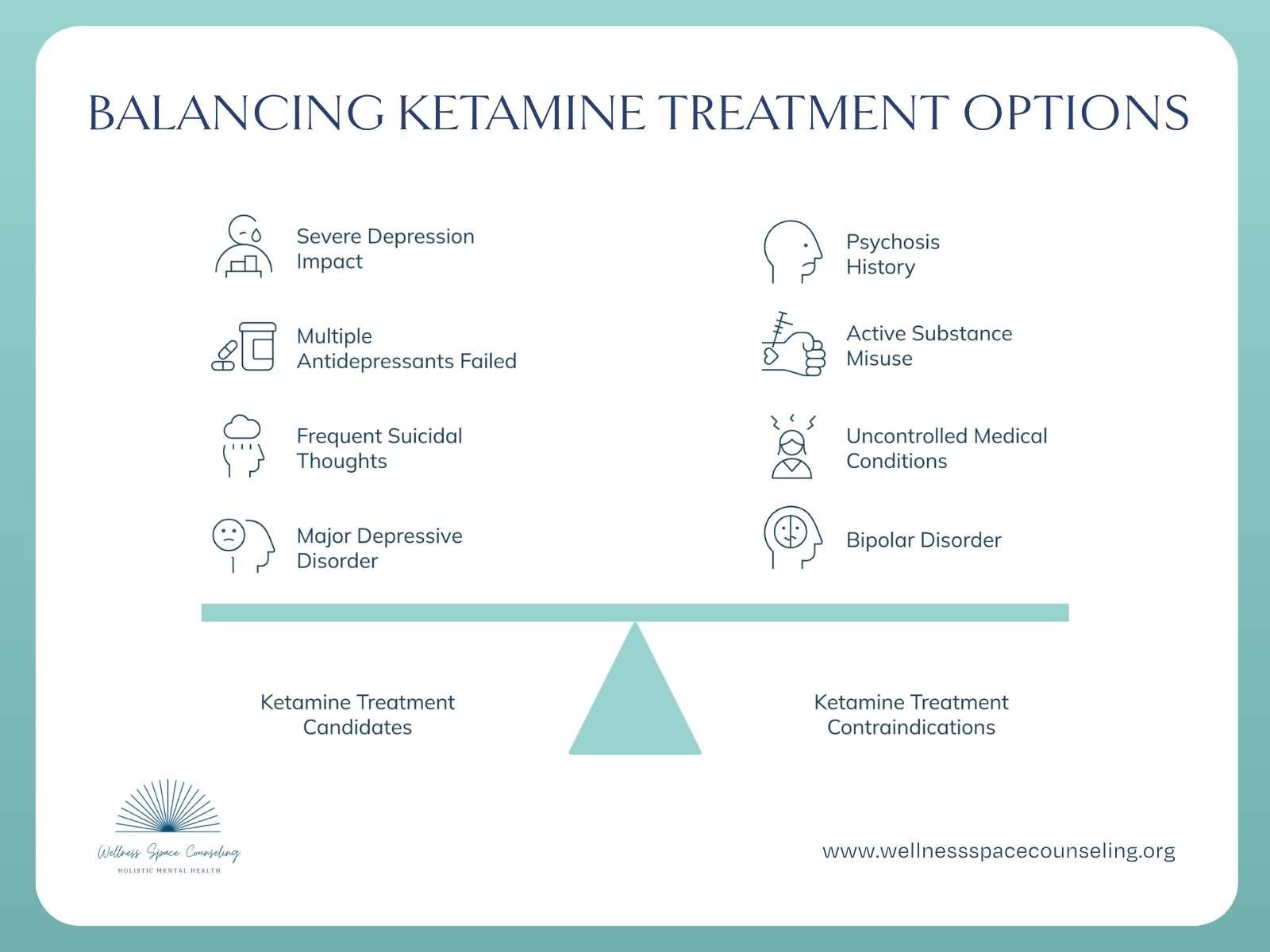
A thorough psychiatric evaluation will clarify your eligibility. We also treat depression alongside conditions like PTSD and anxiety, and our team understands how these often overlap.
Does Ketamine Actually Work for Depression? What the Research Shows
We understand that many people considering ketamine-assisted psychotherapy have already tried a variety of treatment approaches. Rather than making promises about outcomes, we believe it is important to examine the current clinical research and evidence supporting ketamine's use in mental health treatment.
Response rates in treatment-resistant depression
The clinical literature on ketamine for treatment-resistant depression is now substantial. Across multiple randomized controlled trials, researchers have consistently found that ketamine produces rapid antidepressant effects in a population that hasn't responded to standard treatments, and the numbers are meaningful.
Studies reviewed by the National Institute of Mental Health and published in peer-reviewed psychiatric journals report response rates of approximately 50 to 70 percent in people with treatment-resistant depression, meaning a majority of patients who hadn't improved on antidepressants experienced meaningful symptom reduction after ketamine treatment. For context, the response rate for a new antidepressant trial in the same population is often below 25 percent.
Remission rates, where symptoms drop to minimal or absent levels, are lower but still clinically significant, typically reported in the range of 25 to 35 percent after a standard course of treatment. This does not mean ketamine cures depression. It means that for many people who have tried everything else, it offers something that other treatments simply haven't.
How ketamine compares to other interventions for severe depression
For context, electroconvulsive therapy (ECT) has long been considered the most effective intervention for severe, treatment-resistant depression, with reported response rates of 60 to 80 percent. Ketamine approaches comparable efficacy in some studies, with the significant advantage of speed. While ECT typically requires multiple sessions over several weeks before effects are measurable, ketamine often produces noticeable antidepressant effects within 24 hours of a first session.
Research published in Translational Psychiatry found measurable neuroplasticity changes within 24 hours of a single intravenous infusion in patients who had not responded to prior antidepressant medications. The brain was literally beginning to reorganize itself fast.
Sublingual ketamine lozenges have their own emerging evidence base, distinct from the IV neuroplasticity research. A large, prospective, open-label effectiveness trial published in the Journal of Affective Disorders found at-home sublingual ketamine telehealth to be a safe and effective treatment for moderate to severe anxiety and depression. A separate retrospective study of self-administered, off-label sublingual rapid-dissolve ketamine tablets found that after three doses, nearly half of the patients showed significant reductions in both depression and anxiety scores, with stronger responses after completing six doses.
What the research says about ketamine with therapy
Ketamine alone produces results. Ketamine combined with structured psychotherapy appears to produce results that last longer. Several studies suggest that the integration of therapeutic work during the neuroplasticity window that ketamine opens leads to more sustained remission compared to medication alone. This is the foundation of our program, and it is why we are not simply a dispensary for this treatment.
Ketamine as an Antidepressant: Why the Science Is Different
This is where the science becomes especially important, because understanding how ketamine works can help you feel more grounded, prepared, and hopeful as you consider this path.
The glutamate and neuroplasticity connection
Ketamine blocks a receptor called the NMDA receptor, which plays a central role in the glutamate system. Glutamate is the brain's primary excitatory neurotransmitter, and disruptions in this system are strongly linked to depression and mood disorders.
By adjusting glutamate signaling, ketamine creates conditions that allow the brain to form new neural connections rapidly, a process called neuroplasticity. In people with severe depression, the brain becomes trapped in rigid, looping thought patterns. The neural pathways that reinforce hopelessness and withdrawal get used over and over, while the pathways toward connection and meaning go quiet. Ketamine appears to interrupt that loop, creating a window where new pathways can form.
Research published in Translational Psychiatry found that a single intravenous infusion produced measurable neuroplasticity changes within 24 hours in patients who had not responded to prior antidepressant medications. That is not a subtle finding. It means the brain is literally reorganizing itself, and fast.
What is the difference between ketamine infusion and ketamine psychotherapy for depression?
A ketamine infusion focuses on the medical administration of the medication. Ketamine psychotherapy for depression, or ketamine-assisted psychotherapy, integrates the treatment with structured therapeutic support before, during, and after treatment. The psychotherapy component can help the neuroplasticity gains translate into more meaningful, lasting change, rather than temporary symptom relief that fades over time.
Why ketamine works so fast as a rapid-acting antidepressant
SSRIs and other antidepressants can take four to eight weeks to produce noticeable effects. Ketamine often works within hours or days of a treatment session. For someone experiencing suicidal thoughts or severe depression, that speed is not just a convenience. It can be lifesaving. Research from the National Institute of Mental Health confirms antidepressant effects appear within one day in many patients, a timeline no current antidepressant medication matches.
Ketamine psychotherapy depression integration: how we make the changes last
This is where our approach at Wellness Space Counseling differs from a standalone infusion clinic. Ketamine can open a powerful window for neuroplasticity, creating greater flexibility and opportunity for change. But lasting healing often depends on how that window is used. When paired with intentional, structured therapy, those openings can become the foundation for meaningful and lasting change.
Our ketamine psychotherapy for depression integrates each session with preparation work before and integration therapy after. We help you understand what came up during the experience, process difficult emotions that surfaced, and build new patterns at a time when your brain is most receptive to them. This is the piece that transforms a treatment into a turning point.
Pros and Cons of Ketamine Therapy for Depression: An Honest Look
We believe you deserve a complete picture, not a sales pitch. Here is our honest take on what ketamine therapy for depression offers, and where it has real limitations.
The benefits worth knowing about
Rapid onset: Antidepressant effects can appear within hours to days, compared to weeks for traditional medications. For people in acute distress or with active suicidal ideation, this speed matters enormously.
Effectiveness in treatment-resistant cases: Ketamine helps a significant proportion of people who haven't responded to multiple antidepressant trials, a population that traditional psychiatry often struggles to serve.
Different mechanism: Because it works on the glutamate system rather than serotonin or dopamine, ketamine can work when nothing else has, not because it's stronger, but because it's different.
Neuroplasticity window: The period following ketamine treatment is one in which the brain is unusually receptive to forming new patterns. When paired with therapy, this creates an opportunity to do in days what might otherwise take months.
Short treatment course: Most protocols involve six sessions over two to three weeks, not an open-ended commitment.
The limitations to be honest about
Relief can be temporary without integration work: A ketamine session without therapeutic support may produce mood improvement that fades within days to weeks. The medication opens a window. Therapy is what helps you climb through it.
Not a cure: Ketamine does not eliminate depression. For many people, it reduces symptoms meaningfully and creates the conditions for deeper healing. Maintenance sessions may be needed over time.
Side effects are real: Dissociation, dizziness, nausea, and temporary blood pressure changes are common during and immediately after sessions. These are expected and managed in a supervised clinical setting.
Misuse potential: Ketamine has a history of recreational use, and dependency is a genuine consideration. This is why thorough screening, appropriate dosing, and clinical oversight are non-negotiable parts of responsible treatment.
Not appropriate for everyone: People with a history of psychosis, active substance misuse, or certain medical conditions may not be candidates. A proper evaluation is always the first step.
Insurance coverage is inconsistent: Esketamine (Spravato) is often covered when criteria are met through in-network providers. While we do not accept insurance directly, clients can use their out-of-network benefits, which may cover a portion of the cost for ketamine treatment. This is a real consideration and worth discussing with our team upfront.
Our honest recommendation
If you've tried multiple medications without relief, if your depression is affecting your ability to function day to day, and if you're ready to do the therapeutic work alongside the treatment, ketamine-assisted psychotherapy may be worth a serious conversation. If you're looking for a quick fix that requires no effort on your part, it probably isn't the right fit.
We believe it is important to set realistic expectations from the outset so you can make an informed decision about whether this treatment is right for you.
How is ketamine therapy different from recreational ketamine use?
Dosing, context, and clinical oversight are the critical differences. Ketamine used therapeutically is administered at carefully calibrated sub-anesthetic doses, under the supervision of a trained clinician, in a structured environment with clear therapeutic intent. Recreational use involves different quantities, no clinical monitoring, and no integration support, which is why misuse carries meaningful risks that therapeutic use, when properly managed, does not.
How Long Does Ketamine Work for Depression?
We believe in being honest with you about this because realistic expectations matter.
After a single infusion
Relief from a single ketamine session can last anywhere from a few days to a few weeks. Clinical research and outpatient experience suggest one to two weeks on average. Some people feel more, some less, depending on the individual, the severity of depression, and what happens in the days after treatment.
A full course of ketamine depression therapy
Most treatment protocols involve a series of infusions, typically six sessions over two to three weeks. Many clients experience cumulative benefits, where each session builds on the last and symptom relief extends further over time. The goal is remission, or at minimum a meaningful and sustained reduction in symptoms. Unlike treatments designed for ongoing use, ketamine is typically used as a short-term intervention, with the goal of creating meaningful changes that continue well beyond the treatment period.
When ketamine therapy is combined with psychotherapy and integration work, as it is in our model, the benefits often last longer than the effects of the medication alone. This is because healing is not only happening at the level of brain chemistry, but also through the deeper work of understanding and shifting the emotional patterns, beliefs, and coping strategies that shape your life. Some individuals may benefit from periodic maintenance sessions after their initial course of treatment, and your clinical team will work with you to find the approach that best supports your needs. Individual therapy often continues alongside or after ketamine treatment to help deepen the work and support lasting healing.
Some clients benefit from periodic maintenance sessions following their initial course of treatment. Your clinical team will work with you to determine an approach that best supports your individual needs and treatment goals. Continued therapeutic support can help translate insights gained during ketamine treatment into lasting changes in daily life.
Can a psychiatrist prescribe ketamine for depression?
Yes. A psychiatrist or licensed prescriber can prescribe oral ketamine lozenges, esketamine (Spravato), or refer to an IV clinic for qualifying patients. We partner with Journey Clinical, where clients are connected with a doctor who reviews their case and prescribes ketamine. The process begins with a full psychiatric evaluation to determine whether you are an appropriate candidate based on your history and mental health conditions.
What Happens During a Ketamine Session
During a lozenge session
A session with us typically begins with a brief check-in with your therapist about how you're arriving, what's present, and what intention you're bringing. The lozenge is placed under your tongue and held there for 10 to 15 minutes as it absorbs. You'll be in a comfortable, supported setting with soft lighting and your therapist present.
The experience that follows varies by person, but often includes a sense of mental softening, dissociation from the usual grip of anxious or depressive thinking, and in some cases, unexpected clarity or emotional material rising to the surface. Your therapist does not direct the experience, but they are there throughout as a steady presence in an unfamiliar space.
The altered state typically lasts one to two hours. Side effects to expect include mild dizziness, blurred vision, and nausea in some cases. These pass as the medication clears your system.
After your session
Plan to have someone drive you home. Integration begins before you leave. Your therapist will check in with you about what arose, what you noticed, and what felt significant. Formal integration therapy continues in follow-up sessions, where you'll have the space to process what emerged and begin translating it into your daily life. This is where the work deepens.
Risks and Side Effects: An Honest Overview
Ketamine has a strong safety record when used in a certified clinical setting with proper supervision. These are the most common side effects to be aware of, mostly when trying KAP Experiential:
Dissociation during the session (expected and short-lived)
Dizziness and blurred vision
Sedation immediately after treatment
Nausea
Temporary increases in blood pressure
Misuse potential is also worth acknowledging. Ketamine has a history of recreational use, and its potential for dependency requires an honest conversation with your provider before starting. This is why thorough screening and clinical oversight are non-negotiable parts of responsible ketamine treatment for depression.
The Harvard Health review of ketamine for treatment-resistant depression offers a balanced look at safety considerations. You can also explore this NIH review on integrative approaches to ketamine therapy for a deeper dive into the evidence base.
What is the difference between ketamine infusion and ketamine psychotherapy for depression?
A ketamine infusion focuses on the medical administration of the medication. Ketamine psychotherapy for depression, or ketamine-assisted psychotherapy, integrates that infusion with structured therapeutic support before, during, and after treatment. The psychotherapy component is what helps the neuroplasticity gains translate into lasting change, rather than temporary symptom relief that fades over time. At Wellness Space Counseling, we don't offer one without the other.
You've Tried Everything Else. Let's Try This Together.
We built our ketamine-assisted psychotherapy program around one belief: medication alone is rarely the full answer. What changes your life is what happens around the medication, the preparation, the therapeutic work, and the integration.
Our team of licensed therapists brings specialized training in ketamine psychotherapy alongside advanced modalities, including EMDR therapy, IFS, attachment theory, and somatic therapy.
When you work with us, your care extends beyond simply monitoring vital signs or administering medication. Ketamine is woven into a broader therapeutic process, grounded in trauma-informed care and meaningful integration. We walk alongside you through the more difficult parts of healing—helping you understand what is happening in your brain, preparing you for each session, supporting you in therapy as deeper material emerges, and building a personalized treatment plan tailored to your life, your history, and your goals.
If you're ready to explore whether ketamine therapy is right for you, we invite you to reach out to our team.
