
Ketamine Therapy for PTSD: Why It Works When Other Treatments Haven't
If you’ve been living with PTSD for a long time, you already know what it feels like to do everything right and still feel stuck. You’ve shown up for therapy. You’ve tried medication. You’ve pushed through hard sessions and hard days, and yet the intrusive memories, the constant sense of unease, the emotional shutdown are still there, quietly reshaping your life.
We see you. And we want you to know: struggling to respond to standard treatments doesn't mean you're beyond help. It often means you need a different kind of approach.
Ketamine therapy for PTSD is one of the most promising developments in trauma treatment in decades, bringing relief that can arrive faster than almost anything else in the mental health field. At Wellness Space Counseling, we offer ketamine-assisted psychotherapy (KAP) as part of a thoughtful, therapist-led model where healing, not just symptom management, is always the goal.
This article walks you through the history, the research, what the experience actually looks like, and how we approach it a little differently.
What Is PTSD?
Why Traditional Treatments Don't Always Work
How Ketamine Became a PTSD Treatment
How Ketamine Works on the PTSD Brain
What the Research Shows
Does Ketamine Help with Complex PTSD?
KAP vs. IV Infusion: What Makes Our Approach Different
What to Expect: Assessment Through Integration
Side Effects and Safety
Who Is and Isn't a Good Candidate
What Is PTSD?
Post-traumatic stress disorder can develop after experiences that overwhelm your sense of safety or leave lasting emotional wounds. For some, this follows a single traumatic event. For many others, it develops through prolonged exposure to chronic stress, relational trauma, abuse, neglect, betrayal, or living in environments where safety and trust were never consistent. It can affect anyone, though survivors of childhood trauma, abuse, and prolonged relational harm often carry a particularly heavy burden.
According to the National Center for PTSD, about 6% of U.S. adults will develop PTSD at some point in their lives. That translates to millions of people, many of whom move from treatment to treatment and still find only partial relief.
Common Symptoms of Post-Traumatic Stress Disorder and Complex Trauma:
Unwanted memories, body sensations, or emotional reactions that resurface without warning, often tied to past experiences rather than a single event.
Avoidance and emotional protection: Pulling away from people, places, conversations, or feelings that feel too vulnerable, overwhelming, or reminiscent of past pain.
Negative beliefs and emotional pain: Persistent shame, self-blame, emptiness, emotional numbness, or a deep-rooted belief that you are unsafe, unworthy, or alone.
Chronic nervous system activation: Living in a state of tension, scanning for threat, struggling to relax, startling easily, or feeling exhausted from always being “on.”
Relationship difficulties: Difficulty trusting others, fear of abandonment, people-pleasing, conflict avoidance, or repeating painful relational patterns.
Disconnection from self: Feeling detached from your body, your needs, your emotions, or even your sense of identity—often shaped by years of survival mode.
These symptoms ripple into every corner of life. Relationships suffer. Work becomes hard. The body carries what the mind can't set down. And for many people with PTSD, that weight has been there for years.

Why Traditional Treatments Don't Always Work for People with PTSD
There are several evidence-based treatments for PTSD, including interventions we incorporate into our work at Wellness Space Counseling. EMDR, cognitive processing therapy, Internal Family Systems (IFS), and somatic-based therapies are all widely recognized approaches that can support trauma healing.
Medication can also be an important part of treatment for some people. Two SSRIs, sertraline and Paroxetine, are FDA-approved for PTSD and can be helpful in reducing symptoms when prescribed and managed by a qualified medical provider.
At Wellness Space Counseling, we also have an in-house psychiatric prescriber who can evaluate and provide medication treatment when it is clinically appropriate.
At the same time, fewer than 30% of people with PTSD achieve full remission with SSRIs alone. Even the most effective trauma therapies can reach limits, particularly when trauma is chronic, layered, or intertwined with depression and anxiety, making it harder to fully engage in the healing process.
That gap between the people who need help and the treatments that can actually reach them is exactly what has driven serious scientific interest in ketamine. It works through a completely different mechanism than anything that came before it. For many people, that difference can make meaningful healing possible when other treatments have fallen short.
How Ketamine Became a PTSD Treatment
Ketamine has been used in medicine since the 1960s, originally as an anesthetic and approved by the FDA for human use in 1970. Its therapeutic potential for mental health was discovered largely by accident.
In the 1990s, doctors noticed something striking: injured soldiers who received ketamine as an anesthetic during battlefield surgery rarely developed PTSD afterward, while soldiers treated with opiates developed PTSD at rates around 30%. That observation raised a question researchers couldn't ignore: was ketamine doing something protective to the brain?
Around the same time, Yale researchers discovered that sub-anesthetic doses of ketamine produced rapid, meaningful improvements in severe depression, including in people who hadn't responded to anything else. The door to a new chapter in psychiatric medicine opened. Over the following two decades, researchers turned their attention to ketamine for treating PTSD, and the results have been compelling.
How many ketamine treatments are needed for PTSD?
It varies. Research protocols typically involve six sessions over twelve weeks. In practice, the number depends on symptom severity, individual response, and how integration therapy progresses. Some people notice significant relief after a few sessions; others benefit from an ongoing series. We build a personalized treatment plan and adapt it as we go.
How Ketamine Works on the PTSD Brain
At carefully supervised doses, ketamine induces a controlled dissociation, which is a temporary separation from the emotional intensity of traumatic memories. Rather than pulling you back into the fear the way a flashback does, it allows you to approach those memories from a distance, without being overwhelmed by them. As researchers have described it, ketamine lets patients look at the trauma without reexperiencing it, and that shift, even briefly, can open the door to genuine processing.
Ketamine Targets the Receptors That Hold Trauma in Place
Ketamine works by blocking the NMDA receptor, part of the brain’s glutamate system involved in how memories, including traumatic ones, are formed and reinforced. When those receptors are temporarily quieted, the emotional intensity and grip of traumatic memories can begin to soften. Researchers also believe ketamine may support fear extinction, the brain’s natural ability to learn that something once experienced as dangerous is no longer a present threat. In PTSD, that process often gets disrupted, leaving the nervous system stuck in old patterns of protection. Ketamine may help reopen that pathway, creating more space for healing.
Ketamine Promotes Neuroplasticity
Chronic PTSD physically changes the brain. Prolonged stress and trauma cause structural changes in the prefrontal cortex and hippocampus, regions central to memory and emotional regulation. Ketamine promotes neuroplasticity, stimulating new synaptic connections within hours of administration. This "neuroplasticity window," when met with skilled therapy, allows people to begin building new pathways that weren't accessible before.
Why Norepinephrine Matters in PTSD Treatment
Ketamine also influences norepinephrine, the neurotransmitter at the center of the stress response. In people with PTSD, norepinephrine is often dysregulated, running too hot (fueling hypervigilance and hyperarousal) or too low (contributing to emotional flatness). By modulating norepinephrine alongside glutamate, ketamine may help the nervous system recalibrate toward a more stable baseline, one reason many people notice a shift in their background anxiety levels after treatment, sometimes after just one or two sessions.
Ketamine Works Remarkably Fast
Traditional antidepressants take four to six weeks to show any benefit. Ketamine's effects on PTSD symptoms can be felt within 24 hours of the first session, sometimes sooner. For someone who has been suffering for a long time, that kind of rapid relief can make it easier to keep showing up for the deeper work of healing.
What the Research Shows about Ketamine Treatment for PTSD
The evidence base for ketamine for PTSD has grown substantially over the past decade. It's worth noting upfront that ketamine is currently an off-label treatment for PTSD, meaning it is not yet FDA-approved specifically for this condition, though it is FDA-approved as an anesthetic and widely used in psychiatric settings. The research supporting its use continues to grow.
Single Sessions Produce Rapid Relief
A landmark 2014 randomized controlled trial found that a single ketamine dose produced rapid and significant improvements in core PTSD symptoms, such as intrusive thoughts, avoidance, and hyperarousal, compared to a placebo control. Effects were measurable within 24 hours.
Repeated Sessions Produce Greater, More Durable Gains
In one well-cited controlled trial, six ketamine sessions over two weeks led to meaningful symptom improvement in 67% of participants, compared to just 20% in the control group. A 2025 systematic review confirmed that repeated administration protocols consistently outperform single doses in both magnitude and durability of improvement.
Ketamine + Psychotherapy Outperforms Either Alone
This is the finding we return to most in our own practice: combining ketamine with trauma-focused psychotherapy produces better outcomes than ketamine alone. A 2025 open-label trial from the Icahn School of Medicine at Mount Sinai found that 69% of patients receiving ketamine alongside written exposure therapy met criteria for treatment response, with 61.5% maintaining that response at six-month follow-up.
This is precisely why we offer ketamine as part of a full therapeutic model, as a catalyst for deeper work, not a standalone procedure.
One additional finding worth knowing: ketamine has also demonstrated rapid anti-suicidal effects in controlled trials, reducing suicidal ideation within hours, which is meaningful for the many people with PTSD who experience these thoughts.
If you are struggling with thoughts of suicide right now, please reach the 988 Suicide and Crisis Lifeline by calling or texting 988.
Can ketamine make PTSD worse?
For a small number of people, the experience can temporarily bring up distressing material. This is exactly why we invest so heavily in preparation and why having a therapist present throughout is non-negotiable for us. A well-held therapeutic context significantly reduces this risk and our assessment is designed to catch people for whom ketamine may not be the right tool right now.
Does Ketamine Help with Complex PTSD?
Complex PTSD (also called C-PTSD) develops from prolonged or repeated trauma rather than a single traumatic event. It is common in survivors of childhood abuse, chronic emotional neglect, attachment wounds, relational betrayal, or long-term exposure to unstable or unsafe environments. The symptoms often run deeper than classic PTSD: profound difficulty regulating emotions, a fragmented sense of self, persistent shame, and difficulty trusting others.
For many people with C-PTSD, standard trauma treatments help but don't fully reach the layers underneath. The neuroplasticity window ketamine creates can be especially meaningful here, not because it erases what happened, but because it gives the nervous system a chance to soften its defenses enough to allow the therapeutic work to go deeper.
That said, treating complex PTSD with ketamine requires careful clinical judgment and a strong therapeutic relationship We conduct thorough assessments and are honest when someone needs other foundations in place first. If you're wondering whether this could help with what you're carrying, the best place to start is a conversation.
KAP vs. IV Infusion: What Makes Our Approach Different
As ketamine treatment becomes more widely available, the term “ketamine therapy” now encompasses a broad range of very different experiences. For trauma survivors, especially, it can be important to understand those differences and what each approach is designed to offer.
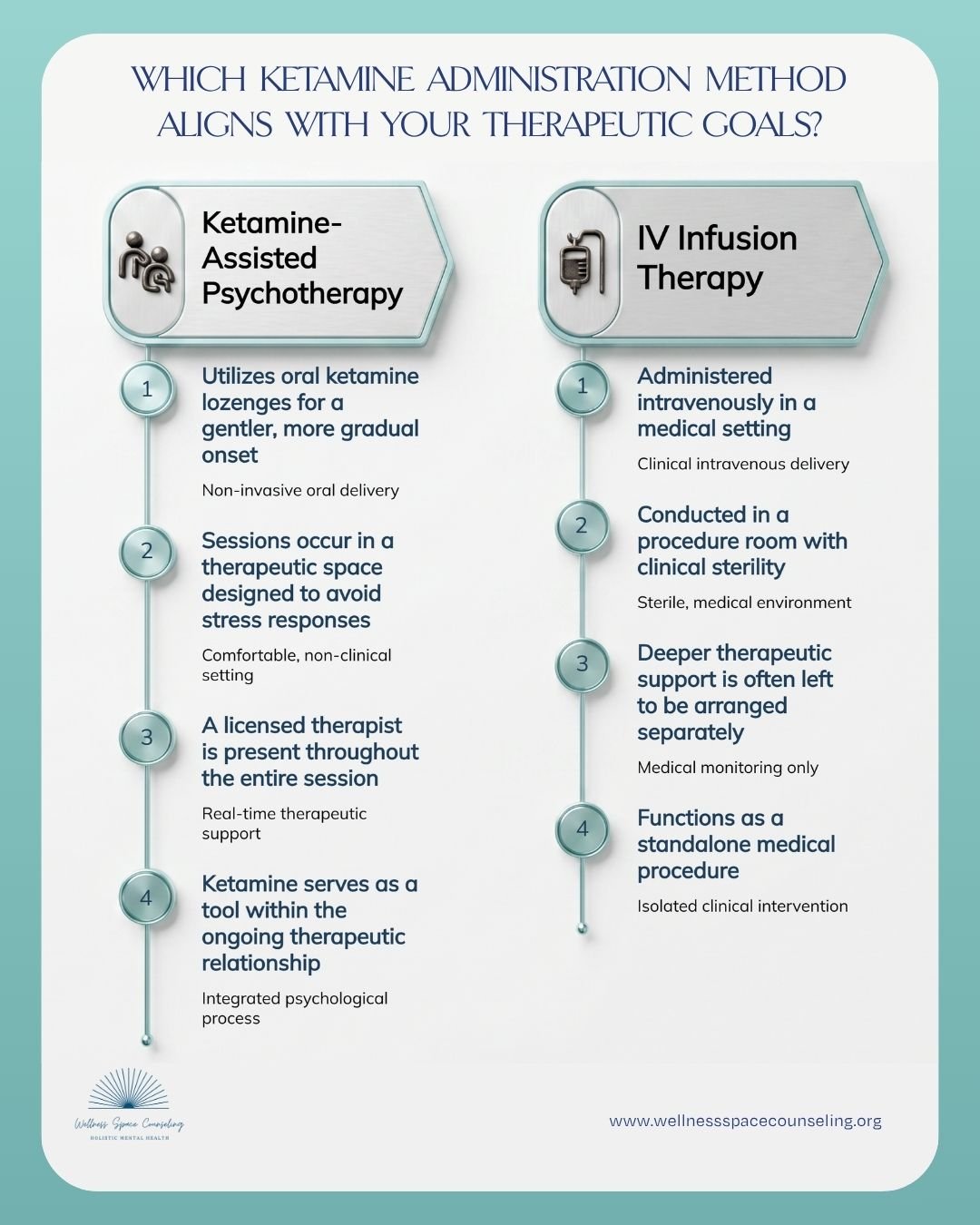
Many clinics provide ketamine infusion therapy, where ketamine is administered intravenously in a medical setting and monitored by clinical staff. The medication is given, the experience is supported medically, and the session comes to a close. In many cases, that deeper therapeutic support is left to be arranged separately.
At Wellness Space Counseling, we offer ketamine-assisted psychotherapy (KAP) using oral ketamine lozenges, not IV infusion. A licensed therapist is present with you for the entire session, not just before or after, but throughout the experience itself.
Why the Lozenge Approach Works Well for Trauma
A gentler, more gradual onset than IV ketamine infusion; more manageable for people with trauma histories and medical anxiety
Sessions take place in a therapeutic space, not a procedure room. No IV lines, no clinical sterility that can itself activate a stress response
Your therapist is present in real time, so anything that surfaces, such as insights, emotions, or difficult material, is supported as it arises
Ketamine is always a tool within the therapeutic relationship, never a standalone medical procedure
How We Tailor Ketamine Dosing to Your Trauma History
We're a therapy practice first, and that means we adjust the dose itself to fit what each person needs:
Ketamine Healing (Psycholytic dosing): A lower, more grounded ketamine dose keeps you verbal and connected during the session, so you can process difficult material in real time alongside your therapist. We turn to this when the goal is staying present through hard memories, easing PTSD-related hypervigilance, and softening emotional walls gradually, often alongside the EMDR, IFS, or somatic work we may already be doing together.
Ketamine Experiential (Psychedelic dosing): A higher, more immersive dose creates more distance from everyday thought patterns. We turn to this when someone feels stuck, numb, or hasn't found relief through other treatment, since it can interrupt entrenched patterns and open up real shifts in perspective, with most of the verbal processing happening in the preparation and integration sessions around it.
KAP at Wellness Space Counseling always includes preparation sessions, a therapist-supported ketamine session, and structured integration therapy, regardless of which dosing approach is clinically appropriate for you. Ketamine can help create openness and flexibility in the mind, but it is the therapeutic process that helps translate those experiences into lasting insight and meaningful change.
Is ketamine therapy dangerous?
When administered at low, sub-anesthetic doses in a supervised clinical setting, ketamine has a well-established safety record. It is not the same as recreational use: the doses, context, and level of monitoring are entirely different. Side effects are typically mild and temporary. That said, it is not appropriate for everyone, which is why thorough screening before treatment is essential.
What to Expect: Assessment Through Integration
Step 1: Assessment
Before anything, we get to know you: your history, symptoms, medications, and whether KAP is the right fit right now. Not everyone is a candidate, and we'd rather be honest than rush someone into treatment before they're ready.
Step 2: Preparation Sessions
This is where the therapeutic foundation is built. We set intentions together, address your questions and fears, and build the trust that makes the ketamine experience feel safe. Mindset and therapeutic context directly shape how people respond to ketamine. Preparation is part of the treatment.
Step 3: The Ketamine Session
You'll take the oral lozenge in a calm setting, with your therapist present throughout. Sessions typically run two hours. The onset is gradual. You'll experience a shift in perception over the first 20–30 minutes. Some people notice warmth or lightness; others experience dreamlike imagery, or an unusual ability to look at painful things from a gentler distance. Some feel emotions moving through in unexpected ways. There's no correct experience, and whatever arises, you're not navigating it alone.
Step 4: Integration Therapy
Integration is where lasting change takes root. In follow-up sessions, you and your therapist make meaning of what came up, processing insights, emotions, and new perspectives that emerged. The neuroplasticity window ketamine creates is most valuable when it's met with skilled therapeutic support. Without integration, the window opens and closes without much changing. With it, real healing becomes possible.
Side Effects and Safety
Ketamine is well-studied and has a strong safety profile at sub-anesthetic doses in clinical settings. Here's an honest picture.
Common Side Effects
Dissociation: A temporary sense of detachment, part of how ketamine works therapeutically, not a sign that something is wrong
Nausea: Mild and short-lived; pre-session eating guidelines help minimize this. Clients are also given medication for nausea if they are prone to it
Dizziness or lightheadedness: Common during onset and as the medication clears
Elevated heart rate or blood pressure: Mild and temporary
Fatigue: Rest is recommended afterward; do not drive
Serious adverse events in controlled settings are rare. Your therapist is with you throughout, and nothing happens without your preparation and consent.
Does ketamine therapy work for treatment-resistant PTSD?
Treatment-resistant PTSD, where SSRIs and trauma-focused therapy haven't produced adequate relief, is actually one of the populations where ketamine shows the most consistent promise. Research on repeated ketamine administration for chronic PTSD points to significant and rapid PTSD symptom reduction in those who haven't responded elsewhere.
Who Is and Isn't a Good Candidate
People Who May Benefit Most from Ketamine Therapy for PTSD
Those with treatment-resistant PTSD who haven't found adequate relief through SSRIs or trauma-focused therapy
People with severe or chronic symptoms that significantly impact daily life
Individuals with co-occurring depression or anxiety who haven't responded to medication
Those committed to the preparation and integration process, not just the ketamine session itself
Who May Not Be a Good Fit Right Now
People with certain cardiovascular conditions or uncontrolled high blood pressure
Those with active psychosis, or presentations requiring stabilization first
Individuals with a history of substance misuse involving dissociative substances. They require careful assessment, not automatic exclusion from this treatment option.
Those whose current medications interact with ketamine in ways that affect safety
If you're in Columbia, MD, and wondering whether this is right for you, reach out. The assessment conversation is exactly where we figure that out together.
If Nothing Has Worked Yet, This Is Worth a Conversation
We understand what it means to carry trauma for a long time. And we understand the particular kind of discouragement that comes from trying hard, doing the work, and still not breaking free.
At Wellness Space Counseling in Columbia, MD, we offer ketamine-assisted psychotherapy as part of a therapy-first model. We use oral ketamine lozenges, not IV infusion, in a setting where a licensed therapist is with you throughout your session. Our team brings training in EMDR, somatic therapy, trauma-focused modalities, and the KAP model. We serve clients in person at our Columbia, MD office.
If you've been living with PTSD and something in this article landed for you, we'd love to have that conversation. Reach out to schedule a consultation or call us at 410-498-4300. You don't have to keep carrying this alone.
This article is for educational purposes only and does not constitute clinical advice, diagnosis, or treatment. Ketamine therapy is not appropriate for everyone. Please consult a licensed mental health professional to determine whether this approach is right for your situation. If you are in crisis, please contact the 988 Suicide and Crisis Lifeline by calling or texting 988.
