
How Does Ketamine Therapy Work?
Ketamine therapy has moved out of the research lab and into real clinical practice, but most people searching for answers still get either oversimplified explanations or dense pharmacology papers. Neither actually tells you what's happening in the brain, or what to expect.
This article breaks it down clearly. Whether you're a client weighing your options, a clinician looking for a plain-language reference, or someone supporting a loved one through this decision, here's what you actually need to know about how ketamine therapy works.
We cover:
What makes ketamine different from conventional antidepressants
The NMDA receptor mechanism and what it means in practice
How ketamine neuroplasticity creates a window for therapeutic change
The difference between psycholytic and psychedelic dosing approaches
What a full course of ketamine-assisted treatment actually looks like
What Is Ketamine, Really?
Ketamine has been used as an anesthetic in medical settings since the 1960s. At lower, carefully controlled doses, researchers discovered it produces powerful antidepressant effects, often within hours rather than the weeks typical antidepressants require.
Unlike SSRIs, which target serotonin, ketamine works on the glutamate system, the brain's primary excitatory neurotransmitter. That's a fundamentally different mechanism, and it's why ketamine can help people who haven't responded to traditional treatments.
Ketamine has been safely used in medical settings for decades. In recent years, research has explored its potential to support mental health treatment by creating a temporary period of increased flexibility and openness in the brain. When paired with psychotherapy, this window can support deeper emotional processing and meaningful therapeutic work.
Wondering if ketamine-assisted therapy is right for you?
What we offer is different from a ketamine infusion clinic specialized ketamine-assisted psychotherapy in Columbia, MD. We'll walk you through every step of the process and help you decide if it's a good fit.
Book a Free 20-Minute Consultation
The NMDA Receptor Ketamine Mechanism Explained
Ketamine works by blocking NMDA receptors in the brain. NMDA receptors respond to glutamate, and when they're overactive, they suppress healthy mood-regulating activity in key areas of the brain, including the prefrontal cortex and hippocampus.
By temporarily blocking these receptors, ketamine reduces that suppression. According to a 2024 peer-reviewed narrative review published in the International Journal of Molecular Sciences, NMDA receptor antagonism triggers downstream signaling cascades, including the BDNF-TrkB and mTOR pathways, that promote synaptic growth and regeneration.
In practical terms, depression damps down neural signaling in the regions that the brain uses for mood and motivation. Ketamine interrupts that pattern at the receptor level, and the downstream effect is a burst of synaptic activity that can shift how the brain processes emotional experience.
Is ketamine therapy safe, and is professional supervision important?
Ketamine therapy can be safe for the right person, but professional supervision is essential. It can affect blood pressure, perception, mood, and coordination, so screening, monitoring, and aftercare matter.
How does ketamine therapy work differently from antidepressants?
Unlike traditional antidepressants that target serotonin or norepinephrine, ketamine blocks NMDA receptors and increases glutamate activity in the brain. This produces antidepressant effects within hours rather than weeks, making it a valuable treatment option for people with treatment-resistant depression who haven't responded to conventional medications.
Ketamine Neuroplasticity: Why Ketamine Can Help When Other Treatments Haven't
One of the most compelling aspects of ketamine treatment is what it does to neuroplasticity, the brain's ability to form new connections and reorganize itself.
Depression and post-traumatic stress disorder can physically degrade neural pathways over time. Chronic stress shrinks the synaptic connections in the areas of the brain responsible for mood, learning, and emotional regulation.
Ketamine may help restore or strengthen some of those neural connections. Research shows it rapidly stimulates synapse formation through mTOR pathway activation and increases levels of brain-derived neurotrophic factor (BDNF), a protein that supports the growth of new neural connections. A review of ketamine's NMDA mechanism published in PMC describes this as a possible explanation for its rapid reduction in depression symptoms, including suicidal ideation.
What clients often notice isn't just a lift in mood. It's a loosening of the mental ruts that felt permanent. That's the neuroplasticity effect in practice, and it's why the post-session window matters so much for therapeutic work.
Here's where skepticism is reasonable: neuroplasticity alone doesn't produce healing. A brain that's more open to change is only useful if something intentional happens during that window. That's the therapist's job. Without skilled guidance before, during, and after dosing, the neuroplasticity effect fades without being put to use.
Psycholytic Dosing vs. Psychedelic Dosing in Ketamine-Assisted Psychotherapy
Not all ketamine sessions are the same. The dose matters, and it determines the type of experience you'll have.
Psycholytic Dosing
Psycholytic dosing uses a lower dose that reduces psychological defenses while keeping you alert enough to engage in talk therapy. You're relaxed and more emotionally open, but you're still very much present and able to have a conversation.
At this dose range, the therapist is actively working with you throughout the session. They can ask questions, offer reflections, and help you stay with difficult material rather than avoiding it. The therapeutic relationship is doing real work in real time, not just waiting for the session to end.
This approach pairs well with integration-focused modalities like Internal Family Systems therapy, where the goal is to access inner parts and beliefs that are hard to reach in a normal waking state.
Psychedelic Dosing
Psychedelic dosing uses a higher dose that produces a more immersive, dissociative experience. You may encounter vivid imagery, a sense of altered time, or a feeling of floating outside your usual perspective.
This approach isn't about "tripping." It's about creating a temporary state where the brain's default mode network, the part responsible for rumination and rigid self-criticism, is quiet enough to allow a genuine shift in perspective.
At higher doses, the therapist's role shifts. Active verbal engagement is less possible, so the work shifts to holding the space: making sure the client feels physically safe, emotionally anchored, and supported to go wherever the experience leads. The depth of the therapeutic relationship built in preparation directly affects how safely someone can enter and return from that state.
Both approaches are conducted in a safe, supportive clinical setting with a trained therapist present throughout the entire ketamine session.
What mental health conditions can ketamine therapy treat?
Ketamine therapy is most commonly used for treatment-resistant depression and PTSD. Some clinics may also use it for anxiety, PTSD, or trauma-related symptoms, but the strongest evidence is still for depression.
The Ketamine Therapy Process
Ketamine infusion therapy and ketamine-assisted psychotherapy are related but not the same thing. Infusion clinics focus primarily on the pharmacological effect. KAP structures the entire experience around three distinct phases, each doing different work.
The distinction matters more than most people realize. Ketamine can produce mood relief on its own, and a standalone infusion can do that. But the research on lasting change consistently points to the therapeutic relationship and structured integration as the variables that determine whether a client's life actually shifts. A trained therapist doesn't just observe the process. They shape the outcome.
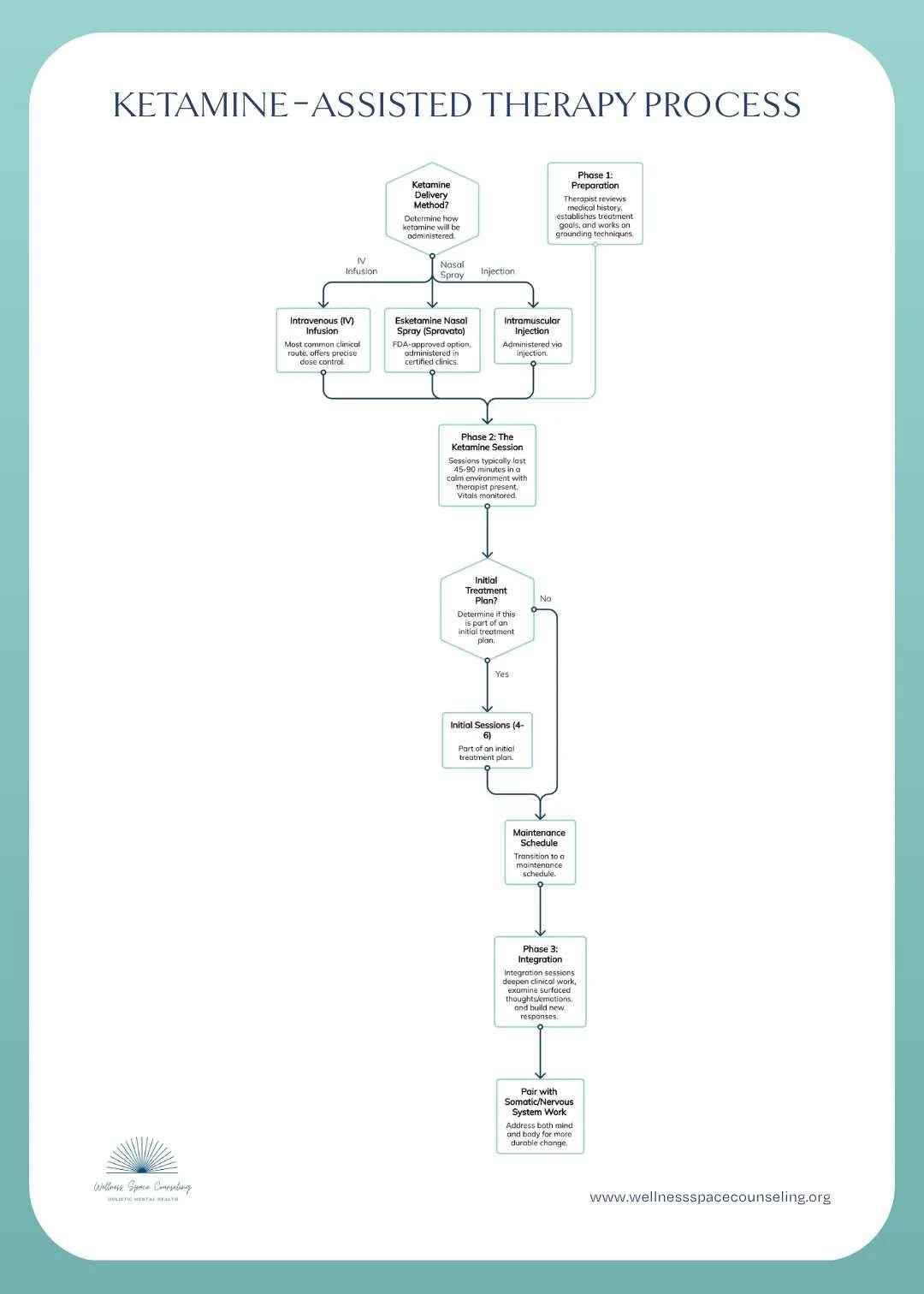
Phase 1: Preparation
Preparation sessions happen before any ketamine is administered. Your therapist reviews your medical history, establishes your treatment goals, and works with you on grounding techniques specific to the altered state you'll be entering.
This phase shapes the quality of everything that follows. The more intentional the preparation, the more a person can engage productively with what comes up during dosing rather than simply riding out the experience.
Phase 2: The Ketamine Session
At Wellness Space Counseling, ketamine is prescribed through our medical partners and taken as an oral lozenge as part of the ketamine-assisted psychotherapy process.
During the dosing session, clients relax in a comfortable and supportive environment while working with a trained therapist. Depending on the treatment approach and dosage, clients may experience increased emotional openness, enhanced self-reflection, reduced defensiveness, or a shift in perspective that supports therapeutic work.
Some clients remain highly engaged in conversation throughout the experience, while others spend portions of the session focused inward. The therapist’s role is to provide support, guidance, and a safe therapeutic environment throughout the process.
The experience of KAP at this stage typically lasts 45 to 90 minutes.
Phase 3: Integration
Integration sessions happen after dosing and are where the clinical work deepens. During and immediately after a ketamine session, the brain is in an elevated state of neuroplasticity. Thoughts, memories, and emotional patterns that felt fixed become more workable.
Integration therapy uses that window deliberately. The therapist helps you examine what surfaced, identify how it connects to current patterns in your life, and build new emotional responses that can hold once the session effect fades.
This is also why we pair ketamine-assisted therapy with approaches like somatic and nervous system regulation work. The body holds a lot of what the mind processes during these sessions, and addressing both layers tends to produce more durable change.
How many ketamine therapy sessions are typically recommended?
It depends on the person and the treatment model. Many programs begin with a short series of sessions over several weeks, then adjust based on response, safety, and treatment goals.
Ketamine Infusion Clinic vs. Ketamine-Assisted Therapy: What You're Missing
At a standalone ketamine infusion clinic, the clinical focus is the drug. You arrive, receive the IV, and recover. The experience may bring relief. But without a therapist in the room, three things don't happen:
No preparation work. There's no one helping you set intentions, build grounding tools, or create a therapeutic container before you enter an altered state. You go in cold.
No in-session guidance. During dosing, you're monitored medically but not held therapeutically. Whatever surfaces emotionally, you process alone.
No structured integration. The neuroplasticity window that opens after a session, the period when the brain is most receptive to change, closes without being used. The insight fades. The patterns return.
This is the core difference between ketamine as a procedure and ketamine as a therapy. A well-run KAP program treats the medication as one component of a larger clinical relationship, not the whole treatment.
Many people who have tried an infusion clinic and felt the effects wear off faster than expected aren't experiencing a failure of ketamine. They're experiencing what happens when the neuroplasticity effect has nowhere to go. The drug opened a door. Nobody was there to walk through it with them.
KAP doesn't just add therapy around ketamine. The therapy is what makes the ketamine work.
Ketamine Infusion Clinic vs. Ketamine-Assisted Therapy: What You're Missing
At a standalone ketamine infusion clinic, the clinical focus is the drug. You arrive, receive the IV, and recover. The experience may bring relief. But without a therapist in the room, three things don't happen:
No preparation work. There's no one helping you set intentions, build grounding tools, or create a therapeutic container before you enter an altered state. You go in cold.
No in-session guidance. During dosing, you're monitored medically but not held therapeutically. Whatever surfaces emotionally, you process alone.
No structured integration. The neuroplasticity window that opens after a session, the period when the brain is most receptive to change, closes without being used. The insight fades. The patterns return.
This is the core difference between ketamine as a procedure and ketamine as a therapy. A well-run KAP program treats the medication as one component of a larger clinical relationship, not the whole treatment.
Most people who've tried an infusion clinic and felt the effects wear off faster than expected aren't experiencing a failure of ketamine. They're experiencing what happens when the neuroplasticity effect has nowhere to go. The drug opened a door. Nobody was there to walk through it with them.
KAP doesn't just add therapy around ketamine. The therapy is what makes the ketamine work.
Is Ketamine Therapy Right for You?
Ketamine therapy is not for everyone, and determining that requires a careful look at your full picture. Generally, it's worth exploring if you're dealing with:
Treatment-resistant depression that hasn't improved after trying two or more antidepressants
Post-traumatic stress disorder (PTSD), where trauma processing has stalled with traditional approaches
Chronic pain conditions that are intertwined with depression and anxiety
Suicidal ideation that requires faster relief than standard antidepressants can offer
Major depression or mood disorder symptoms that are significantly affecting daily life
A full assessment of your medical history, current medications, and mental health conditions is always the first step. Some contraindications exist, and a responsible treatment plan means ruling those out before anything else.
According to research published in Neuropsychopharmacology, ketamine's rapid antidepressant effects have opened new pathways in understanding mood disorders, and the clinical evidence continues to grow. It's an innovative treatment that can be helpful for many people, especially when other approaches have not brought enough relief.
Ready to Explore Ketamine Therapy? Here's What Makes Our Approach Different
If you've looked into ketamine before, you may have come across IV infusion clinics that offer a series of drips, hand you discharge paperwork, and send you home. That model can produce short-term relief. But it leaves out the most important part.
At Wellness Space Counseling, we don't administer ketamine and step back. Our licensed therapists are with you before the first session to prepare you, present during dosing to hold the space, and alongside you in the integration work that follows. That's not a differentiator we invented. It's what the research actually supports as the path to lasting change.
You're not here for a temporary lift. You're here because you want something to actually shift. And that requires more than a medication. It requires someone who knows your history, understands what you're carrying, and can help you make real use of the window ketamine opens.
If you're ready to talk through whether this is the right fit for you, reach out. No pressure, no script.
