
Ketamine Therapy for Anxiety: Why It Works When Everything Else Hasn't
You cancel plans again. Not because you want to. Because the thought of going feels like too much, and the thought of explaining why feels even worse. Or maybe anxiety shows up differently for you: the jaw that’s always tight, the issues with sleep patterns, the low-grade dread that follows you into ordinary moments and makes them feel heavier than they should.
Living with anxiety isn't just worrying too much. It's a nervous system that has learned to stay on guard, even when the danger isn't real. And when you've tried medication, spent years in therapy doing everything right, and still can't find your way to the other side of it, that's not a character flaw. It’s a treatment gap.
Ketamine therapy for anxiety is changing what's possible for people in this situation. It works through a completely different mechanism than SSRIs or traditional anti-anxiety medications, it acts fast, and it can do something those approaches often can't: give the anxious brain a real chance to step out of the pattern it's been locked in.
At Wellness Space Counseling, we offer ketamine-assisted psychotherapy (KAP) using oral ketamine lozenges, with a licensed therapist present with you throughout every session. It's a therapy-first model, not a medical setting procedure, and that difference matters more than you might think. Here's everything you need to know.
Understanding Anxiety Disorders
Why Traditional Treatments Don't Always Work
How Ketamine Works for Anxiety
Types of Anxiety Ketamine May Help
What the Research Shows
KAP vs. IV Infusion: Why Our Approach Is Different
What Happens From Your First Call to Your Last Session
What Ketamine Actually Feels Like and What to Watch For
Who Is and Isn't a Good Candidate
Understanding Anxiety Disorders
Anxiety is one of the most common mental health conditions in the world. The Anxiety and Depression Association of America (ADAA) estimates that anxiety disorders affect over 40 million adults in the United States every year, making them the most prevalent mental health condition in the country. Yet fewer than 40% of those affected receive treatment.
It's worth being clear about what anxiety disorders actually are, because they're often misunderstood or minimized. This is not about normal nervousness before a presentation or the worry that comes with a difficult life event. Anxiety disorders involve persistent, excessive fear or worry that is out of proportion to the situation and meaningfully disrupts daily functioning. Work, relationships, physical health, and the ability to simply be present in your own life, all become impacted.
Common Symptoms of Anxiety Disorders
Persistent, intrusive worry worry running in the background
Panic attacks: sudden surges of intense fear with physical symptoms like racing heart, shortness of breath, chest tightness, or dizziness
Avoidance of people, situations, or places that trigger anxiety, even when logically you know they're safe
Physical symptoms that keep showing up: muscle tension, fatigue, headaches, digestive issues, difficulty sleeping
Difficulty concentrating or making decisions
A constant background sense of dread, like you're always waiting for the other shoe to drop
Anxiety has a way of feeding on itself, creating patterns that can feel difficult to break. Anxiety triggers a fear response. That fear response leads to avoidance. Avoidance prevents you from discovering that the feared thing was survivable, so the threat never gets updated. Over time, the list of avoided things grows. In the brain, this cycle shows up as an overactive amygdala, the brain's fear center, firing louder than it should, while the prefrontal cortex, which helps regulate emotional responses, can't quite keep up.
Anxiety also rarely shows up alone. Between 30% and 63% of people diagnosed with an anxiety disorder also meet the criteria for depression, with each condition affecting the other and making both harder to treat through standard approaches.
Why Traditional Anxiety Treatments Don't Always Work
Cognitive behavioral therapy and SSRIs are well-established first-line treatments for anxiety, and they provide meaningful relief for many people. At Wellness Space Counseling, we use both and believe in their effectiveness. But well-established does not mean universally effective.
And for many people, they work. But not for everyone. Research suggests that about 30 to 40% of people do not get enough relief from first-line anxiety treatments, and for generalized anxiety disorder, that number may be closer to 50%. It’s common to feel like you’ve tried multiple approaches and are still carrying the same weight. And while medication can be effective, it often takes four to six weeks to fully work—and for some, the beginning can feel harder before it feels better. For many people, the side effects alone are enough to make them stop before the medication has a real chance to work.
CBT can be incredibly effective, but when someone’s nervous system is stuck in a constant state of alarm, the work of slowing down, reflecting, and challenging thoughts can feel out of reach. It’s hard to think your way through fear when your body is already responding as if the danger is real.
There’s also the longer-term concern: untreated or inadequately treated anxiety doesn’t just persist. Over time, chronic anxiety and stress can begin to affect the parts of the brain responsible for emotional regulation, memory, and clear thinking—particularly the hippocampus and prefrontal cortex. Research suggests these changes may increase vulnerability to other mental health challenges over time. This is one reason finding a treatment that truly works matters. It’s not only about managing symptoms, but about protecting your long-term well-being and supporting deeper healing.
Ketamine treatment for anxiety addresses the problem at a different level. It doesn't nudge neurotransmitter levels gradually over weeks. It acts directly on the glutamate system, the brain's primary excitatory pathway, and creates a window of neurological flexibility that traditional medications simply don't produce.
How fast does ketamine work for anxiety?
Meaningfully faster than anything most people with anxiety have tried before. Research shows that anxiety symptoms can begin to reduce within 40 minutes to 24 hours of the first session, compared to the four to six weeks traditional psychiatric medications require to reach a therapeutic level. For people dealing with severe, persistent anxiety, that speed of response can help with anxiety in a way that finally opens the door to engage in therapy in a deeper way.
Does Ketamine Help with Anxiety?
Ketamine has been used as an anesthetic since the 1960s. Its application in mental health treatment came later, when researchers discovered that using ketamine at low doses produces rapid changes in brain chemistry and structure with meaningful implications for anxiety, depression, and trauma.
Ketamine Interrupts the Fear Loop at the Source
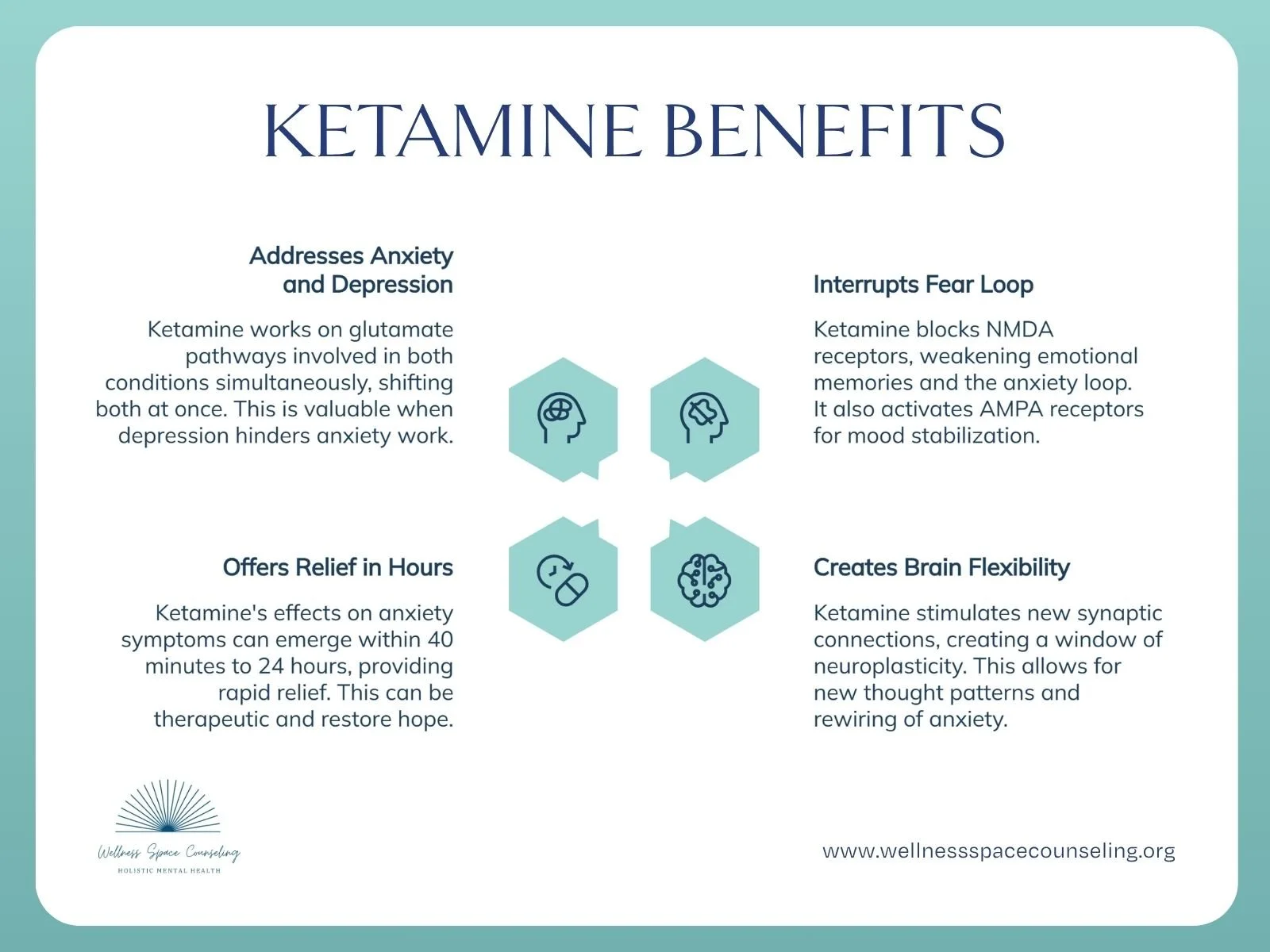
Ketamine works by blocking NMDA receptors, glutamate receptors involved in encoding and reinforcing emotional memories, including the fear memories that keep the anxiety loop running. When those receptors are temporarily quieted, the loop loses some of its grip. Ketamine also activates AMPA receptors, which support rapid mood stabilization and help build the neural flexibility needed for lasting change. Together, these effects can meaningfully interrupt anxiety patterns in ways that standard treatments simply can't match.
Ketamine Creates Genuine Brain Flexibility
Years of an overactive stress response reshape the neural circuits associated with worry, fear, and threat detection. Those pathways get worn in deep. Using ketamine at low doses stimulates the growth of new synaptic connections within hours of administration, producing a window of neuroplasticity that no other common anxiety treatment can match for speed. What makes this clinically significant is what can happen inside that window. New patterns of thought and response become more accessible. When that openness is met with skilled psychotherapy, people can begin rewiring what anxiety has built up over years, in a timeline that actually feels possible.
Ketamine Offers Relief in Hours, Not Weeks
For most people with anxiety, the treatments they’ve tried require patience, often taking weeks or months before meaningful relief begins. Ketamine offers a different timeline. Its effects on anxiety symptoms can emerge within 40 minutes to 24 hours after the first session. For someone who has been carrying severe anxiety for a long time, the experience of feeling noticeably calmer after a single session can be therapeutic in itself. It can restore something that may have felt lost: evidence that the nervous system is capable of settling.
Ketamine Can Address Anxiety and Depression at the Same Time
For the large percentage of people who carry both depression and anxiety, standard treatment typically means addressing one and hoping the other follows. Ketamine works on the glutamate pathways involved in both conditions simultaneously. That dual action can begin shifting both at once, which is particularly valuable when depression has been making it hard to engage with the anxiety work, or when anxiety has been feeding the depression by keeping the nervous system in a constant state of threat.
Types of Anxiety Ketamine May Help
Ketamine is currently an off-label treatment for anxiety disorders. Healthcare providers may prescribe ketamine for several types of anxiety, particularly where conventional treatments haven't been effective enough. Here are the conditions where the research is strongest.
Generalized Anxiety Disorder (GAD)
Generalized anxiety disorder (GAD) is a form of anxiety where the worry is not tied to one specific trigger. Instead, it moves from one area of life to another—health, finances, relationships, work, the future, or the wellbeing of people you love. It can be deeply exhausting because the mind rarely feels at rest. Many people with GAD describe living with a constant undercurrent of mental activity, always scanning for what could go wrong next. Ketamine may help interrupt this cycle by disrupting the anxiety loop and helping the nervous system settle into a calmer baseline, making it a meaningful option for people whose anxiety has remained severe despite standard treatment.
Social Anxiety Disorder
Social anxiety disorder is about more than being shy or introverted. It involves intense, persistent fear of being judged, embarrassed, or evaluated in social situations. At its most severe, it makes ordinary interactions feel genuinely dangerous and gradually shrinks the life someone is willing to live. A randomized, placebo-controlled trial found that a single dose of ketamine significantly reduced social anxiety symptoms compared to placebo, with response rates of 33% in the ketamine group versus 0% in the placebo group.
Panic Disorder
Panic disorder is not only about the panic attacks themselves. It’s often about the way life gradually begins to shift around the fear of having another one. People may start changing where they go, what they do, or who they’re with in an effort to feel safer and avoid triggering another episode. Over time, that fear of the next attack can become just as disruptive as the attack itself. Because ketamine can work quickly on the brain’s fear response system, it may offer another path for people who feel like their panic symptoms have not eased enough with more traditional treatments.
Obsessive-Compulsive Disorder (OCD)
OCD is often more complex than the way it’s commonly portrayed. At its core, it involves persistent intrusive thoughts and compulsive behaviors driven by anxiety. Early research suggests ketamine may also have rapid effects on OCD symptoms, making it part of the broader picture of anxiety-related conditions where ketamine shows promise.
Treatment-Resistant Anxiety
When multiple medications and therapy approaches haven't produced adequate relief, ketamine treatment becomes most clinically relevant. A 2022 systematic review in the British Journal of Clinical Pharmacology found that single-dose ketamine produced significant positive outcomes for patients with anxiety, with effects reducing anxiety from baseline within an hour and continuing for up to a week.
How long do the benefits of ketamine for anxiety last?
A single session can provide anxiety relief for up to one to two weeks. With a full course of sessions and ongoing integration therapy, many people sustain improvements for months.
The Different Ketamine Treatment Types and What We Do
Not all ketamine therapy is the same, and the term now covers a much wider range of experiences than many people realize. In some settings, ketamine is offered as part of a thoughtful therapeutic process—with preparation beforehand, support during the experience, and integration afterward. In others, it may be delivered more as a stand-alone medical procedure, with little therapeutic involvement beyond the session itself. Understanding that difference before you begin matters, because the structure around the experience can shape what you take from it.
The most common form of ketamine therapy is IV ketamine infusion therapy: medication delivered through an IV drip in a clinical setting, monitored by medical staff over 40 to 60 minutes. The procedure ends, you're observed for a short period, and you leave. There may be a note to follow up with a therapist. For someone whose anxiety is already sensitive to unfamiliar physical sensations, medical environments, or the feeling of being out of control, a procedure room with IV lines can activate the exact nervous system response you came in to treat.
There is also Spravato (esketamine), an FDA-approved nasal spray for treatment-resistant depression, administered in a certified doctor's office. These models are meant to be medical treatments in a clinical setting, not guided therapeutically by a therapist with whom you’ve built trust.
At Wellness Space Counseling, the model is different from the ground up. We offer ketamine-assisted psychotherapy (KAP) using oral ketamine lozenges (sometimes called ketamine tablets or sublingual lozenges), in a therapeutic setting, with a licensed therapist present with you from start to finish.
How We Tailor Dosing Within KAP
Within KAP, dosing isn't one-size-fits-all. We partner with doctors who review your personal medical history to prescribe the dose that's right for you, and that dose is monitored and reevaluated throughout your treatment in case anything needs to change. We use two different approaches depending on what you need from a given session, and we'll help you understand which one makes sense for you before we begin.
KAP Healing (Psycholytic dosing) uses a lower, more grounded dose that keeps you verbal and present throughout the session, so you can actively process difficult material in real time with your therapist beside you. We reach for this when the goal is staying anchored through hard memories, easing the hypervigilance that often comes with anxiety and trauma, and gradually softening emotional defenses, frequently alongside the EMDR, IFS, or somatic work we may already be doing together.
KAP Experiential (Psychedelic dosing) uses a higher, more immersive dose that creates more distance from everyday thought patterns and a more expansive, altered state. We reach for this when someone feels stuck or emotionally numb despite other treatment, since it can help interrupt entrenched patterns and open up genuine shifts in perspective, with most of the verbal processing happening afterward, in preparation and integration sessions rather than during the dosing itself.
Neither approach is "better." They're different tools for different points in someone's healing, and we'll talk through which one fits your history and your goals before we ever begin.
Why Oral Ketamine Lozenges Work Particularly Well for Anxiety
Oral ketamine lozenges produce a slower, more gradual onset than IV infusion therapy. For someone with anxiety, that gentler entry tends to feel far more manageable than a fast-acting intravenous dose that arrives all at once.
There is no procedure room, no IV line, no clinical equipment signaling to your nervous system that something medical is happening. Sessions take place in a calm, familiar therapeutic environment.
If anxiety surfaces during the session, which occasionally it does, your therapist is right there to help you work with it rather than navigate it alone.
The therapeutic relationship holds the entire experience. Ketamine is a tool within that relationship, not a standalone intervention sent home to work on its own.
We are a therapy practice that offers KAP, not a ketamine clinic that suggests therapy as an add-on. That distinction shapes everything about how ketamine treatment feels and what it's able to do.
What Happens From Your First Call to Your Last Session
Step 1: Getting to Know You and Your Anxiety
Every anxiety story is different. Before anything else, we sit with yours properly: what you've tried, how it landed, what your anxiety actually looks and feels like day to day, and what you're hoping could change. We also look at current medications, any co-occurring conditions, and whether KAP is genuinely the right fit. If it isn't, we'll say so and help you think through what is.
Step 2: Building the Foundation Before the Session
For people living with anxiety, preparation is not a formality. It is an essential part of the work. An anxious nervous system often needs time, context, and support before it can settle into something unfamiliar. In preparation sessions, we take time to explore what you are hoping to move toward, what feels uncertain or vulnerable about the process, and how to ground yourself if something unexpected arises. We also talk through what the ketamine experience may feel like—and what it may not—so you can enter the process with greater clarity, steadiness, and trust.
Step 3: The Experience Itself
You'll dissolve the oral lozenge in your mouth, sitting comfortably, with your therapist beside you throughout. The shift arrives gradually over the first 20 to 30 minutes.
What many people with anxiety notice first is the absence of what has been constantly there. The background current of worry begins to soften. The physical tension—the tight jaw, the braced shoulders, the steady vigilance—starts to ease. Some describe it as the first time in years they’ve been able to simply be present, without their nervous system scanning for what might go wrong. Sessions last approximately two hours, and your therapist remains with you throughout the entire experience.
Step 4: Making Meaning of What Came Up
Integration is where the experience begins to take shape in a meaningful way. In the sessions that follow, you and your therapist work through what surfaced—moments of unexpected calm, thoughts that felt different, emotions that moved with less intensity—and begin translating those shifts into something sustainable in daily life. Without integration, the experience can fade quickly as old patterns return. With it, the changes have the opportunity to take root and grow into lasting change.
Maintenance Sessions
For some people, an initial course produces lasting change. For others, periodic maintenance sessions help sustain the gains. Research suggests a single session can reduce anxiety symptoms for up to one to two weeks, with an ongoing approach extending those benefits further. We build this into your plan based on how you're actually responding, not a fixed protocol applied to everyone.
What is the success rate of ketamine for anxiety?
The research is still developing, but early findings are encouraging. A meta-analysis of randomized controlled trials found that ketamine was associated with significantly higher treatment response rates for anxiety disorders compared to control conditions. Success varies by individual, anxiety type, dosing protocol, and whether therapy is integrated alongside treatment.
What Ketamine Actually Feels Like and What to Watch For
Ketamine has a well-established safety record built over fifty years of clinical use. Here's an honest picture.
Possible Side Effects of Ketamine Therapy for Anxiety
Dissociation: A temporary loosening from your usual stream of thought. For people with anxiety, this often feels surprisingly welcome. It fades completely as the session ends
Nausea: Usually mild and brief. Preparation guidelines around food, nausea medication, and timing reduce this significantly
Dizziness: Common as the medication takes effect and clears by the end of the session
Elevated heart rate or blood pressure: Mild and temporary
Fatigue afterward: Plan for rest and arrange a ride home. Do not drive
The Question We Hear Most from Anxious Clients
People with anxiety often ask: What if the session itself makes my anxiety worse? What if losing control of my thoughts triggers a panic response? It's a completely understandable concern, and we want to answer it honestly.
Occasionally, discomfort does surface during a session, particularly if something unexpected comes up. This is exactly why thorough preparation matters, and why having a therapist present throughout is essential in our model.
The strength of the therapeutic relationship—and the trust built during preparation—creates the foundation that holds the experience. It allows moments of discomfort to be met with support and curiosity rather than fear. For many people with anxiety, the session feels far more manageable than they anticipated. Many also describe it as one of the most settled and grounded they have felt in years.
Who Is and Isn't a Good Candidate for Ketamine Treatment for Anxiety
People Who Tend to Benefit Most
Those with treatment-resistant anxiety who have tried multiple medications or therapy approaches without finding adequate relief
People experiencing severe anxiety symptoms that are significantly limiting their daily life, relationships, or ability to work
Individuals that may have both anxiety and depression, where standard sequential treatment hasn't been enough for either condition
Those ready to engage with the full process: assessment, preparation, ketamine session, and integration. Not just the ketamine part
Who May Not Be a Good Fit Right Now
People with certain cardiovascular conditions or uncontrolled high blood pressure
Those with active psychosis or presentations that require stabilization before this kind of work
Individuals with a history of substance misuse, particularly involving dissociative substances. This warrants careful clinical assessment rather than automatic exclusion
Those with severe liver disease
People whose current medications interact with ketamine in ways that affect safety
Those who are pregnant
The assessment process is where these questions are thoughtfully explored. Providers who prescribe ketamine and offer KAP are required to complete a thorough clinical screening, and we approach that process with care and intention. If you’re in Columbia and wondering whether this approach may be a fit for you, that conversation is often the most important place to begin.
You Deserve More Than Partial Relief. Let's Find What Works.
If you’ve been living with anxiety for a long time, you may know what it’s like to keep adapting—adjusting routines, making accommodations, and gradually narrowing your world in an effort to avoid what feels overwhelming. That kind of ongoing management can be exhausting. And when treatment after treatment has brought only partial relief, it is understandable to begin wondering whether this is simply how life will always feel.
It doesn't have to be.
At Wellness Space Counseling in Columbia, we work with people who feel stuck. Not because they haven’t tried hard enough, but because the treatments they’ve tried haven’t fully reached what keeps them stuck. Our ketamine-assisted psychotherapy program uses oral ketamine lozenges in a setting where a licensed therapist remains with you throughout the entire session.
We do not recommend KAP for everyone, and we are straightforward when it is not the right fit. But if anxiety has been running your life for a long time, and you feel ready to explore an approach that works through a fundamentally different pathway, we would be honored to walk alongside you through that process.
Schedule a consultation or call us at 410-498-4300. We're here when you're ready.
This article is for educational purposes only and does not constitute clinical advice, diagnosis, or treatment. Ketamine therapy is not appropriate for everyone. Please consult a licensed mental health professional to determine whether this approach is right for your situation.
