
Avoidant Attachment Style: Why Closeness Can Feel So Hard
Sometimes closeness does not feel comforting. Sometimes it feels exposing, overwhelming, or like too much all at once.
If you have an avoidant attachment style, you may care deeply about connection and still find yourself pulling back when a relationship starts to feel emotionally close. That can be confusing, especially when part of you wants love and another part wants space.
In this post, we’ll take a thoughtful look at what avoidant attachment can look like, why it often develops, how it can show up in adult relationships, and what healing can look like.
What is an avoidant attachment style?
Signs of avoidant attachment in relationships
How managing avoidant attachment can become possible
What moving toward secure attachment can look like
If this feels familiar, keep reading. Understanding your attachment style can be a meaningful first step toward a more honest, steady connection.
What Is an Avoidant Attachment Style?
An avoidant attachment style is one form of insecure attachment. In simple terms, avoidant attachment is characterized by a tendency to protect yourself through distance.
A person with this attachment style may look independent, self-contained, or hard to read. On the inside, though, there is often more going on. Closeness may feel uncomfortable. Need may feel risky. Relying on someone else may bring up tension instead of relief.
This attachment style often gets misunderstood. People with an avoidant attachment are not necessarily cold, uncaring, or incapable of love. More often, they have learned that staying emotionally guarded feels safer than staying open.
So if closeness feels difficult, that does not mean something is wrong with you. It may mean your attachment system learned, for understandable reasons, that distance feels safer than depending on someone else.
How is avoidant attachment different from anxious attachment?
With anxious attachment, a person usually reaches for more reassurance and closeness. With avoidant attachment, a person often pulls back. Anxious and avoidant patterns can easily get stuck together in relationships.
How Attachment Develops and What Can Cause Avoidant Patterns
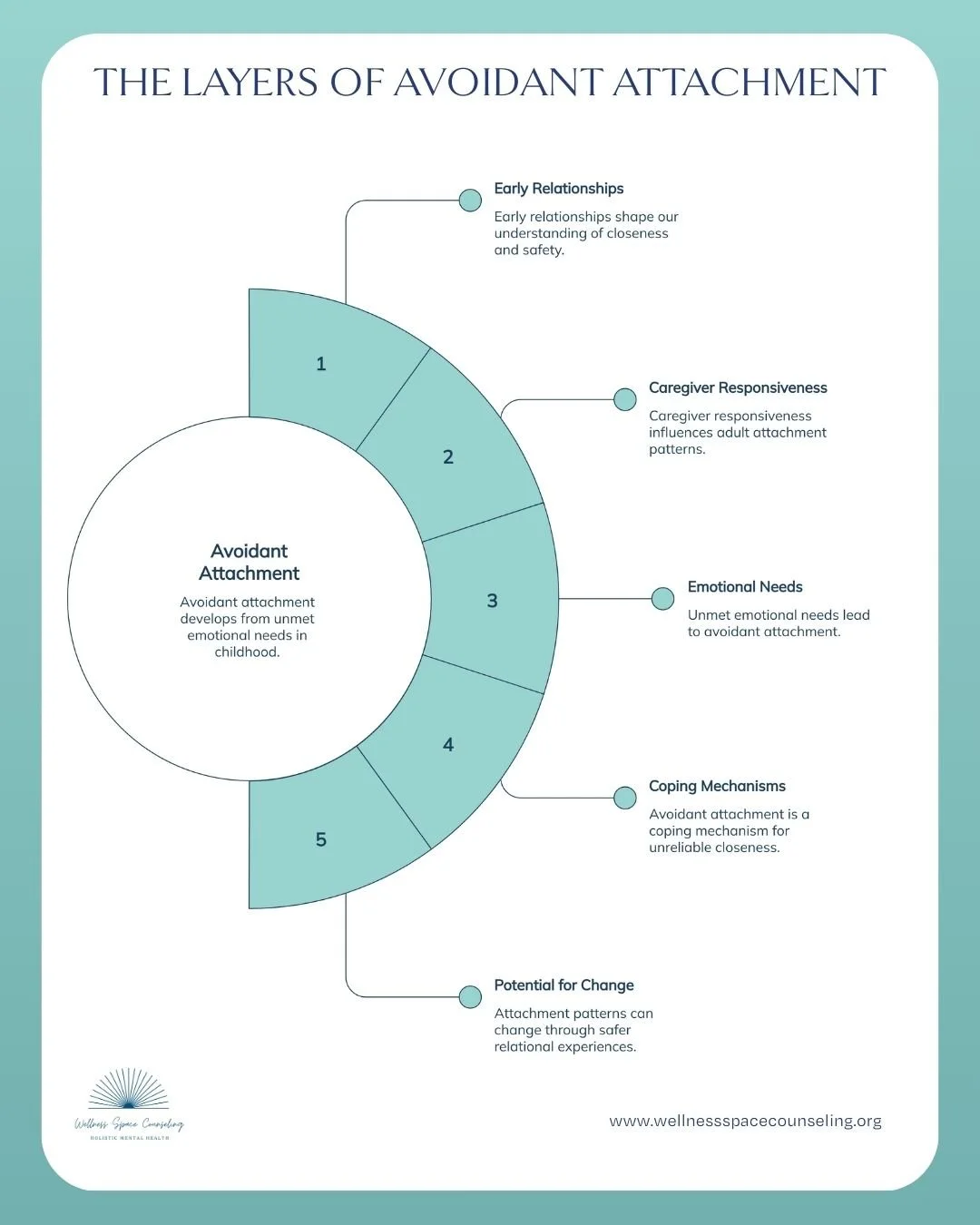
According to attachment theory, early relationships help shape how we relate to closeness, safety, comfort, and emotional needs.
Most of the time, avoidant attachment does not appear out of nowhere. It develops in relationships, through repeated experiences that quietly teach a child what to expect from closeness, comfort, and emotional need.
Attachment research has long shown that the quality of early caregiving, especially caregiver responsiveness and availability, plays a major role in how adult attachment develops.
A child’s attachment begins to take shape in small, repeated moments:
When they are upset and reach for comfort
When they need soothing, reassurance, or emotional attunement
When they look to a caregiver as a source of safety
When they learn, over time, whether closeness feels relieving or disappointing
A child may develop an avoidant attachment pattern when those emotional needs are regularly missed, minimized, or met in a way that feels unavailable.
That does not automatically mean a parent was cruel or intentionally neglectful. That distinction matters. Sometimes caregivers are loving in many ways, but emotionally overwhelmed, uncomfortable with vulnerability, inconsistent, or unsure how to respond when a child is distressed.
This can help explain why children with avoidant tendencies often seem less outwardly distressed than they actually are. The need for comfort does not disappear. What often changes is the child’s expression of that need. Instead of reaching more, they may begin reaching less. Instead of showing distress openly, they may minimize it.
So it can be more helpful to think about avoidant attachment as protection rather than defiance. It is an adaptation. It is one waythe nervous system learns to cope when closeness feels unreliable, uncomfortable, or emotionally costly.
And even if this pattern began early, that is not where the story has to end. Attachment develops in relationship, and it can also shift through new, safer, more consistent relational experiences over time.
Avoidant Attachment Style Traits: What It Can Look Like in Real Life
Avoidant attachment style traits do not always look dramatic. In fact, they are often easy to miss, especially in people who seem capable, calm, and highly functional.
A person with this attachment style may value independence so strongly that needing support feels almost uncomfortable. They may struggle to name feelings, ask for reassurance, or lean on someone else when they are hurting. They may appear steady on the outside while feeling shut down, irritated, or emotionally flooded on the inside.
Some common signs of avoidant attachment include:
Needing space when emotions rise
Feeling uncomfortable with too much closeness
Downplaying problems instead of talking them through
Shutting down during conflict
Struggling to ask for help
Feeling safer in casual relationships than in a deeper commitment
Pulling away after moments of intimacy
These avoidant behaviors often make more sense when you understand what they are trying to do. They usually serve a protective function. Distance can feel like control. Emotional restraint can feel safer than being vulnerable. Independence can become a shield.
This is also why dismissive attachment and dismissive avoidant language often come up here. A dismissive attachment style may look like self-sufficiency, emotional distance, and a tendency to minimize attachment needs. But underneath that trait, there is often a long-practiced way of staying safe.
So if you recognize yourself here, try not to reduce it to labels. The point is not to say, “This is just how I am.” The point is to begin understanding the pattern with enough honesty that it can eventually soften.
Curious how your attachment style shows up in your relationships?
Download our free Attachment Style Quiz—a gentle self-reflection guide to help you understand your patterns and begin shifting them with more awareness and compassion.
Avoidant Attachment in Relationships: Why Intimacy Can Feel So Hard
Avoidant attachment in intimate relationships can make intimacy feel threatening, overwhelming, or exposing, even when the person genuinely wants love and connection.
This pattern often becomes most visible in adult relationships. Why? Because close relationships ask for the very thing avoidant attachment tends to protect against:emotional dependence.
A person with avoidant attachment may want:
Love
Partnership
Safety
Closeness
A stable bond
And still feel activated when those things become real.
In a romantic relationship, closeness may feel like:
Pressure
Loss of control
Too many expectations
A setup for disappointment
That can lead to patterns like:
Withdrawing after vulnerability
Needing distance right after connection
Feeling irritated when a partner wants reassurance
Keeping one foot out emotionally in long-term relationships
There is also evidence that attachment avoidance may affect how people perceive their partner’s emotional signals. A recent study found thatpeople higher in attachment avoidance were less accurate in reading a romantic partner’s positive emotions. That kind of subtle disconnect can make closeness even harder to build.
Soif intimacy feels hard, it does not automatically mean you are with the wrong person or incapable of love. It may mean your attachment system has learned to treat closeness as risky.
Does no contact work on an avoidant person?
Sometimes, no contact creates space, but it is not a reliable way to change someone with an avoidant attachment. If the goal is a healthier relationship, clarity and consistency usually help more than trying to force a reaction.
Avoidant-Dismissive Attachment Style vs. Fearful-Avoidant Attachment
Not all avoidant patterns feel the same from the inside.
The avoidant-dismissive attachment style typically leans toward emotional distance, self-reliance, and downplaying attachment needs. This is the pattern many people mean when they talk about dismissive attachment style or dismissing attachment. A person may tell themselves they do not really need much from anyone, or that staying independent is always better than risking vulnerability.
Fearful-avoidant attachment, on the other hand, tends to hold more internal conflict. Someone with this pattern may deeply want closeness and then panic when it begins to feel real. The longing and the fear can sit side by side.
A dismissive pattern may sound like:
“I’m better off handling this myself.”
“I don’t really need anyone.”
“This is getting too intense.”
A fearful pattern may sound like:
“I want closeness, but I don’t know how to trust it.”
“I miss you when you’re far away, but when you get close, I want to run.”
“I want connection, and I’m scared of it.”
These distinctions are not meant to trap anyone in a category. They are simply a way of understanding how attachment patterns may show up differently from person to person.
That matters because healing is easier when the pattern is named accurately. Not perfectly, but accurately enough that the person can recognize what happens inside them when relationships begin to matter.
Can avoidant attachment change?
Yes. Avoidant attachment style may soften with self-awareness, therapy, and safer relationship experiences. Over time, avoidant individuals may move toward the steadiness of someone with a secure attachment.
Can You Change Your Attachment Style? What Healing Can Actually Look Like
This is often the tender question underneath everything else.
Can you actually change your attachment style?
In many cases, yes. Not overnight, and not by forcing yourself to act differently before you feel safe enough to do so. But yes, attachment patterns can shift.
A more secure attachment style does not mean becoming perfectly vulnerable, never needing space, or suddenly feeling comfortable with every emotional demand. It means developing more flexibility. More trust. More ability to stay connected to yourself and another person at the same time.
Research supports the importance of secure attachment for support-seeking, relationship functioning, and well-being, while attachment insecurity is linked to greater relational and mental health strain.
Healing often includes:
Understanding your attachment style more clearly
Noticing your reflex to withdraw
Staying present a little longer during emotionally close moments
Naming needs before they harden into distance
Experiencing safer, steadier relationships with people
Doing therapy that helps you slow down and make sense of your protective responses
This is how people often begin to develop a more secure attachment. Not by becoming a different person, but by learning that closeness does not always have to cost them their safety.
So yes, you can change your attachment style. But more importantly, you can begin relating to yourself with enough compassion that change becomes possible.

Managing Avoidant Attachment in Everyday Relationships
Insight matters, but most people also want something practical.
What does managing avoidant attachment actually look like in daily life?
Usually, it starts small. Not with a dramatic breakthrough, but with noticing what happens right before you pull away. Maybe you feel irritated. Maybe numb. Maybe trapped. Maybe you suddenly want out of the conversation. Those moments matter because they often tell you your attachment system has been activated.
A few gentle ways to address avoidant attachment include:
Pause before withdrawing completely
Name one feeling instead of none
Ask for space with a clear return time
Notice when “I’m fine” really means “I’m overwhelmed”
Stay curious about your attachment needs instead of judging them
Practice receiving support in smaller ways
If you are in a relationship, it can also help to communicate your inner experience more clearly. Saying “I need a moment because I’m shutting down” is very different from disappearing emotionally. It creates a bridge instead of a wall.
And if these patterns keep repeating in ways that hurt you or the people you love, therapy can help. Not because you need to be fixed, but because understanding your attachment relationship with closeness, need, and vulnerability often goes much deeper in a thoughtful therapeutic space than it can in a self-help article or an attachment style quiz.
Managing avoidant attachment is rarely about becoming more intense. More often, it is about becoming more aware, more honest, and a little more emotionally reachable over time.
If This Feels Familiar, We Can Explore It Together
If reading this has stirred something up for you, you may not need more information as much as you need space to sort through what this looks like in your actual life.
At Wellness Counseling Space, we help clients explore attachment patterns with care, clarity, and without blame. If closeness feels difficult, confusing, or easier to avoid than to stay present for, we can slow things down together and make sense of what is happening.
Our goal is not to pressure you into opening up before you are ready. It is to help you understand your protective responses, your attachment needs, and what it might look like to move toward a more secure and connected way of relating.
If you are ready to explore that gently and honestly, we’d be honored to help. Reach out today!
