
What the Secure Attachment Style Really Looks Like
When relationships feel confusing, many people start looking up secure attachment style not out of curiosity, but out of a deep desire to understand their own patterns of closeness, conflict, and comfort. For a lot of us, the way we connect with partners, friends, and family carries echoes of early experiences, and attachment theory gives us a framework for making sense of those patterns, not a prescription or a label that defines us forever. Attachment styles are not diagnoses or fixed identities; they are relational tendencies that can shift over time with awareness and support.
Research suggests that roughly 50–60% of adults report having a secure attachment pattern, while the remainder show variations of insecure attachment styles such as avoidant or anxious patterns. In children, more than half demonstrate secure attachment behaviors with caregivers. These numbers remind us that many people carry relational strengths alongside vulnerabilities.
In this article, you will explore:
What secure attachment actually means in relationships
How secure and insecure attachment styles differ
What secure attachment looks like in adults and children
Whether it’s possible to develop a more secure attachment over time
If you’ve ever wondered why connection feels easy with some people and so hard with others, you’re in the right place. Let’s explore this together.
What Is Secure Attachment?
When we talk about a secure attachment style, we are describing a way of relating that feels steady, safe, and emotionally grounded. It shows up as an ability to trust, to ask for support when you need it, and to stay connected even when there is tension or disagreement. Secure attachment does not mean relationships are always easy. It means there is enough emotional safety to work through challenges together.
In everyday life, secure attachment can look like:
Feeling comfortable being close while also respecting independence
Being able to express needs without fear of rejection
Trusting that conflict does not automatically threaten the relationship
Feeling emotionally safe enough to repair after misunderstandings
According to attachment theory, secure attachment develops through repeated experiences of responsiveness and care. John Bowlby, who developed attachment theory, described caregivers as a secure base that helps a child feel safe enough to explore the world. Mary Ainsworth’s research later showed that children with secure attachment return to caregivers for comfort and are soothed more easily. These early experiences shape how we learn to feel secure in relationships later on.
Because of this, secure attachment is considered a positive attachment style. Research consistently shows that secure attachment is associated with healthier emotional regulation, stronger romantic relationships, and more satisfying relationships with others across the lifespan.
How does secure attachment develop in childhood?
Secure attachment develops in early childhood when a child has secure attachments with primary caregivers who are responsive, consistent, and emotionally available.
The Four Elements of Secure Attachment: The “4 S’s”
When people ask what actually creates secure attachment, research points us toward a clear and practical framework often called the 4 S’s of secure attachment. This model, grounded in attachment theory and widely used in clinical work, helps explain what allows relationships to feel safe, steady, and emotionally supportive.
The four elements of secure attachment are Safe, Seen, Soothed, and Secure. Here’s what each one looks like in real life:
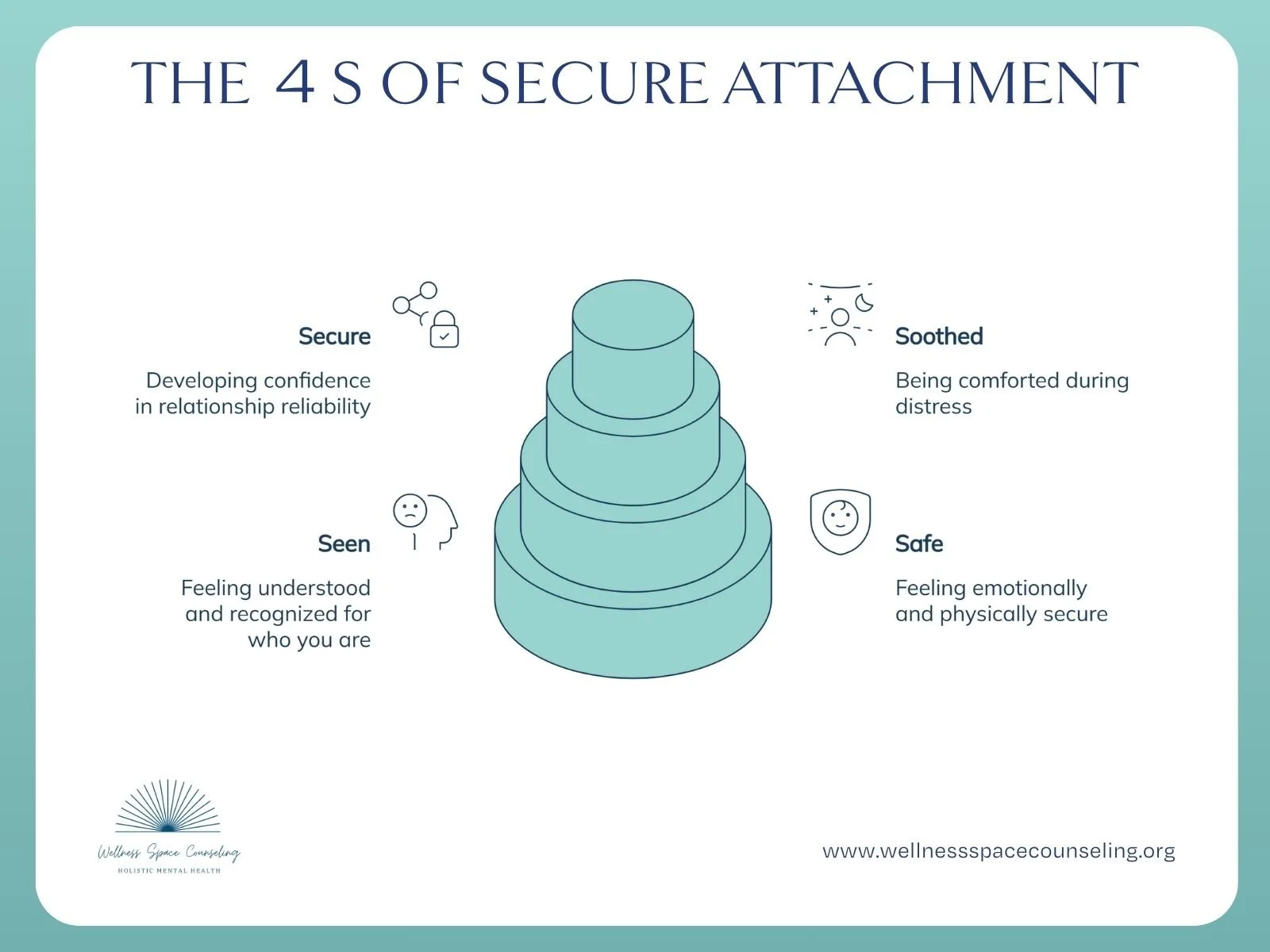
Safe
Secure attachment begins when a person feels emotionally and physically safe. This means knowing that closeness will not lead to harm, rejection, or humiliation. Feeling safe allows the nervous system to relax and makes connection possible in the first place.
Seen
Feeling seen means feeling understood and recognized for who you are. In secure attachment, emotions, needs, and experiences are noticed and taken seriously. Being seen helps people develop a stable sense of self and trust that they matter in relationships.
Soothed
Secure attachment includes the experience of being comforted during distress. Whether in childhood or adult relationships, being soothed teaches the nervous system that emotions can be regulated with support. Over time, this builds emotional resilience and self-soothing skills.
Secure
When safety, being seen, and being soothed happen consistently, a deeper sense of security develops. This creates confidence that relationships are reliable and that connection can be repaired after conflict or distance.
Together, the 4 S’s explain why secure attachment doesn’t require perfection. It grows through repeated experiences of emotional safety, understanding, comfort, and repair. When these elements are present, relationships become a place people can return to, even when things feel hard.
Curious how your attachment style shows up in your relationships?
Download our free Attachment Style Quiz—a gentle self-reflection guide to help you understand your patterns and begin shifting them with more awareness and compassion.
Insecure Attachment Styles and How They Differ
One of the most important things to understand about attachment styles is that insecure attachment isn’t about flaws or failure. These patterns form as adaptive responses to early environments that didn’t consistently provide safety, predictability, and attunement. Attachment patterns areways the nervous system learns to seek connection and safety, even when experiences have been confusing or inconsistent. From infancy through adulthood, attachment affects how we relate to others, but it doesn’t define worth or predict destiny.
Anxious Attachment
In this pattern, a person might deeply fear rejection or abandonment, oftenseeking reassurance and closeness.
Avoidant Attachment
People with avoidant attachment tend to minimize emotional closeness, valuing independence and self-sufficiency over vulnerability.
Disorganized Attachment
Often linked to chaotic or unpredictable early experiences, this style can involve conflicting desires for closeness and distance, making relationships feel confusing or overwhelming.
These styles are not defects but patterns of adaptation that helped a child cope with early relational stressors or unmet needs. They often show up in adult relationships as emotional distancing, inconsistency, or intense worry about connection.
It’s also common for adults to show blended patterns rather than purely one style, especially under stress. Attachment styles develop over time and can vary depending on relationship context, making understanding and growth very possible.
What are the benefits of having a secure attachment style?
A secure attachment style provides greater attachment security, healthier adult attachment styles, and more satisfying relationships and friendships.
Secure vs Insecure Attachment in Relationships
When someone is securely attached, their nervous system is generally comfortable with closeness and separation. They can express needs and emotions and feel confident that their partner will respond with care. This doesn’t mean relationships are perfect, but it does mean people feel emotionally safe enough to communicate and repair when things go wrong.
By contrast, insecure patterns show up as regulation differences rather than simple behaviors:
Anxious attachment often includes difficulty trusting a partner’s availability and persistent worry about losing connection.
Avoidant attachment can look likeemotional withdrawal, discomfort with vulnerability, and keeping distance even when intimacy is desired.
Disorganized attachment may involve unpredictable swings between closeness and avoidance, reflecting internal conflicts about safety.
Why Positive Attachment Is More About Regulation
Positive attachment isn’t just about nice behavior. It is rooted inthe ability to regulate emotions, tolerate stress in relationships, and ask for what you need without fear of abandonment or engulfment. Securely attached adults tend to feel safe expressing vulnerability and confident in the dependability of their connection.
Understanding these differences helps us see attachment patterns with empathy and curiosity rather than criticism, opening the door to growth and deeper relational trust over time.
Signs of a Secure Attachment Style
When people hear the phrase secure attachment style, they sometimes imagine someone who is always calm, confident, or emotionally polished. In reality, secure attachment doesn’t mean never struggling. It means having enough emotional safety, inside yourself and in your relationships, to move through stress without losing connection.
Signs of Secure Attachment in Kids
Much of what we know about secure attachment in children comes from the work of Mary Ainsworth, whoseStrange Situation studies remain foundational in attachment theory and research. Children with secure attachment tend to use caregivers as a secure base.
Common signs of secure attachment in kids include:
A securely attached child seeks comfort from caregivers when distressed
The child calms more easily after reassurance
Willingness to explore the environment and return for reassurance
Distress during separation paired with relief at reunion
Children with secure attachment feel safe exploring because they trust that their caregiver will be there when needed. Secure attachment in children is associated with better emotional regulation, social skills, and resilience later in life.
Secure attachment doesn’t mean a child never struggles. It means the child feels safe enough to return, repair, and reconnect, which is the foundation for healthy relationships across the lifespan.
Which is the unhealthiest attachment style?
There is no “unhealthiest” attachment style. Avoidant attachment styles, anxious patterns, and disorganized attachment reflect adaptations to early experiences, not personal flaws.
Practical Signs of a Secure Attachment Style
People with secure attachment tend to show these observable patterns:
Ability to regulate emotions during stress rather than becoming overwhelmed or shut down
Comfort asking for support and offering support in return
Trust that disagreements don’t automatically threaten the relationship
Willingness to repair after conflict instead of withdrawing or escalating
Feeling generally safe and secure in close relationships
Secure attachment is rooted in early relationships, but attachment doesn’t stop developing in childhood. Adults can develop a secure attachment style later in life through supportive relationships and therapy.
Is It Possible to Develop a Secure Attachment Style?
A question we hear again and again in therapy is this: If my patterns of relating were shaped long ago, can they really change? The short, hopeful answer is yes, it is possible to develop a secure attachment style over time, even if early experiences didn’t provide the emotional predictability you needed. Attachment patterns often form in early childhood through interactions with caregivers, but they are not an unchangeable destiny. Our nervous systems continue to adapt across life, and experiences of safety, responsiveness, and repair can reshape how we connect with others.
Attachment theory research shows that whilemany people maintain relatively stable patterns, about 20% of adults experience meaningful shifts in their attachment style over time. These changes often happen through supportive experiences, close relationships, and intentional work such as therapy.
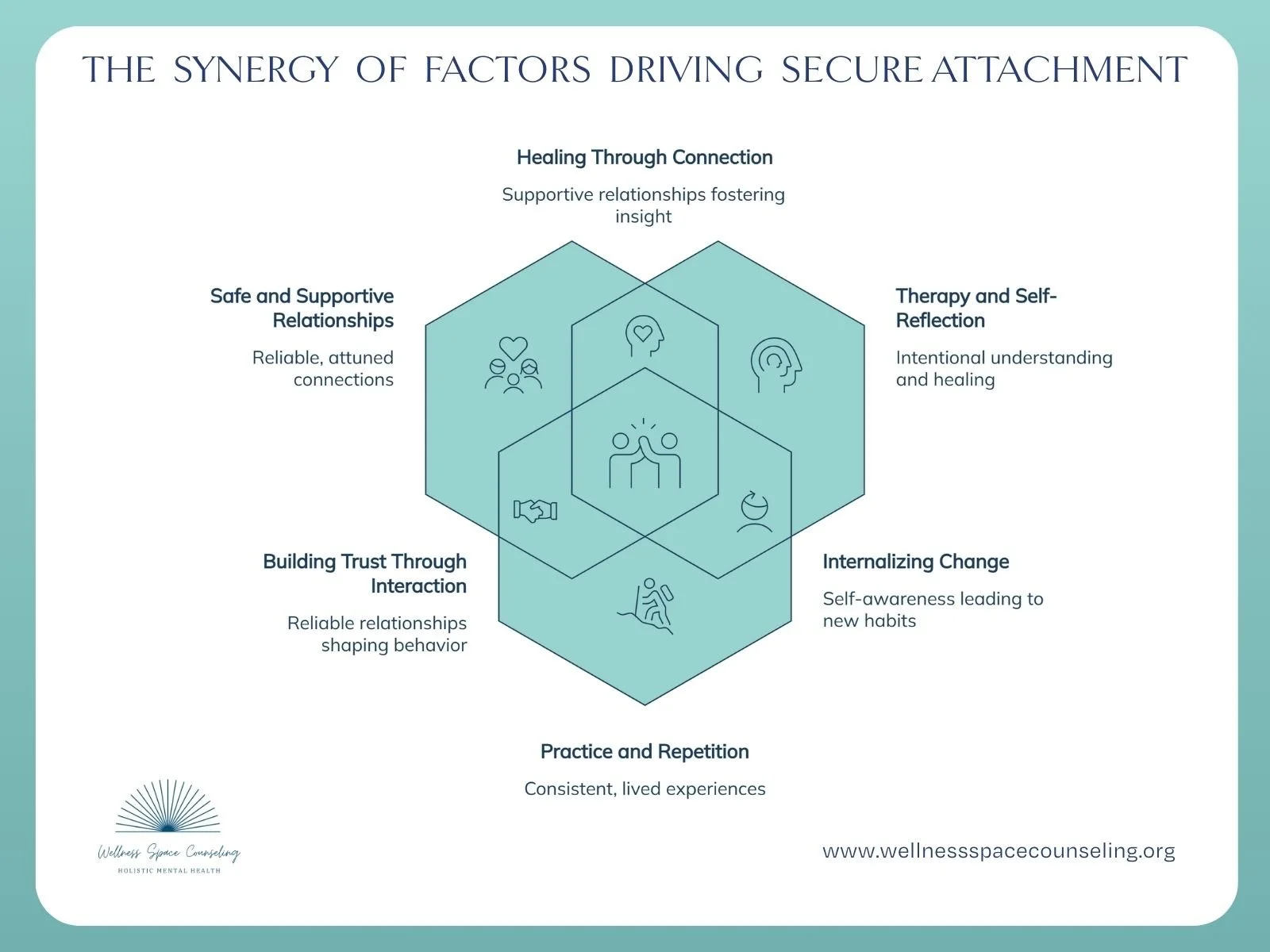
Developing secure attachment is not about suddenly becoming perfect at relationships. It is about gradually strengthening your internal sense of safety and your confidence that connection can be sustaining rather than threatening.
Shifting toward a more secure attachment in adulthood is a process rather than a moment. It often involves:
Safe and supportive relationships
Close relationships that model reliability and emotional attunement help reshape internal attachment beliefs.
Therapy and self-reflection
Therapeutic relationships provide a consistent, supportive space where you can learn to understand your attachment patterns, express vulnerability, and heal old relational wounds.
Practice and repetition
Developing a secure attachment style slowly happens through repeated experiences of connection, safety, and repair. It’s not insight alone that fosters change, but consistent, lived experiences that gradually shift nervous system responses.
Unlike early childhood experiences with primary caregivers, secure relationships in adulthood—whether with a partner, friend, or therapist—can provide a new template for how relationships feel. This is sometimes called “earned secure attachment,” where growth and healing create a more adaptive pattern of relating.
The journey toward secure attachment is not linear, and it doesn’t happen overnight. But with empathy, support, and consistency, many people find they can build a secure and stable way of relating that feels safe, trusting, and deeply connected over time.

Support for Growing Safer, More Connected Relationships
At Wellness Space Counseling, we think about secure attachment not as something you either have or don’t have, but as something that can grow within the right kind of relationship. Many of the people who come to us are thoughtful, self-aware, and still feeling stuck in familiar patterns of distance, conflict, or uncertainty. Therapy offers a place to slow down and understand how those patterns developed and how they might begin to shift.
As therapists, we work from the understanding that attachment lives in relationships. Whether we are sitting with a couple who feels unsure about their future, parents who want to support a child’s emotional world, or individuals trying to build safer connections in adult relationships, our role is to help create the conditions where secure attachment can develop. That means paying attention to emotional safety, responsiveness, and repair rather than assigning blame or rushing toward solutions.
Our work is grounded in approaches that support emotional regulation and connection, including internal family systems therapy, the Gottman Method, and discernment counseling. For children, therapy focuses on helping them feel understood and supported while strengthening the caregiving relationships that allow secure attachment to take root.
If you are curious about how secure attachment might grow in your own relationships, we invite you to reach out. Therapy can be a calm, collaborative space to understand what has shaped you and to begin building relationships that feel steadier, safer, and more connected.
