Anxious Attachment Style: When Love Feels Like It's Never Quite Enough
Maybe you've caught yourself staring at your phone, waiting for a message that hasn't come yet. Replaying a conversation from two days ago and wondering if something small you said changed everything. Feeling a knot in your chest even when the person you love has given you no real reason to worry.
If that sounds familiar, you may be living with an anxious attachment style. More people carry this than you might think.
This post is for anyone who has ever felt like love is something they have to constantly earn, protect, or hold onto tightly to keep from disappearing. Here's what we'll cover:
What anxious attachment style actually is
Where it comes from and why it is not your fault
How it tends to show up in relationships and your inner world
What healing can genuinely look like
You don't have to figure this out alone. Keep reading — and then let's talk.
What Is Anxious Attachment Style?
Anxious attachment style is one of four main ways people learn to relate to closeness, connection, and emotional need, shaped largely by early experiences with caregivers. It falls under the umbrella of insecure attachment, alongside the avoidant and disorganized attachment styles.
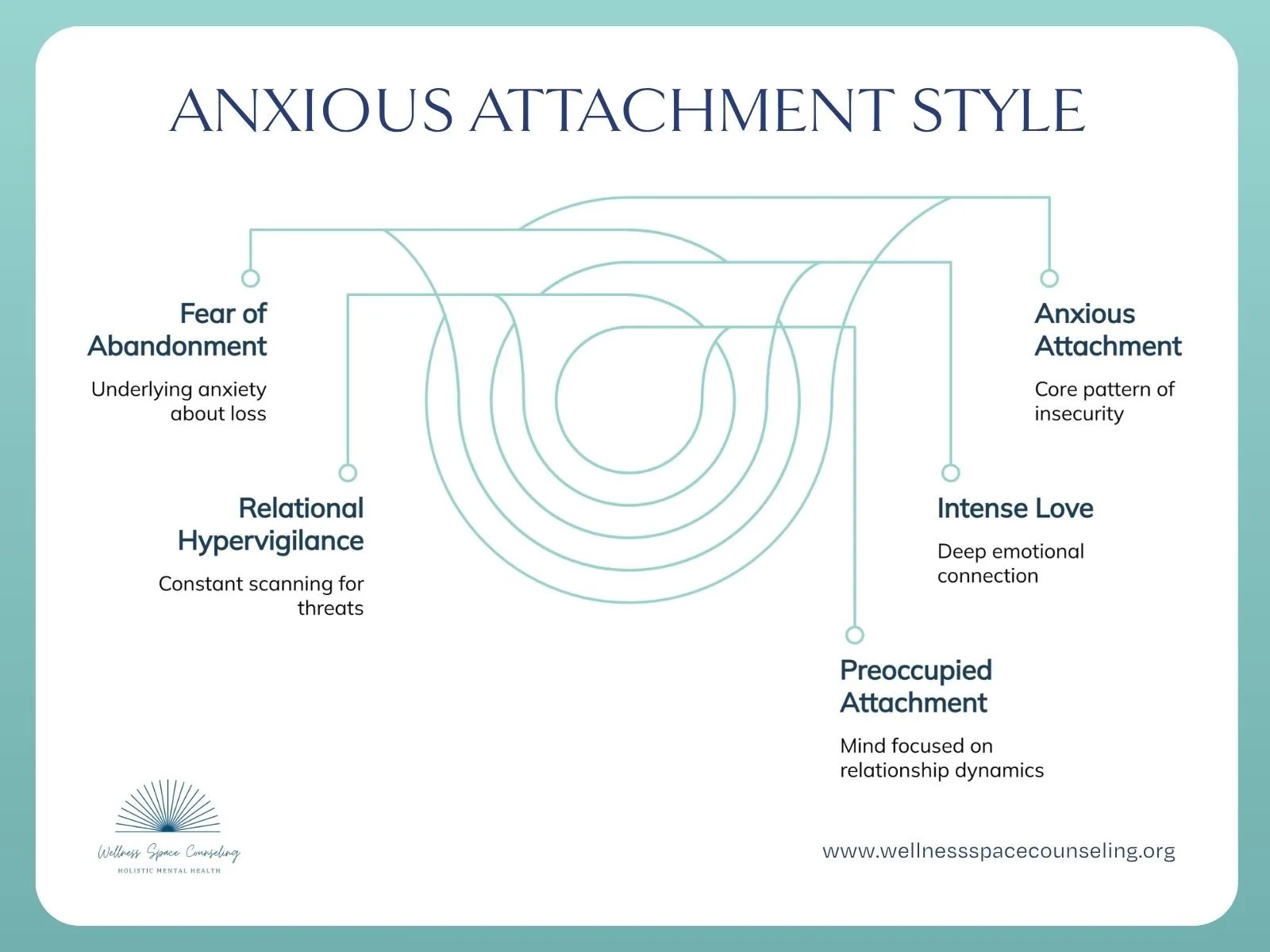
At its heart, anxious attachment is a deep hunger for closeness paired with an equally deep fear that closeness can be snatched away without warning.
People with this pattern often love with great intensity. They are attentive, devoted, and attuned to the people they care about. But underneath that warmth, there is often a quiet, persistent question: Is this going to last? Am I going to be left?
This is also sometimes called the preoccupied attachment style because the mind can become quietly preoccupied with the relationship, scanning for subtle shifts, reading tones, anticipating ruptures that haven't happened yet.
Research estimates that around 20 percent of people develop an anxious attachment style. That is a lot of people sitting with a kind of relational hypervigilance they may not even have a name for. If that's you, you are not broken, and you are not alone.
Where Does Anxious Attachment Come From?
Here is something that really matters: anxious attachment does not mean something is fundamentally wrong with you. It means something happened — usually early, usually small and repeated — that taught your nervous system to stay alert.
Attachment theory research consistently shows that the consistency and emotional availability of early caregiving shape how we later relate to love, need, and closeness. When a caregiver was sometimes warm and responsive and other times unavailable, distracted, or hard to read, a child learns a painful lesson: love exists, but it is not reliable.
So the child adapts. They become watchful. They reach a little louder to make sure they are noticed. They keep one eye on the relationship at all times, just in case.
That adaptation made sense. It was survival. But it tends to follow us long past the moment it was useful.
Some of the early experiences that can shape anxious attachment include:
A caregiver who was emotionally warm sometimes and withdrawn at others — with no clear pattern
Parenting shaped by the caregiver's own unresolved anxiety, stress, or depression
Experiences of loss, early separation, or family instability
Growing up in an environment where emotional needs were sometimes met and sometimes minimized
It's worth saying gently: this does not mean your caregivers were bad people. Many were doing their best. But the nervous system learned what it learned, and now it is ready to learn something new.
What is the unhealthiest attachment style?
There is not one “unhealthiest” type of attachment, but an insecure attachment style can make adult relationships feel more stressful. The good news is that attachment style can change, and you can develop a secure attachment style over time.
What Anxious Attachment Can Look Like in Relationships
Anxious attachment does not always announce itself dramatically. It can look like being a devoted partner who simply needs more reassurance than most. It can look like caring deeply and feeling things intensely. It can also look like exhausting yourself trying to make sure the relationship stays okay.
Signs of Anxious Attachment Style in Romantic Relationships
Checking in frequently — and feeling unsettled when the response is slower than usual
High sensitivity to mood shifts — a partner who seems a little quiet can feel like a warning sign
Difficulty trusting that things are fine — even when there is no real evidence that they aren't
Replaying conversations, looking for what might have gone wrong
A persistent fear of abandonment that doesn't quite match the stability of the relationship
People-pleasing as a way of keeping the peace and reducing the risk of rejection
Pulling for closeness at the exact moment a partner might need a little space
These patterns often create a painful loop. The more anxious the attachment, the more reassurance feels necessary. The more reassurance is sought, the more the other person may feel pressure and pull back, which confirms the very fear driving everything.
Understanding this cycle is not about blame. It is about beginning to see the pattern clearly enough that it can start to shift. And if this dynamic is showing up in your relationship, couples counseling can be a powerful place to start untangling it together, including exploring your communication patterns as a couple.
Curious how your attachment style shows up in your relationships?
Download our free Attachment Style Quiz—a gentle self-reflection guide to help you understand your patterns and begin shifting them with more awareness and compassion.
How Does Preoccupied Attachment Style Feel on the Inside
One of the quieter and more painful dimensions of anxious adult attachment is what it feels like to live inside it, not just in relationships, but in the private moments between them.
There can be an internal narrator that never fully quiets down. It asks: Was that okay? Are they pulling away? Should I have said that differently? Are we still good?
Emotional regulation becomes harder when the nervous system has been trained to stay on alert. Small things — a canceled plan, a shorter text than usual, a moment of silence — can activate feelings that seem too large for the situation. And the gap between the size of the feeling and the size of what actually happened can itself be confusing and exhausting.
Self-worth is often tangled up in this as well. According to researchers at UC Berkeley's Greater Good Science Center, a common internal belief for people with anxious attachment is: "I am only worthy of love if I can make you happy." Low self-esteem, often unconscious, shapes how someone communicates, handles conflict in close relationships, and whether they feel entitled to have needs of their own.
It is worth saying clearly: you are worthy of love simply because you are. Not because you managed it perfectly. Not because you made someone happy. That belief takes time to build, but it is one of the most important things therapy can help with.
What are common anxious attachment triggers, and how can I manage them?
Common anxious attachment triggers include delayed replies, mixed signals, conflict, and distance. Understanding what causes anxious attachment, learning to recognize your attachment patterns, and building tools that help you feel more secure can help you develop a more secure attachment.
What Healing Anxious Attachment Actually Looks Like
This is the part that matters most: anxious attachment style is not permanent. Attachment develops in relationship, and that means it can shift through new relational experiences that offer something genuinely different.
Healing does not mean becoming someone who no longer needs connection. It means building enough internal security that connection stops feeling like something you have to white-knuckle your way through.
Some of what that can look like in practice:
Recognizing the Pattern Without Shaming Yourself for It.
Awareness comes before change. Simply noticing when the anxious alarm activates and pausing before reacting is a real and meaningful skill.
Building a Fuller Sense of Yourself Outside of the Relationship.
Your own interests, friendships, and sources of meaning create a wider internal base. When your sense of worth is not entirely tied to one person's responsiveness, the alarm gets quieter.
Learning to Ask for What You Need Directly.
Anxious attachment often involves indirect communication: hinting, testing, withdrawing. Learning to say clearly and kindly what you need, without expecting the other person to read your mind, changes the dynamic.
Working with a Therapist.
Working with a therapist is one of the most consistent pathways to genuine attachment change. Internal Family Systems (IFS) therapy is especially helpful for getting to know the parts of yourself that are still in protection mode and understanding what they actually need.
The brain genuinely can learn new patterns. Neuroplasticity research shows that with consistent, safe relational experiences, including in therapy, the nervous system begins to expect something different. And eventually, to feel it.
You can explore what a more secure attachment style looks like and how people move toward it as part of that journey.
How can I support a partner with an anxious attachment style?
If your partner may have an anxious attachment, consistency, reassurance, and clear communication can help them feel more secure.
You Don't Have to Keep Holding Your Breath — Let's Work on This Together
If you've made it this far, something in here probably touched something real for you. Maybe you recognized the pattern. Maybe you've been carrying it for years and didn't quite have words for it until now.
Anxious attachment is not a character flaw. It is a story your nervous system learned, one that made sense at the time it was written. The fact that it no longer serves you doesn't mean you failed. It means you have grown beyond the environment that created it. And now there is more available to you.
So much of what brings people into my office is exactly this: a quiet ache that relationships feel harder than they should. That love sometimes feels like holding your breath. That no matter how much reassurance comes in, it never seems to fully land.
That is not a personal failing. That is a nervous system that never learned it was safe to rest, and that is exactly the kind of thing we can work on together.
If you are ready to begin, whether through individual therapy, couples counseling, or simply a conversation to see what feels right, I would be glad to sit with you in that process. This work is gentle. It goes at your pace. And it is absolutely possible.