How Attachment Styles Shape the Way We Love
Attachment styles are the ways we act and feel in our relationships with others. They are important because they affect how we get along with people and handle close relationships.
These styles are formed based on how our main caregiver, often our mom, took care of us when we were babies. If our caregiver met our needs and made us feel safe, we likely developed a secure attachment style. This can make us confident, trusting, and good at handling problems with others.
However, if our caregiver was inconsistent or couldn't comfort us, we might have developed an insecure attachment style, which can make it hard for us to understand and manage our emotions in relationships.
In this article, you’ll find a closer look at:
What attachment styles are
Secure attachment style
Anxious-preoccupied attachment style
Dismissive-avoidant attachment style
Fearful-avoidant attachment style
Why understanding your attachment style matters
If you’ve ever wondered why relationships can feel easy in some moments and complicated in others, this article can help you make more sense of those patterns. Keep reading to better understand your attachment style and how it may be shaping your relationships.
What Is Attachment Theory?
Attachment theory, first developed by John Bowlby, helps explain how our early bond with an attachment figure shapes our sense of safety, closeness, and trust in relationships later in life.
At the heart of the theory is the idea of a secure base: when connection feels safe, we are often better able to explore, regulate emotions, and return to relationships for comfort.
Over time, those early experiences can shape an adult attachment style and influence our behavior in relationships, including romantic attachment, interpersonal relationships, and other meaningful relationships.
This is why attachment theory can help us understand patterns of closeness, distance, and fear in relationships with partners. It also helps explain the differences between the four main attachment styles, including anxious and avoidant attachment styles.
In other words, attachment styles refer to the emotional patterns we carry into connection. The good news is that attachment styles can change, which means understanding your style of attachment can help you make more sense of your patterns and begin moving toward greater attachment security.
What are attachment issues?
Attachment issues are patterns of fear, insecurity, or distance that can make trust, closeness, and emotional connection feel harder in relationships.
What Are the Different Attachment Styles?
Understanding attachment styles can help make sense of why relationships feel easy in some moments and much more complicated in others.
Research on adult attachment shows that attachment patterns can influence how people respond to stress, seek support, and handle emotional intimacy in romantic relationships.
Before we look at each one more closely, it helps to understand that attachment styles are not about labeling yourself or putting your relationships into neat boxes. They are simply a way of noticing the emotional patterns that may be shaping how you give, receive, and protect yourself in connection with others.
Types of Attachment Styles
When people refer to the four attachment styles, they are talking about a framework used to describe common ways people tend to respond to closeness and connection.
In general, attachment styles can affect:
How safe closeness feels
How easily someone trusts another person
How they respond when a relationship feels uncertain
How they handle emotional needs in an intimate relationship
Whether they tend to move toward connection, distance, or both
This is one reason attachment can be so helpful to understand. It gives language to patterns that might otherwise just feel confusing or personal.
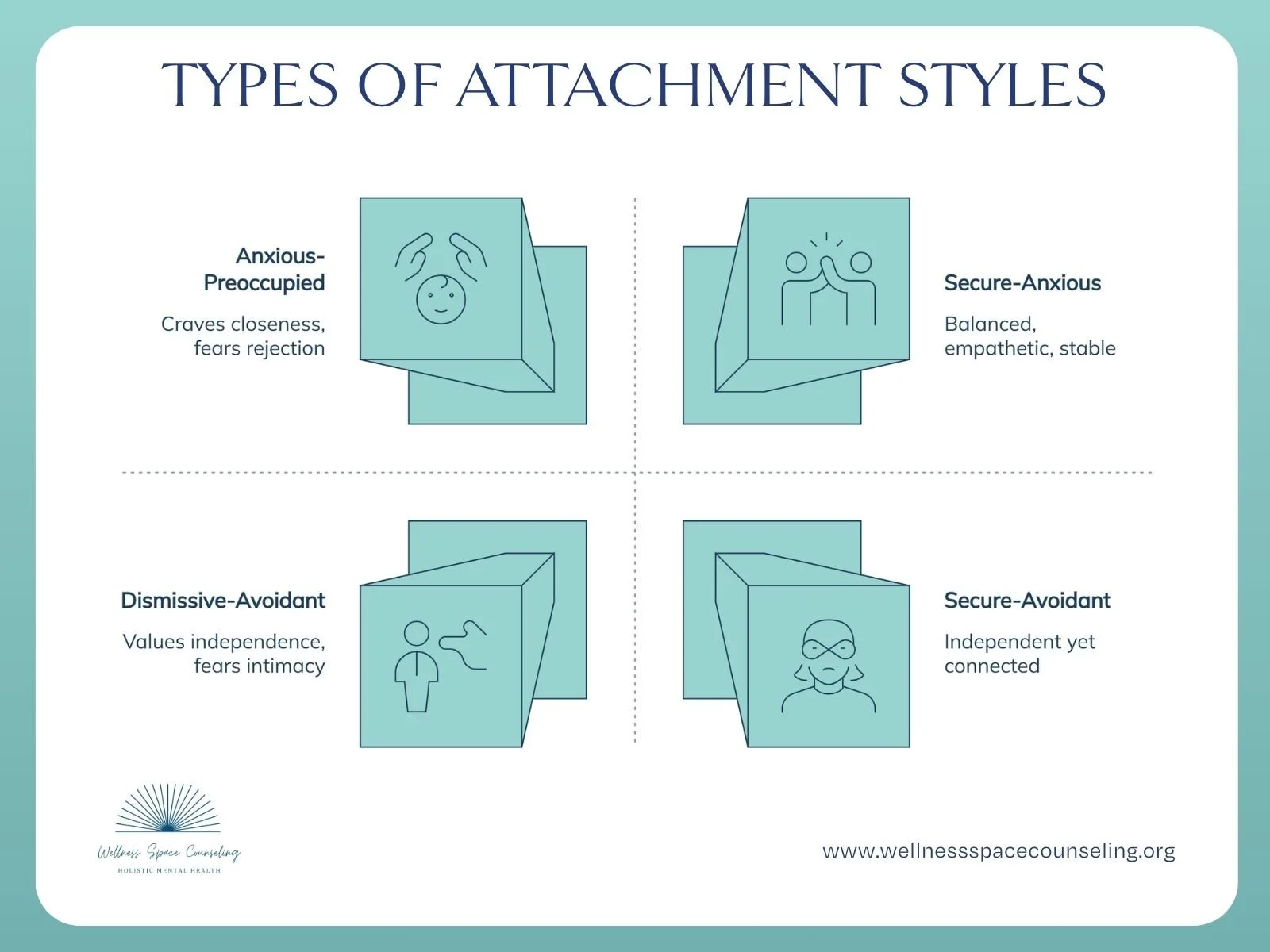
For example, some people tend to feel more secure with closeness, while others may lean toward anxious attachment, avoidant attachment, or a more conflicted pattern often connected todisorganized attachment style.
Research consistently shows that attachment-related anxiety and avoidance are two major dimensions shaping how people function in close relationships.
That does not mean attachment is destiny. It does mean your attachment style may influence:
How you react to distance or conflict
Why certainrelationship patterns keep repeating
So before we look at each of the attachment styles individually, it helps to know this: attachment is not about putting yourself in a box. It is about understanding the emotional patterns that shape how you connect, protect yourself, and respond to love.
Then, once that foundation is in place, each of the attachment styles starts to make a lot more sense.
Curious how your attachment style shows up in your relationships?
Download our free Attachment Style Quiz—a gentle self-reflection guide to help you understand your patterns and begin shifting them with more awareness and compassion.
Secure Attachment Style
Secure attachment is a healthy and positive emotional bond formed between a baby and their main caregiver, often their mother. This bond happens when the caregiver responds to the baby's needs, provides comfort, and creates a sense of safety and security.
People with a secure attachment style:
Feel safe, stable, and satisfied in their close relationships
Are good at understanding others' feelings, setting boundaries, and expressing their own feelings
Handle conflict well and findhealthy ways to manage relationship problems
Having a secure attachment style in relationships has many benefits. It helps people take responsibility for their mistakes and ask for help and support when needed. They feel comfortable being themselves in close relationships and can keep their emotions balanced. They also give and receive support and comfort, leading to more fulfilling and stable connections with others.
Anxious-Preoccupied Attachment Style
Anxious-preoccupied attachment, also known as anxious-ambivalent attachment, causes people to oftenfeel anxious and unsure, lacking self-esteem. They crave emotional closeness but worry that others don’t want to be with them.
People with an anxious-preoccupied attachment style:
Feel overly needy, constantly seeking love and attention
Feel worn down by fear andanxiety about whether their partner really loves them
Struggle to trust or fully rely on their partner
May become overly focused on the other person
See the space between them and their partner as a threat
Common challenges for people with anxious attachment style include feeling embarrassed about being too clingy, experiencing jealousy and anxiety when away from their partner, and using guilt or controlling behavior to keep their partner close.
They may also struggle to maintain close relationships, feel overly dependent on their partner, and have difficulty healthily handling conflict.
How do attachment styles and relationships connect?
Attachment styles and relationships are closely connected because attachment can shape trust, closeness, conflict, and emotional safety.
Dismissive-Avoidant Attachment Style
Dismissive-avoidant attachment is another type of insecure attachment style where people often avoid emotional closeness andintimacy in relationships. They strongly desire independence and do not like to rely on others or have others rely on them for emotional support.
Characteristics of individuals with a dismissive-avoidant attachment style include:
A preference for being alone
Downplaying the importance of relationships
Reluctance to show emotions or vulnerability
Having trouble forming deep emotional connections with others
In relationships, people with an avoidant attachment style may show emotional distance, hesitate to discuss personal feelings, and minimize the importance of their partner's emotions.
They might struggle with trust and have difficultyshowing empathy or understanding their partner's needs. This can lead tocommunication issues, difficulty resolving conflicts, and a habit of pushing their partners away when they feel too emotionally close.
Which attachment style is the hardest to love?
No one attachment style is simply “the hardest to love.” The influence of attachment styles can make connection feel more complicated, but people of all styles can build healthy relationships.
Fearful-Avoidant Attachment Style
Fearful-avoidant attachment, also known asdisorganized attachment, is an insecure attachment style that comes from intense fear, often due to childhood trauma, neglect, or abuse.
People with this attachment style often feel they don’t deserve love or closeness in a relationship. They struggle with wanting emotional intimacy but also fearing it, leading to confusing and unpredictable behavior in their relationships.
Characteristics of people with a fearful-avoidant attachment style include:
Having trouble calming themselves down
Finding relationships and the world around them scary and unsafe
Repeating abusive patterns of behavior if they were abused as children
Swinging between loving and hating a partner
Showing insensitivity, selfishness, and controlling behavior
Engaging in explosive or abusive actions
They may also struggle with addiction, aggression, or violence, and find it hard to take responsibility for their actions.
Forming relationships with people who have a fearful-avoidant attachment style can be very challenging. They often struggle to trust and connect with others, making it hard to maintain healthy and stable relationships.
Their unpredictable behavior can make it difficult for their partners to understand and meet their emotional needs, leading to conflict and instability. Their fear of intimacy and deep insecurities can make it hard for them to open up and form a secure emotional bond with a partner.
Those with a fearful-avoidant attachment style may need special support and therapy to address their deep fears and insecurities and to learn healthyways of forming and maintaining close relationships.

Can Attachment Styles Be Changed?
Yes, attachment styles can change.
Even though early experiences matter, your attachment style as an adult is not fixed forever. The science of adult attachment suggests that the patterns we learn in early relationships can continue into adult relationships, but they can also shift through new experiences, healthier connections, andintentional work. In other words, attachment may shape you, but it does not have to define you.
Over time, people can begin forming a secure attachment by noticing their usual patterns of attachment, understanding what those patterns are protecting, and practicing new ways of relating. This can happen in therapy, in supportive relationships, and through experiences that make closeness feel safer and more consistent.
Some of the ways attachment styles may change include:
Building more awareness of your attachment behavior in relationships
Understanding how attachment styles influence trust, closeness, and conflict
Noticing the differences in attachment between you and your partner
Working through relationships due to fear, distance, or emotional shutdown
Creating new experiences of safety in adult romantic attachment
Moving toward the steadiness that a secure attachment style may offer
For example, people with anxious attachment may learn to feel less consumed by fear of disconnection, while people with avoidant attachment may begin to feel safer staying emotionally present. A disorganized attachment style may also soften over time as relationships become more stable and supportive.
So while attachment styles tend to shape how we connect, they are not permanent. With insight, support, and practice, the attachment process can move in a healthier direction.
Are attachment styles fixed in adulthood?
No. While adult attachment theory shows that attachment patterns can be lasting, they can also shift with new experiences, healthier relationships, and therapy.
Curious About Your Attachment Style? Let’s Take a Closer Look
We often find that learning about attachment helps people see their relationship patterns in a new light. A secure attachment style can make it easier to feel safe, steady, and connected in a relationship. Insecure attachment styles, on the other hand, can make closeness feel more complicated. For some people, that may look like fear of abandonment or clinginess. For others, it may look like emotional distance or difficulty letting someone in.
This is why understanding your attachment style can be so meaningful. It can help explain why certain relationship struggles keep showing up, and why love may sometimes feel harder than you want it to.
At the same time, we think it is important to remember that attachment is not shaped by just one thing. These patterns can be influenced by experiences in childhood, adolescence, and adulthood, not only by how loved or cared for you felt growing up.
If you are beginning to recognize yourself in any of these patterns, you do not have to sort through them on your own. Individual therapy can offer space to better understand your attachment style and how it affects your relationships. Couples counseling can also help if these patterns are showing up between you and your partner. If you are ready to explore this more deeply, we invite you to reach out and schedule a consultation.