
What to Expect in Couples Therapy: The First Steps Toward Repair
You've been thinking about it. Maybe for a while. And one of the things holding you back is simply not knowing what to expect in couples therapy. Will it feel awkward? Will the therapist take sides? Do you have to have everything figured out before you walk in?
You don't. And you're not alone in that.
At Wellness Space Counseling, we work with couples at every stage. Most wait an average of six years before seeking help, and that delay almost always comes down to fear of the unknown.
So here's what we'll cover:
Why many couples seek therapy and what brings them in
What happens in your first couples therapy session
What the couples therapy process looks like over time
How to find the right couples therapist for you
Common questions about what to expect from couples counseling
Let's walk through it together.
Why Couples Seek Therapy and What Happens in Couples Therapy
There's no single reason couples seek counseling. The range of things couples experience that leads them to seek help is wide. Some come in after a major rupture, infidelity, a big life transition, or a fight that went too far. Others come because they feel like roommates, or because the same argument keeps cycling on repeat. And some couples come not because anything is "wrong," but because they want to build something stronger before problems take root.
Some of the most common reasons couples come to us include:
Communication issues — feeling unheard, misunderstood, or like conversations always end in conflict
Recovering from infidelity or a breach of trust
Navigating a major life change like a new baby, a move, or career stress
Emotional distance or loss of intimacy
Differences in parenting, finances, or values
Wanting to strengthen the relationship proactively before issues escalate
Whatever brings you in, know this: seeking therapy is a sign of strength, not failure. The couples we work with who experience the greatest success in couples therapy are the ones who show up willing to try, even when they're not sure it will work.
What Happens in Your First Couples Therapy Session
Understanding what happens in couples therapy before you arrive can make a real difference. Here is what you can realistically expect.
Your first session is really an intake session. Think of it less as diving into the deep end and more as getting your bearings together. The primary goal is for your therapist to understand who you are as a couple, your history, your strengths, what's brought you in, and where you'd like to go.
Your Therapist Will Ask Questions to Understand Your Story
A good couples therapist won't come in with a fixed agenda. Instead, they'll ask open questions and really listen. Some things your therapist may ask in the initial session include:
How long have you been together, and what does your relationship history look like?
What's bringing you to therapy right now — was there a specific moment, or has this been building?
What does each of you hope to get out of couples therapy?
What does communication look like between you — what works, what doesn't?
Have either of you been in individual therapy before?
These partner questions aren't meant to put you on the spot. They're how your therapist starts to understand your dynamic and what kind of support will actually be useful.
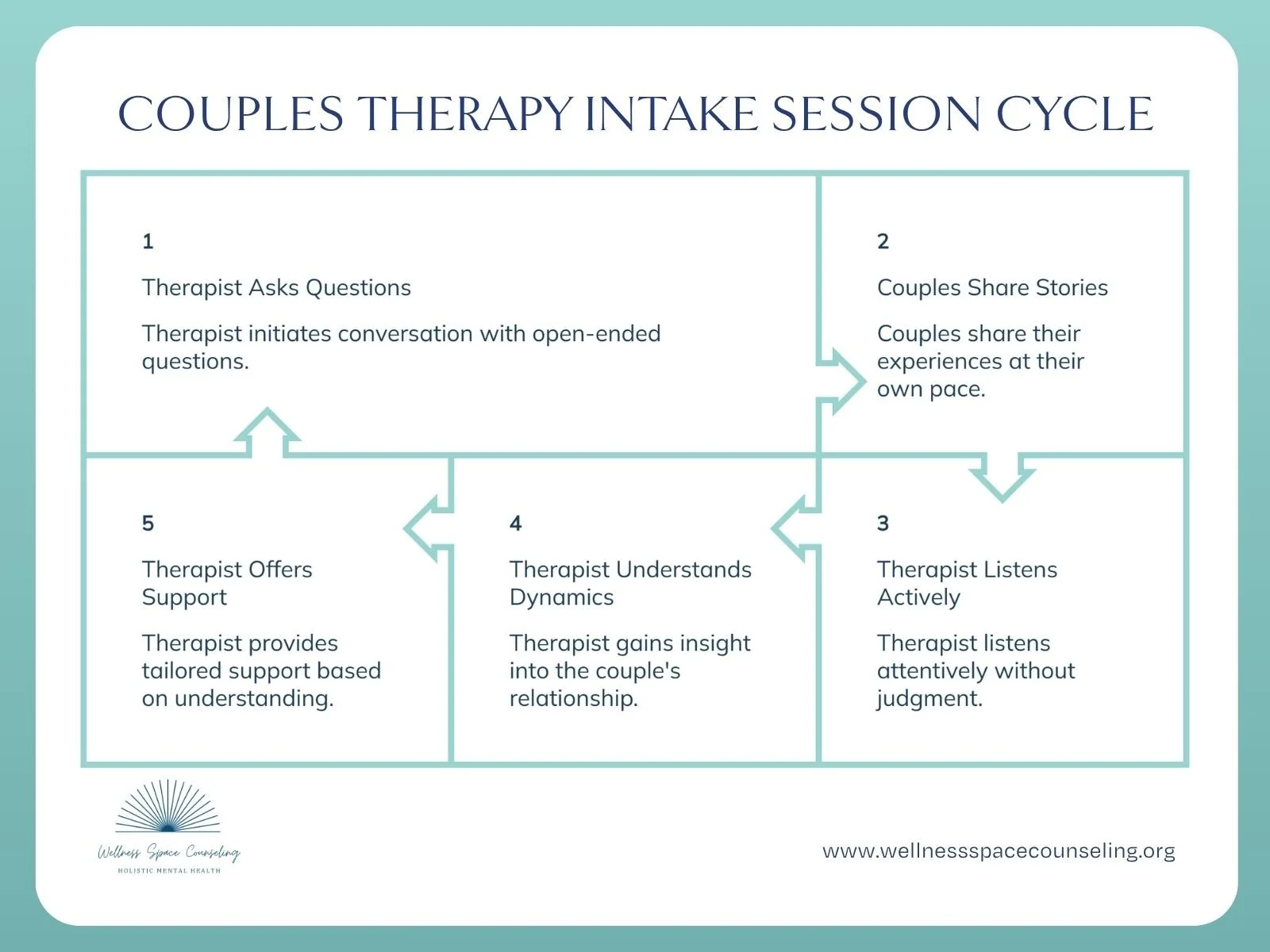
You'll Share Your Story at Your Own Pace
You won't be expected to unpack everything in session one. A skilled couples counselor knows that trust takes time, and they'll follow your lead. Some couples arrive ready to talk openly; others are more guarded. Both are completely fine.
What's important is that both of you feel heard, not judged, not compared, and not pressured to take a particular position. Your therapist is not there to declare a winner. They're there to help you understand each other better and find a way forward together.
Your Therapist Will Start to Build a Treatment Plan
By the end of the first few sessions, your therapist will have a clearer sense of your relationship patterns, your communication styles, and the underlying dynamics at play. From there, they'll work with you to develop a treatment plan — a shared direction for your work together.
This plan is collaborative. You'll know what you're working toward, and you'll have input in shaping it.
How long does a couples therapy session last?
Most couples therapy sessions run 50 to 60 minutes, though some therapists offer extended sessions, particularly early in the process or during intensive work.
What the Couples Therapy Process Really Looks Like
Couples or relationship therapy is not a one-size-fits-all process. Different therapists use different approaches, and a good therapist will adapt their approach when working with couples based on what you actually need.
The Gottman Method
One of the most research-backed approaches to couples therapy is the Gottman Method, which our team is trained in. Developed by Drs. John and Julie Gottman, after decades of research, this approach focuses on building friendship, managing conflict constructively, and creating shared meaning as a couple.
In Gottman-informed sessions, your therapist may use specific tools and conversations to help you identify patterns — like criticism, contempt, defensiveness, and stonewalling — that research shows predict relationship breakdown. The goal isn't to shame anyone but to give you both a shared language and practical communication skills you can actually use outside the therapy room.

Emotionally-Focused Therapy (EFT)
Another approach we use is Emotionally-Focused Therapy, or EFT. This type of therapy helps couples identify the emotional patterns underneath their conflicts — the fear, hurt, or longing that often drives the arguments on the surface. Rather than just teaching communication techniques, EFT helps couples understand what each person's deeper needs are and respond to each other from that place.
Research consistently shows EFT to be one of the most effective approaches to couples therapy, with studies showing significant improvement in relationship satisfaction for 70-73% of couples who complete treatment.
How often will we meet for couples therapy?
Weekly sessions are the most common cadence, especially in the early stages. As the work progresses and you build new skills, some couples shift to bi-weekly. Your therapist will work with you on a schedule that makes sense for your goals and your life.
Every Approach Helps Couples Build the Same Core Things
Regardless of the specific type of therapy your therapist uses, successful therapy typically helps couples develop:
Better communication skills — both expressing and listening
A deeper understanding of each other's needs and emotional triggers
Tools for navigating conflict without damaging the relationship
Renewed connection, intimacy, and shared purpose
Starting Couples Therapy: What the First Few Sessions Look Like
The first couples therapy session is just one piece of the puzzle. Here's a rough sense of how the early phase of therapy often unfolds.
Session 1: The Intake and Getting to Know You
As we covered above, this is about introductions, context, and establishing trust. Your therapist will ask questions, listen carefully, and begin to understand your relationship. You don't need to have all the answers. Coming in with openness is enough.
Sessions 2 to 3: Going Deeper and Setting Direction
Many therapists like to meet with each partner individually in the early sessions of couples therapy, sometimes in separate appointments. This gives each person a space to share things they might find hard to say in front of their partner, and helps the therapist understand both perspectives fully.
By the end of these sessions, you'll usually have a clearer treatment plan and a shared sense of what you're working toward together.
Ongoing Sessions: The Real Work
This is where the deeper work happens. You'll start practicing new ways of communicating, explore the patterns that keep you stuck, and slowly build new ways of relating. It's not always comfortable — real change rarely is — but most couples find that even difficult sessions leave them feeling more connected than before.
Couples therapy requires both partners to participate actively. It's not something that's done to you; it's something you do together. The success of couples therapy depends significantly on both people's willingness to show up honestly and be open to change. Couples therapy works best when both partners are committed to the process, even during the hard stretches.
What Couples Counseling Looks Like at Wellness Space Counseling
At Wellness Space Counseling, our couples therapists specialize in working with couples across a wide range of relationship issues. We're licensed marriage and family therapists with training in evidence-based approaches, including the Gottman Method and Emotionally-Focused Therapy, and we work with couples both in-person at our Columbia, MD office and virtually across Maryland, DC, Virginia, and Florida.
Whether you're coming to us in the middle of a crisis or simply feeling like your relationship could use a tune-up, we meet you where you are. We believe every couple deserves a space that feels safe, non-judgmental, and genuinely supportive because that's the foundation that makes real growth possible.
How many sessions of couples therapy will we need?
There's no fixed number. Some couples make significant progress in 8 to 12 sessions; others work together for longer, particularly if they're navigating complex issues like infidelity or deep-rooted patterns. The important thing is that you're moving forward, not just marking time.
We Also Work with Individuals on Relationship Issues
Sometimes one partner isn't ready or willing to come to therapy, and that's okay. Individual therapy can also be a powerful way to work on relationship patterns, whether you're hoping to improve your current relationship, healing from a past one, or trying to understand your own role in recurring dynamics.
If you've been wondering whether to seek out couples therapy but your partner isn't on board yet, starting individually is a completely valid path. Many people find that their own growth eventually opens the door for couples to work down the line.
How to Find the Right Therapist for You
Finding a couples therapist who feels like a good fit matters more than most people realize. Research consistently shows that the relationship with the therapist is one of the strongest predictors of success in therapy, often more so than the specific techniques they use.
What to Look for When You Find a Couples Therapist
Specific training in couples work. Not all therapists are equally equipped to work with couples. Look for someone who is a licensed marriage and family therapist (LMFT) or who has completed specific training in couples therapy approaches like Gottman or EFT.
Someone both partners feel comfortable with. It's important to find a therapist both of you can connect with. If one person feels the therapist is siding against them, it's hard to do meaningful work.
Transparency about their approach to therapy. A good therapist will be happy to explain how they work and what you can expect from couples therapy with them specifically.
Practical accessibility. Consider things like session availability, whether they offer virtual appointments, and whether they accept your insurance.
It's Okay If the First Therapist Isn't the Right Fit
Therapy is a relationship, and like any relationship, sometimes it takes a couple of tries to find the right match. If after a few sessions something feels off — the dynamic isn't working, or you don't feel genuinely understood — it's completely appropriate to say so or to try someone else. Finding the right therapist is worth the effort.
Ready to Take the First Step?
If you've been considering couples therapy, we hope this gives you a clearer picture of what to expect and what the process can look like. The most important thing to know is that coming to therapy is a brave, meaningful step, and you don't have to have it all figured out before you start.
We'd love to be part of your journey. Reach out today!
