
Autism Parenting Resources Every Parent Should Know About
If you found this page at eleven at night with your phone brightness turned all the way down so you don't wake anyone, I want you to know something first. You're not behind. You're not failing your kid by still figuring this out. Autism parenting resources exist for exactly this moment, the one where you don't know what you don't know yet. The World Health Organization estimates that autism affects roughly 1 in 127 people worldwide, which means somewhere out there, plenty of other parents are up at eleven at night too, scrolling for the exact same thing you are.
This guide is organized a little differently than most. Instead of dumping every link in one long list, we'll walk through it by stage, because what actually helps you changes as your kid grows. And we won't skip over you. Caregiver wellbeing gets just as much space here as anything aimed at your child. Here's what's ahead:
Where to start if the overwhelm feels like too much right now
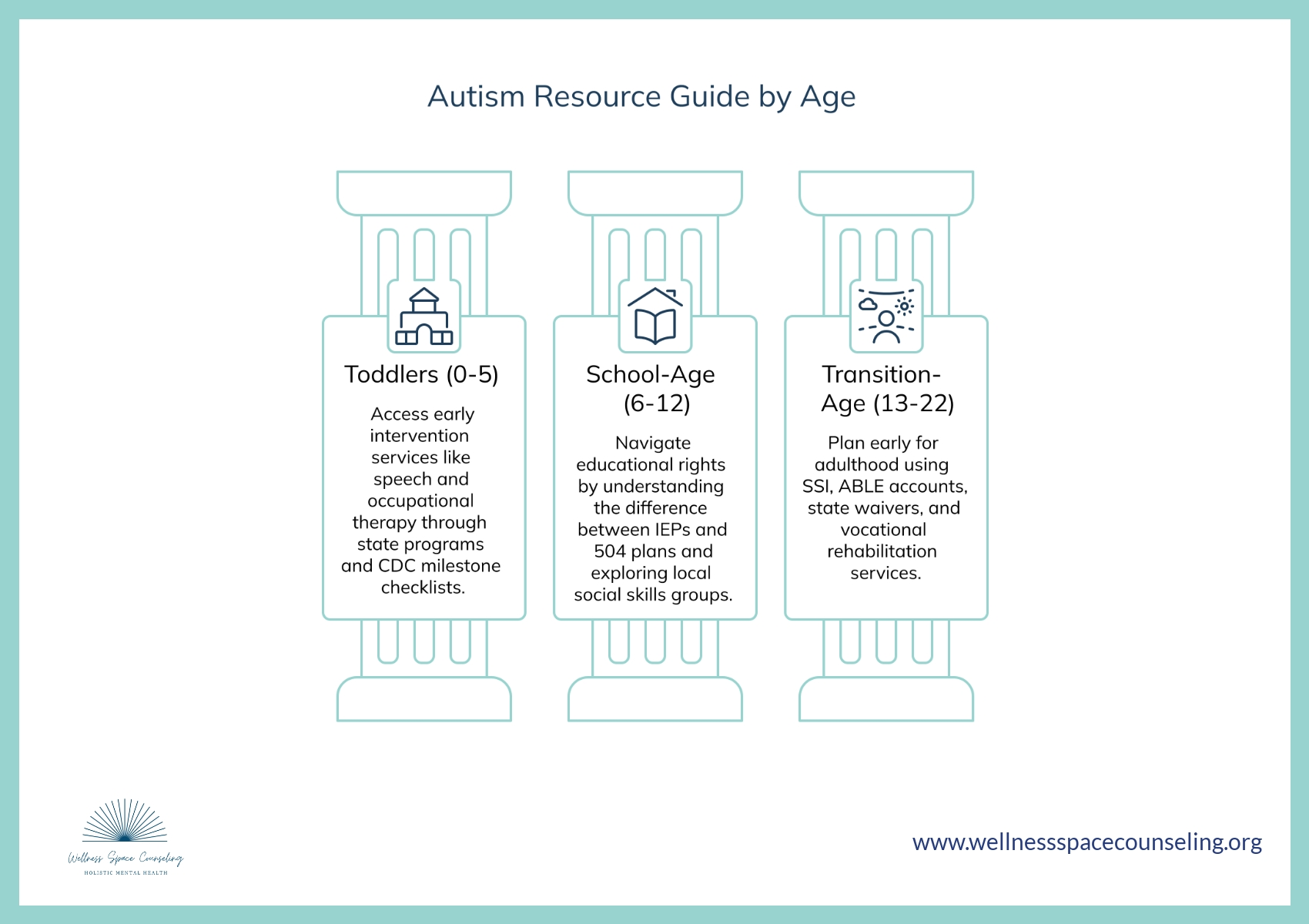
Toddler and early childhood resources (ages 0 to 5), including early intervention and free milestone tools
School-age resources (ages 6 to 12), including IEP basics and the difference between an IEP and a 504 plan
Teen and transition-to-adulthood planning (ages 13 to 22), including SSI, ABLE accounts, and waiver waitlists
How to tell whether a resource is actually evidence-based, plus the national organizations worth knowing
Books, podcasts, and local Maryland resources
Support for you, not just your child
Let's start with the part most guides skip entirely: you.
You're Not Behind, You're Just Getting Started
A note for parents with autistic kids, wherever you are in this: the overwhelm you're feeling right now is not a sign you're doing this wrong. It's a sign you love your kid, and you're trying to get it right. As one of my clients said, "sometimes success is keeping the boat afloat for that day only."
A lot of parents I coach tell me they feel like they should already know what to do. Here's the truth. Nobody hands you a manual. Finding the right resources is a process you build over months and years, not a test you pass or fail in week one. And the truth is, there is not a single manual to understand your child; you build that manual along with them.
I'll be honest with you about something personal, because I think it matters more than any resource list. My daughter has both ADHD and autism, and for a long time I was chasing a version of her that didn't exist. I had a predefined picture in my head of who she should be, and I was measuring her against it without realizing I was doing that.
Learning to actually see her and treasure who she actually is, instead of that picture, changed everything. It's what built the deep, connected relationship we have now. And honestly, she's made me a more grounded person. More empathetic. More resilient than I think I would have become any other way.
Training and Support for Parents of Autistic Children: Where to Begin
Here's something that surprises people: some of the most useful autism parenting classes and training aren't aimed at your child at all. They're aimed at you. Learning your own skills, your own regulation tools, and your own advocacy language changes your child's daily life just as much as any therapy hour does.
Not every resource is created equal, though. Some are free. Some cost real money. Some are backed by solid research. Some are just well-marketed. Through this guide, I'll flag which is which so you can spend your limited time and energy where it counts.
Autism Resources for Toddlers and Early Childhood (Ages 0 to 5)
If your child was just diagnosed and they're still small, you're probably in some mix of grief, relief, and total information overload. That's normal. Here's where to actually start.
Early Intervention Comes First
Under IDEA Part C, children from birth to age three can access early intervention services, often at no cost to your family. In Maryland, that's the Maryland Infants and Toddlers Program, a free, family-centered system that connects you with speech, occupational, and developmental therapy right in your home or daycare setting. If you're outside Maryland, every state runs an equivalent Part C program under a different name.
The CDC's Learn the Signs. Act Early. program is also worth bookmarking. It's completely free, offers milestone checklists by age, and gives you plain-language guidance on what to do if something feels off.
Understanding Your Treatment Options
You'll hear a lot of acronyms fast. ABA, or Applied Behavior Analysis, is one of the most widely covered by insurance, though it's also one of the more debated approaches within the autistic community, and I'll come back to that debate shortly. Naturalistic developmental behavioral interventions, or NDBIs, blend behavioral principles with play and your child's own interests rather than structured drills. DIR/Floortime is another play-based, developmental approach that we lean on heavily in our coaching work. It focuses on meeting your child at their developmental level through play rather than pushing them toward a neurotypical benchmark.
Speech and occupational therapy referrals often come through the same early intervention pathway, so it's worth asking your evaluator directly what's included.
What parenting style is best for autism?
A warm, structured style tends to work best. Keep routines consistent and expectations clear, and adapt to your child's sensory and communication needs.
School-Age Autism Resources for Parents (Ages 6 to 12)
Once your child hits school age, the landscape shifts from clinical services to educational rights, and that's a different kind of learning curve entirely.
Know the Difference Between an IEP and a 504 Plan
An IEP provides specialized instruction and services. A 504 plan provides accommodations only, without the specialized instruction piece. A lot of parents don't realize there's a difference until they're already in a meeting. If you want the full walkthrough, including sample goals and how to prepare for the actual meeting, I wrote a complete guide to IEPs for autism that covers this in detail.
In Maryland, the Maryland State Department of Education publishes IEP timelines and parent resources that spell out exactly what the school owes you and by when. DC and Virginia have their own equivalent guides through their departments of education.
Beyond the IEP Itself
Social skills groups, after-school programs built for neurodivergent kids, and understanding your child's specific learning profile all matter just as much as the paperwork. Ask your school's special education coordinator what's available locally, and don't be afraid to ask other autism parents in your area what's actually worked for their kids, not just what's on the district's official list.
Teen and Transition-Age Autism Resources (Ages 13 to 22)
This is, honestly, the stage where the resource map thins out the most. Parents tell me constantly that they felt well supported through elementary school and then hit a wall around middle school, right when things become more complicated rather than less. This can be an especially complicated time because now the world might be expecting your child to navigate the world as an adult when they still need supportive resources to navigate all the complexities of their lives.
Start Transition Planning Earlier Than You Think You Need To
A few things worth knowing well before your child turns 18:
Supplemental Security Income (SSI): Children under 18 can qualify for SSI based on disability, and eligibility rules shift at 18. The Social Security Administration's SSI eligibility page lays out exactly what changes.
ABLE accounts: These allow a person with a disability to save up to $100,000 without it counting against SSI resource limits. The ABLE National Resource Center explains eligibility and how to open one.
Maryland's Developmental Disabilities Administration (DDA) waiver: Waitlists in Maryland can run long, so the Autism Society of Maryland's resource page is a good place to understand the waiver landscape and get on a list well before you think you'll need it. Virginia and DC run comparable Medicaid waiver programs, and Florida families should look into the state's APD waiver.
Vocational rehabilitation and college disability services: Both exist specifically to support autistic young adults, and both usually require you to initiate contact rather than waiting for a referral.
One small, practical resource worth knowing about if your teen is learning to drive: many states offer Blue Envelope programs that help autistic drivers communicate with law enforcement during a traffic stop. It's a small thing that can prevent a genuinely frightening situation.
What are some tips for parenting a child with autism?
Keep routines predictable, use simple language and visual supports, praise specific behaviors, and build on your child's interests. Take care of your own well-being too.
Autistic Resources by Type: What's Actually Evidence-Based
One thing that frustrates me about a lot of autism content online is that it just links out to resources without ever explaining whether they're any good. So here's a simple framework.
Ask These Three Questions
Is it peer-reviewed or backed by an organization like ASHA, AAP, or a credentialed research body?
Does it use neurodiversity-affirming language, treating your child's autism as an identity to understand rather than a set of behaviors to eliminate?
Is it transparent about cost and about what's actually covered by insurance versus what's out of pocket?
ABA remains the most heavily insurance-covered treatment option, but it's also the one with the most active internal debate, particularly from autistic adults who experienced older, more rigid versions of it. Speech therapy and occupational therapy are broadly evidence-based and typically insurance-covered. DIR/Floortime and other play-based, relationship-driven approaches have a growing evidence base, including a randomized controlled trial published in PMC pointing to real gains in social-emotional development. If you want to see how we build that into coaching for parents, that's the exact approach we lean on.
My advice here is that any practice on solid footing should be able to:
Fully explain and show you the practices and strategies they will be employing with your child, have solid goals, and set times when you can speak with them about progress.
Allow you to be in the space, especially in the beginning, to bear witness to how these strategies are being employed, maybe not all the time, but you want to see what your child is experiencing.
Talk to your child (when possible) about how they are experiencing treatment. Ultimately, you want them to feel valued and respected in any treatment plan.
National Autism Organizations Worth Knowing
A quick, honest rundown:
Autism Speaks: The largest and most visible national autism organization, offering a comprehensive parent toolkit and a large resource directory. It's also worth knowing that some autistic self-advocates have criticized Autism Speaks over the years for its framing and representation, so you may want to consider those perspectives as you form your own view.
Autism Society of America: A national organization focused on local chapter support, resource directories, and community connection, often a good bridge to your specific region.
CDC: The most reliable source for prevalence data, developmental milestones, and free public health tools.
Organization for Autism Research (OAR): OAR focuses exclusively on applied research, meaning studies that translate directly into practical, day-to-day guidance for families, teachers, and autistic individuals themselves.
Autistic Self Advocacy Network (ASAN): ASAN is run by and for autistic people. If you want to understand your child's experience from the inside, autistic-led organizations like this one are an essential complement to anything written from a purely clinical or parent perspective.
Local and State-Specific Autism Resources in Maryland, DC, and Virginia
National organizations matter, but local support groups are often where parents find their people. In the Columbia and Howard County area specifically, connecting with other local families changes the day-to-day experience of this whole journey. If you're not sure where to start locally, your state's Parent Training and Information Center or your local chapter of the Autism Society is usually the fastest way to connect families in your specific school district or county, since state-specific programs vary enough that a national search often won't surface what's actually available where you live.
Books and Podcasts Every Autism Parent Should Have on Their List
A few that come up again and again in conversations with the parents I work with:
"NeuroTribes" by Steve Silberman: A deep, well-researched look at the history of autism understanding. Dense, but genuinely worth the time.
"Uniquely Human" by Barry Prizant: A more strengths-based, compassionate read that reframes autistic behaviors as meaningful rather than problems to fix.
"The Explosive Child" by Ross Greene: Not autism-specific, but enormously useful for understanding meltdowns as a skills gap rather than defiance.
Podcasts: Look for shows hosted by autistic adults themselves, not just clinicians talking about autism. Hearing directly from autistic voices changes how you understand your own kid.
What financial assistance programs are available for families raising children with autism?
Options include Medicaid waivers, SSI, CHIP, Early Intervention and school services under IDEA, ABLE accounts, and nonprofit grants. Many states also require private insurance to cover autism therapies.
Support for Parents with Autism: Caregiver Mental Health and Burnout Prevention
I want to say this as plainly as I can. If you're an ASD parent reading this at the end of a hard day, the exhaustion is real, and it deserves attention on its own, not just as a side effect of your child's needs.
A large cohort study comparing autism caregivers to non-autism caregivers found that autism caregivers reported significantly higher rates of stress, along with notably higher rates of anxiety and depressive disorders, even after adjusting for age, sex, and income. This isn't a personal failing. It's a documented pattern.
Getting support for yourself isn't selfish. It's part of caring for a child well over the long haul. That can look like:
Respite care, even a few hours a week, to give your nervous system a chance to reset
Parent support groups, whether local, virtual, or through an online community built specifically for autism parents
Individual therapy for the anxiety, grief, or burnout that tends to show up quietly and build over years
Mindfulness or self-compassion practices, which sound small but can genuinely change your baseline stress level
I mentioned earlier what my daughter has taught me. This is the other half of that same truth. Getting my own support wasn't a detour from being a good parent to her. It's what actually made me capable of being present with her, instead of running on fumes and reacting instead of responding.
Resources for the Whole Family
Autism parenting resources tend to focus almost entirely on mothers, which leaves a lot of people out. Fathers and other male caregivers often feel like there's no content written for them specifically. Grandparents frequently want to help but don't know how to talk about autism with the rest of the family without stepping on toes. And siblings need their own support too, since growing up alongside a neurodivergent brother or sister comes with its own complicated feelings.
If tension is showing up between partners around parenting approaches or division of labor, that's common, and it's not a sign your relationship is failing. Whole-family support through family therapy or, for couples specifically navigating one or both partners' own neurodivergence alongside their child's, neurodiverse couples therapy can give everyone in the house somewhere to land, not just the parent doing most of the day-to-day advocacy.
You Don't Have to Do This With Just a Resource List. Let's Talk.
Everything in this guide is meant to help you find your footing. But a resource list, even a good one, can only take you so far. At some point, most parents want something more individualized than a directory.
Two ways we support families in exactly that spot:
Autism Parenting Coaching, built around your specific child's sensory needs, communication style, and school advocacy, not a generic curriculum.
Individual Therapy for you, if the weight of this journey is starting to show up as your own anxiety, grief, or burnout.
If your family is holding more than one neurodivergent profile under one roof, our ADHD Parent Coaching program pairs naturally with the autism-specific work, and our child therapy team is here if your child could use their own dedicated space to process big feelings.
If you'd like more individualized support than any list of links can offer, whether that means working through your child's specific needs or having a place to process this whole journey, I offer a free consultation to see if coaching is the right fit for your family. Reach out, and let's talk it through together.
Virtual sessions are available across Maryland, DC, Virginia, and Florida, so distance from Columbia doesn't have to be a barrier.
