
What to Expect in a Ketamine Therapy Session: Preparation, the Experience, and Integration
If you’re preparing for your first ketamine therapy session, you may be feeling hopeful while also wondering what to expect. Those feelings are common. Starting a new treatment for your mental health is a meaningful decision, and understanding the process beforehand can make the experience feel less intimidating.
Here's what this guide covers:
Common myths about ketamine therapy, and what's actually true
How to prepare for your first session, including setting an intention
What happens during the session, and how IV, oral, and nasal ketamine differ
What a difficult moment looks like and how your care team manages it
How KAP differs from a standalone infusion
What integration therapy involves
A realistic timeline for feeling better
Questions worth asking before you book
Let's Clear Up a Few Myths First
Most of what people have heard about ketamine comes from headlines, not clinical experience, so let's address a few things directly.
Isn't ketamine just a party drug?
Ketamine has a street history, and we understand why that raises an eyebrow. The ketamine used in a licensed clinic is given in a controlled, measured dose and in a supervised medical setting for a specific therapeutic purpose. This is not the same context or quantity associated with recreational use.

Will I be completely out of it?
Most patients stay conscious and aware throughout treatment. You might feel a sense of lightness, a dreamlike quality to your thoughts, or a floaty, introspective state, but you're never unconscious and never left alone.
Isn't KAP just an infusion with extra steps?
Not quite. We break this down further below because the difference actually matters for your outcomes.
Ketamine Therapy Preparation: Getting Ready for Your First Session
Preparation isn't just paperwork. It's part of the therapeutic process. Before your first ketamine session, your therapist spends time with you talking through your history, your treatment goals, and what you hope to work through.
A few practical things to know prior to treatment:
Avoid a heavy meal for a few hours beforehand
Wear something comfortable since you'll likely be reclined
Arrange a ride home, since driving isn't safe for hours afterward
Setting an Intention Before Your Session
One part of preparation that surprises many first-time patients is intention setting. This isn't about scripting the experience. It's closer to picking a compass point: a feeling or question you hold loosely in mind, such as "I want to understand why I shut down during conflict," or as open as "I want to feel less numb." Patients who set an intention, even a simple one, tend to find it easier to connect the session to their broader treatment plan afterward.
What does ketamine therapy feel like?
Most patients describe a floaty, dreamlike state with a softened sense of time. Some feel introspective and calm, others notice more intense shifts in perception. Dissociation is common and expected at therapeutic doses, and it typically resolves within an hour or two.
Your Ketamine Therapy First Session: What Actually Happens
Here's what many people want to know most: what does ketamine therapy actually feel like? The honest answer is that it's different for everyone, but there are common threads. Many describe a sense of floating, a softened sense of time, and an easier ability to view painful thoughts from a bit of distance instead of being flooded by them. The effects of ketamine typically begin within minutes and peak in the first 15 to 30 minutes.
Throughout the session, your provider stays present and monitors how you're doing so you feel safe the entire time. You do not navigate the experience alone.
KAP Healing vs. KAP Experiential: Two Different Ways a Session Can Feel
Not every KAP session looks the same, even at the same practice. We offer two dosing approaches, and your therapist helps you choose the one that fits your goals or move between them over time.
KAP Healing uses a lower, psycholytic dose. You stay present and conversational, so you and your therapist can do active work together, like EMDR, IFS, somatic work, or mindfulness, right in the moment.
KAP Experiential uses a higher, more psychedelic dose. Dosing and integration happen in separate sessions. You'll typically use an eye mask and headphones, and the experience is more internal and immersive, closer to a dreamlike journey inward.
Neither one is "better." It depends on what you're working through and how you tend to process things, which is exactly what your intake conversation is for.
IV, Oral, and Nasal Ketamine: How the Experience Differs
IV ketamine is delivered through a drip over roughly 40 minutes to an hour, offering precise dose control. This is the standard approach in standalone infusion clinics.
Intranasal ketamine is self-administered under supervision, with a somewhat slower onset than IV ketamine.
Oral ketamine (lozenges) dissolves under the tongue over several minutes. Onset is more gradual, which many patients find easier to settle into, and it requires no IV line.
At Wellness Space Counseling, we use oral ketamine lozenges rather than IV infusion. We've found that patients tend to feel more grounded with a slower onset, and every session happens in the same comfortable therapy room with your therapist, not a medical infusion suite.
How long does a ketamine infusion last?
An IV infusion typically lasts 40 minutes to an hour, plus monitoring afterward. Oral lozenges dissolve over roughly 15 to 20 minutes, with effects lasting about an hour to an hour and a half. Most appointments run at least 90 minutes once you include preparation and monitoring.
What a Hard Moment Looks Like (and How We Handle It)
Not every session feels light, and we don't think it's honest to pretend otherwise. Some patients hit a wave of grief, fear, or intense emotion partway through. Some feel physically strange or unsteady. This is exactly why clinical oversight matters.
The American Psychiatric Association's consensus statement on ketamine use calls for in-person monitoring for any reaction that becomes distressing rather than therapeutic. In practice, your therapist recognizes when a hard moment is part of meaningful processing and when it needs calm redirection through verbal reassurance, breathing guidance, or switching gears. You're never pushed through something that feels unsafe.
KAP Session Process: How Ketamine-Assisted Psychotherapy Differs From a Standalone Infusion
This distinction matters because a lot of marketing blurs it. A standalone infusion clinic administers the medication, monitors your vitals, and sends you home, often with no therapist in the room and no plan for what to do with whatever surfaced.
KAP is built differently. Every session sits inside a three-part structure: preparation, the dosing experience, and integration, all guided by the same licensed therapist who knows your history.
We work with Journey Clinical as our prescribing partner, so medical decisions stay with a qualified prescriber while the therapeutic relationship stays with your dedicated therapist. That collaborative model is linked to strong outcomes: Journey Clinical reports that 87% of patients see improvement in depression and anxiety symptoms over a full course of treatment.
Put simply, the medication is the beginning of the work, not the whole treatment.
Ketamine Integration Therapy: The Work That Happens After
The dosing session is only part of the picture. Ketamine integration therapy is the follow-up work that helps translate whatever surfaced during your session into something you can actually use in daily life.
Integration usually happens within a few days of dosing, while the material is still fresh. Depending on what came up, your therapist might draw on talk therapy, EMDR, IFS, somatic work, or mindfulness to help you process and apply the experience. If you already work with your therapist through EMDR or IFS therapy, that work often folds naturally into integration.
Skipping integration is one of the most common reasons patients feel that ketamine ‘didn't work’ for them. The medication may open a window. Integration is what helps you build something through it, alongside the rest of your individual therapy plan.
Before and After Ketamine Therapy: A Realistic Timeline
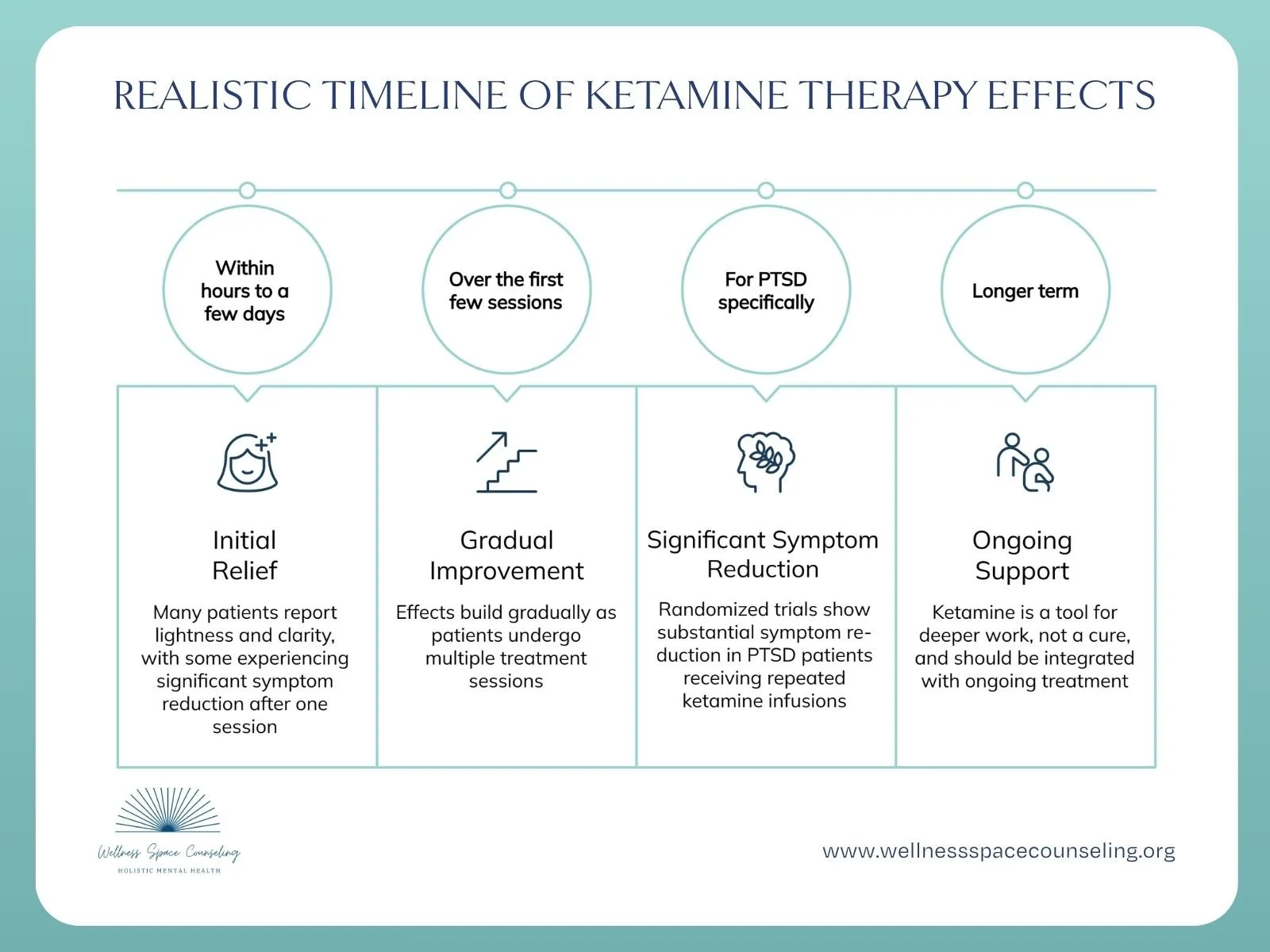
Within hours to a few days: Many patients report a sense of lightness or clarity soon after treatment, even after one session. Clinical trials on treatment-resistant depression have found response rates in the 50–70% range in some studies after a single low-dose session, with some noticing relief within a couple of hours.
Over the first few sessions: Most treatment plans call for a series, not just one. Many patients report that the effect builds gradually rather than arriving all at once.
For PTSD specifically: A randomized trial out of Mount Sinai found that 67% of patients receiving repeated ketamine infusions had a 30% or greater reduction in symptoms, compared to 20% in the placebo group.
Longer term: Ketamine isn't a cure and isn't meant to replace your ongoing treatment plan. It's a tool that, paired with integration, can open the door to deeper work on conditions like depression, anxiety, PTSD, and even chronic pain.
You may feel tired or a little groggy for the rest of the day after a session. That's normal and usually resolves by morning.
Can I drive myself home after a ketamine session?
No. Ketamine affects coordination, reaction time, and judgment. You'll need someone to drive you home, and you shouldn't operate machinery for the rest of the day.
Questions Worth Asking Before You Book
A good provider welcomes these questions:
Will a licensed therapist be present during dosing appointments?
What route of administration do you use, and why?
How do you screen for conditions where ketamine isn't appropriate?
What happens if I have a difficult reaction during a session?
How many sessions does a typical treatment plan involve?
What does integration actually look like between sessions?
You should have the opportunity to ask questions like these before your first appointment, not just on the day of treatment.
We Stay With You From the First Dose to the Last Integration Session
We built our ketamine-assisted psychotherapy program around one idea: the medication is the beginning, not the treatment. Every KAP session we offer includes a licensed therapist who knows your story, oral ketamine lozenges instead of an IV line, and a preparation and integration plan built around you rather than around a generic protocol.
We work alongside Journey Clinical for prescribing and medical oversight, so the clinical and therapeutic sides of your care stay connected instead of happening in separate appointments.
Whether you're dealing with treatment-resistant depression, PTSD, or anxiety that hasn't responded to traditional treatments, our team is here to talk honestly about whether KAP fits your treatment goals, without overpromising what any single session can do.
Ready to Talk Through Whether KAP Is Right for You?
Reach out to learn more about ketamine-assisted psychotherapy, and let's figure out together whether this form of treatment fits where you are right now. You don't have to have it all figured out before you call. We'll help you sort through the rest.
