IEP for Autism: A Parent's Complete Guide to Understanding and Advocating for Your Child
Long before I ever became a therapist, I was the parent sitting at that table with sweaty hands and no clinical training to fall back on, just love and a lot of nerves. I've since sat on the other side of that table too, as the clinician in the room, and both seats taught me the same thing: parenting well through this process depends almost entirely on how supported you feel outside of it.
If you're staring down an IEP for autism for the first time, or you're back at the table again this year, that feeling makes sense. You're not doing it wrong. About 1 in 31 children in the U.S. are now identified with autism spectrum disorder, according to the CDC's latest surveillance data, and a huge number of families are learning this system at the exact same time you are.
Here's what we'll get through together:
What an IEP actually is and who qualifies
The six things every autism IEP has to include
What good IEP goals for autism look like, with real examples
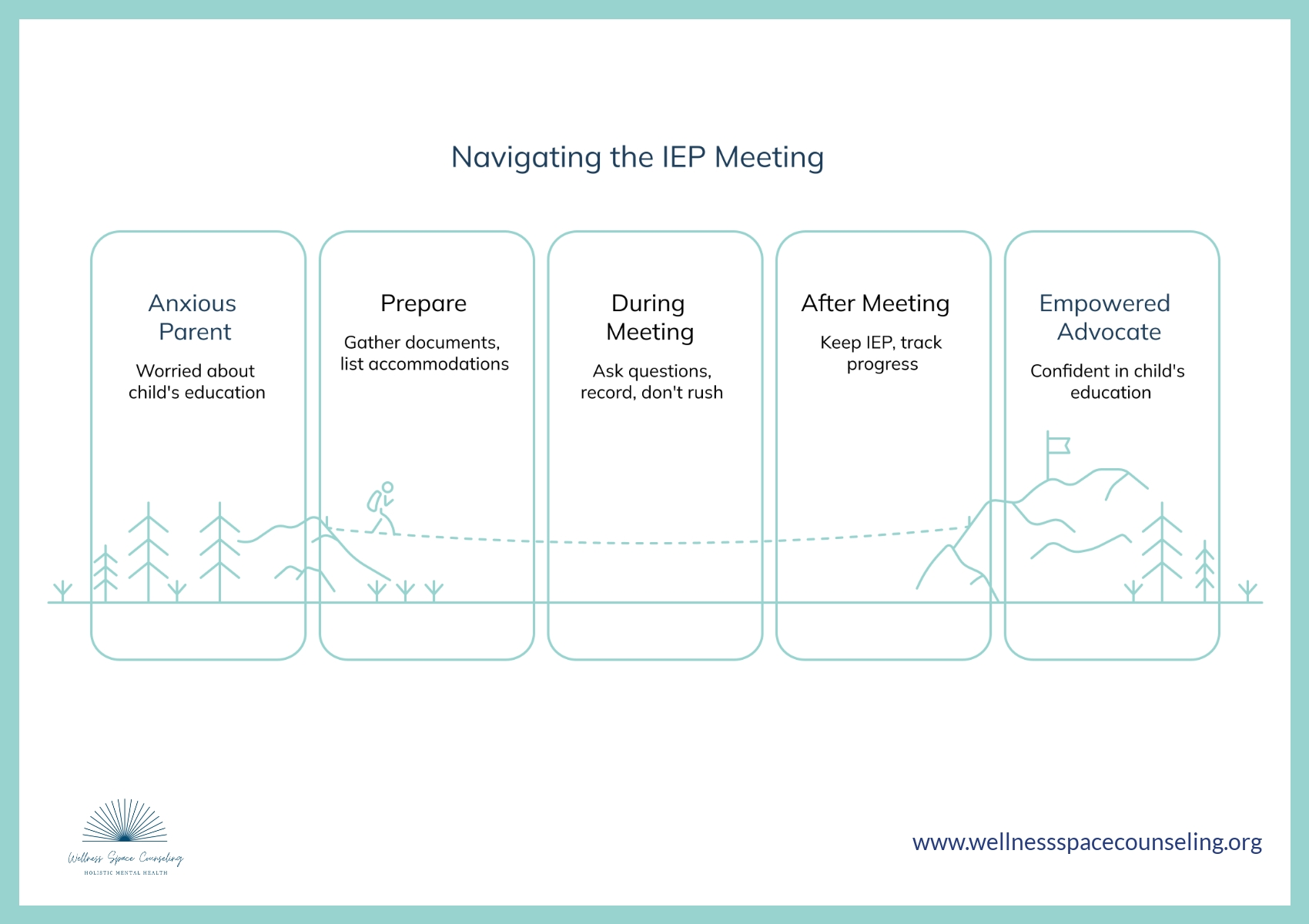
How to prepare for the meeting itself, phrases and all
Your rights and where to get backup when you need it
Let's start where most parents start: completely overwhelmed and not sure where the process even begins.
What Is an IEP for Autism?
An individualized education program for autism, or IEP, is a legally binding document. It spells out the special education services and supports your child is entitled to receive at school.
That's it. It's not a punishment, a label, or a life sentence. It's a plan, and it's one your child has a legal right to under the Individuals with Disabilities Education Act (IDEA). Once I began to see an IEP as a support structure for my child and not a negative label on them, it shifted my whole lens on the process.
Autism is one of 13 disability categories covered under IDEA, alongside speech or language impairment, specific learning disability, and several others. What makes an individualized education plan for autism specific to your child is exactly what the name says: it's individualized. No two IEPs should look the same, even for two kids with the same diagnosis.
Special Education and IEP: How They Work Together
People use these terms almost interchangeably, but they're not quite the same thing. Think of it this way: the IEP is the roadmap, and special education is the vehicle that gets your child there.
Special education services provided through an IEP can include speech therapy, occupational therapy, ABA, social skills groups, and time with a special education teacher in a resource room or general education classroom. All of it is delivered under the framework laid out in the IEP.
Something I say a lot in coaching sessions: the IEP is the contract. Special ed IEP services are the follow-through. If the services on paper don't match what's actually happening in the classroom, that's worth a conversation, not something you have to just accept.
What is the difference between an IEP and a 504 plan?
An IEP provides specialized instruction and services under IDEA, with measurable goals and a legal process behind it. A 504 plan provides accommodations only, under a different federal law, and doesn't include specialized instruction or the same level of formal goal tracking.
Does My Child Qualify? Understanding IEP Eligibility for Autism
Here's something that surprises a lot of parents: an autism diagnosis alone doesn't automatically get your child an IEP. The school also has to determine that autism is affecting your child's ability to access their education. Most of the time, it does. But the process still has to happen. Prepare yourself for this because it can be the hardest part of the process - feeling like you have to prove to the school that your child needs support before they begin to offer accommodations.
The path generally looks like this:
Referral: You, a teacher, or a pediatrician raises a concern and requests an evaluation
Evaluation: The school assesses your child across relevant areas of development
Eligibility determination: A team reviews the results and decides whether your child qualifies
IEP development: If eligible, the team builds the actual plan
Practical tip #1: Contact your state's Child Find office before you need it, not after. Every state runs a Child Find program under IDEA, and it exists to identify kids who might need services, often starting from birth. If you have any suspicion that your child may need support, reaching out to Child Find early means you're not starting from zero when a formal evaluation becomes necessary.
Under IDEA, schools have 60 calendar days from the date you sign consent to complete the evaluation and hold the eligibility meeting. In Maryland, if your child is found eligible, the IEP itself has to be developed within 30 additional days. Timelines shift slightly by state, so it's worth checking your own state's specifics, but the 60-day window is the federal floor almost everywhere.
And this evaluation is free. You never have to pay out of pocket for a public school to assess your child. If your school suggests otherwise, that's a red flag worth pushing back on.
What's Inside an IEP? Breaking Down the Key Components
Every legally compliant IEP has to include six core pieces. Once you know what they are, the document stops feeling like a locked box.
Present Levels of Academic Achievement and Functional Performance (PLAAFP): Where your child is right now, academically and functionally
Annual measurable goals: What the team expects your child to accomplish in the next year
Special education and related services: The actual supports, like speech therapy, OT, or a paraeducator
Accommodations and modifications: Adjustments to how your child accesses instruction and testing
Transition planning: For older students, planning for life after high school
Progress measurement: How and when the school will report on your child's progress toward each goal
A quality autism IEP doesn't just check these six boxes. It reflects your specific kid. A peer-reviewed study examining IEP quality for young children with autism found that goals were often vague or hard to measure, which makes them hard to actually work toward. That's exactly why you, as the parent, are allowed to push for more specificity. More on that in a minute.
Who Is on the IEP Team? Meet the People in Your Child's Corner
Walking into an IEP meeting can feel like walking into a job interview where everyone else already knows each other. Here's who's usually at the table:
You, the parent or guardian: A full and equal member of the team, by law, not a guest
The general education teacher: Speaks to how your child functions in the regular classroom
The special education teacher: Often coordinates the services and modifications
A school psychologist: Usually presents evaluation results
Related service providers: Speech-language pathologists, occupational therapists, or physical therapists, as relevant
A school administrator: Represents the district and its resources
Your child: When age-appropriate, especially as they get older
Practical tip #2: Bring an advocate if you possibly can. An educational advocate knows the language, the legal thresholds, and the questions that get real answers instead of vague reassurance. You don't need one at every meeting forever, but for an initial IEP or a contested one, having a second set of trained eyes changes the dynamic at that table.
Practical tip #3: Call your county before you assume you have to hire one privately. Some counties maintain a list of parent advocates or connect families to a Parent Training and Information Center at no cost. It's worth one phone call to find out what's already available to you in Maryland, DC, Virginia, or Florida before you spend money you might not need to spend.
How often is an IEP reviewed?
At least once a year, at what's called the annual review. Every three years, your child is typically due for a full reevaluation to confirm continued eligibility, unless the team agrees that existing data is sufficient.
IEP Goals for Students with Autism: What Good Goals Look Like
IEP goals for students with autism should follow a SMART framework: specific, measurable, achievable, relevant, and time-bound. A goal that says "will improve social skills" tells you nothing. A goal that says "will initiate a greeting with a peer in 4 out of 5 observed opportunities across two consecutive weeks" tells you exactly what to look for.
Good goals usually fall into a handful of domains:
Communication: Requesting, labeling, or expanding language use
Social skills: Initiating interaction, turn-taking, reading social cues
Behavior and emotional regulation: Using coping strategies, reducing escalation
Academic skills: Reading, math, and other core content areas
Adaptive and daily living skills: Self-care, routines, independence
One thing I tell every parent I coach: your child's goals should never be copy-pasted from another student's IEP. If a goal looks generic, it probably is one, and you're allowed to ask for something that actually reflects your kid.
Sample IEP Goals for Autism Across Key Developmental Areas
These are illustrative, not a template to hand to your team. But seeing what a sample IEP for autism can look like makes it much easier to spot the difference between a strong goal and a weak one.
Communication: Will request a preferred item or activity using a 3-word phrase or AAC device in 8 out of 10 opportunities across three sessions
Communication: Will answer "wh" questions about a shared story with 80% accuracy across four consecutive data collection sessions
Social skills: Will initiate an interaction with a peer during unstructured play in 3 out of 5 observed opportunities weekly
Social skills: Will take turns during a structured game with one prompt or fewer in 4 out of 5 trials
Behavior: Will use an identified calm-down strategy independently when frustrated in 4 out of 5 documented instances
Behavior: Will transition between activities with no more than one verbal prompt in 80% of observed transitions
Academic: Will identify 30 sight words from a district-approved list with 90% accuracy
Academic: Will solve single-digit addition problems using manipulatives with 80% accuracy across three trials
Adaptive skills: Will complete a 3-step morning routine (visual schedule) with no more than one adult prompt
Adaptive skills: Will independently wash and dry hands following a visual sequence in 4 out of 5 opportunities
Notice the pattern. Every sample IEP for autism goal here has a number, a condition, and a way to measure it. If your child's draft goals don't have all three, that's a fair thing to raise at the table.
Can parents request changes to an IEP outside of the annual meeting?
Yes. You can request an IEP meeting at any point during the school year if something isn't working. You don't have to wait for the scheduled annual review to raise a concern.
Preschool IEP Goals for Autism: Supporting Your Youngest Learners
Preschool IEP goals for autism deserve their own section because the domains that matter most at age three or four look different from those at age eight. The CDC notes that early intervention services can meaningfully change a young child's developmental trajectory, and the parents around that child play a central role in how those gains carry into daily life. At this age, IEP goals for preschoolers with autism often focus on:
Play skills: Engaging in simple pretend play or parallel play alongside a peer
Joint attention: Following a point or shared gaze to a shared object of interest
Early communication: Making a request using a gesture, picture, or single word
Self-care: Participating in hand washing, snack time routines, or simple dressing steps
Pre-academic readiness: Matching colors or shapes, sitting for a short group activity
A real example of a preschool IEP goal for autism might read: "During snack time, [child] will point to or hand a picture symbol to request a preferred food in 4 out of 5 opportunities." Small. Specific. Winnable. That's exactly what you want at this age.
Your Rights as a Parent in the IEP Process
Under IDEA, you have real, enforceable rights in this process, not just a seat at the table:
The right to participate in every meeting where your child's education is discussed
The right to request an Independent Educational Evaluation (IEE) if you disagree with the school's findings
The right to Prior Written Notice anytime the school proposes or refuses a change
The right to dispute resolution, through mediation or due process, if you and the school can't agree
One pattern worth watching for: schools tend to spend most of the meeting on the goals your child is expected to hit, and much less time on the accommodations that actually help your child get there. Both matter equally under the law, but goals are easier to write down, and accommodations are easier to skip. If the draft IEP is heavy on milestones and light on the specific supports backing them up, that's worth flagging out loud. You're allowed to ask the team to slow down and spell out the accommodations with the same level of detail they gave the goals.
Autism Speaks' IEP guide is a solid starting point if you want to go deeper into any of these rights before your next meeting.
Practical tip #9: Find your local support group before you need it in a crisis. Parent Training and Information (PTI) Centers exist in every state, and beyond that, local and diagnosis-specific support groups can point you toward advocates, attorneys, and other families who've already walked this exact road in your school district. You don't have to build this knowledge from scratch.
Common IEP Challenges for Autistic Children (and How to Work Through Them)
A few patterns come up over and over in my coaching sessions:
Vague or Unmeasurable Goals
Ask specifically how progress will be tracked. If the answer is fuzzy, the goal probably needs to be rewritten before you agree to it.
Services That Feel Insufficient
You can request a meeting to revisit service minutes at any point, not just at the annual review. Document specific examples of where the current plan is falling short.
Disagreements With the School Team
Disagreement doesn't have to become a fight. Ask for data, ask for the reasoning behind a decision, and use your right to an IEE if you genuinely believe the evaluation missed something.
Transitions Between Grades or Schools
IEPs transfer with your child, but implementation can vary wildly between buildings. A transition meeting before the school year starts can prevent a lot of scrambling in September.
The Emotional Weight of It All
Advocating for your child, year after year, is exhausting in a way that's hard to explain to people who haven't done it. Some families also find the stress showing up between partners, not just at school. If that's happening in your house, neurodiverse couples therapy or broader family therapy can give the whole household somewhere to land, not just the parent doing the advocating.
At what age does an IEP end?
IEP services generally end at age 21 or upon graduation with a standard diploma, whichever comes first. Some states extend eligibility slightly differently, so it's worth checking your state's specific rule.
How Emotional Support for Parents Fits Into the IEP Journey
I want to say something plainly: the exhaustion you feel after an IEP meeting is real, and it deserves its own attention, separate from your child's needs.
My daughter has autism and ADHD. I've sat on both sides of that conference table, as the clinician in the room and as the dad whose hands were sweating under it. What I've learned is that parenting well through this process depends almost entirely on how supported you feel outside of it.
That's not a sales pitch. It's just true. A parent running on empty makes decisions from a place of panic instead of clarity, and your child deserves you at your steadiest, not your most depleted.
If your family is navigating more than one neurodivergent profile under one roof, our ADHD Parent Coaching program pairs naturally alongside the autism-specific work, and our ADHD therapist can work with your child directly if they need their own dedicated support too. And if your child could use their own space to process big feelings more broadly, our child therapy team is here as well. None of this replaces what happens at the IEP table. It just means you're not walking into that room, or leaving it, completely alone.
You Don't Have to Do This Perfectly, Just Consistently
Raising a child who needs an IEP means learning a new language while you're still catching your breath from the diagnosis itself. Some meetings will go smoothly. Others won't. Both are normal.
I've spent years helping parents of autistic and ADHD kids build exactly the kind of confidence this process asks of you, and I've needed that same support in my own home more times than I can count.
If any part of this felt heavy while you read it, that's not a flaw in you. It's a sign you love your kid enough to keep showing up for the hard parts. If you'd like to talk through your own child's IEP, discuss their sensory needs, or simply have a place to process the exhaustion of it all, I offer a free consultation to see if coaching is the right fit for your family. Reach out and let's talk it through together.