High-Functioning Autism Parenting: Practical Tips for Everyday Life
You know the moment. Your child holds it together all day, through school, through the noise, through every unwritten social rule, and then walks through your front door and comes apart. It can feel confusing and exhausting, and it is far more common than anyone tells you.
Many families search for “high-functioning autism parenting” because that’s the phrase they’ve heard. It’s a useful starting point, but it can hide how much a child is carrying behind a calm, capable surface.
This guide starts with your child’s strengths and works toward the harder moments from there. We'll move from understanding to everyday strategy, without pressure, hype, or promises of a quick fix.
What High-Functioning Autism Actually Looks Like at Home
When parents say "high-functioning autism," they usually mean a child who has strong verbal and cognitive skills and few obvious support needs on the surface, yet still struggles with transitions, sensory input, social nuance, or emotional regulation. It's a widely searched phrase and a common shorthand, but it's not an official clinical or diagnostic label in the DSM-5, and support needs vary enormously from one child to the next. They can even fluctuate day to day for the same child.
Autism spectrum disorder is a developmental difference in how a person communicates, processes sensory information, and relates socially. Like other spectrum disorders, it shows up differently in every child. About 1 in 31 children aged 8 years has been identified with ASD, according to the CDC's ADDM Network, which means you and your child are part of a very large, very real community.
At home, "high-functioning" often looks like the pattern parents instantly recognize: a child who holds it together all day at school and then melts down the moment they walk through the door. A strong vocabulary can sit right alongside genuine difficulty reading a friend's tone, coping with a schedule change, or tolerating a scratchy shirt. The outside says "fine." The inside says "overwhelmed." If you're just beginning to make sense of all this, our broader guidance on supportive autism parenting in Columbia, MD offers a gentle place to start.
You may also hear about support levels. The DSM-5 describes three levels of support for autistic people, and what some call "low-functioning autism" generally refers to higher support needs (Level 2 or Level 3), where more day-to-day assistance is needed. These terms can be stigmatizing and don't capture the full person, so it helps to think in terms of specific support needs rather than high or low labels. Here's a quick reference for the behaviors parents often notice, what may be happening underneath, and a supportive response to try.
| What you notice | What may be happening underneath | What tends to help |
|---|---|---|
| After-school meltdown or shutdown | Masking all day at school, then releasing built-up stress at home where it feels safe | Quiet decompression time before homework or questions |
| Resistance to transitions | Uncertainty about what comes next; loss of predictability feels threatening | Visual timers, first/then language, advance warnings |
| Covering ears, picky eating, clothing battles | Sensory sensitivities, ordinary input registers as overwhelming | Sensory accommodations and reduced sensory load |
| Missing social cues or “rude” comments | Unwritten social rules weren't absorbed by observation alone | Narrating social expectations out loud, in advance |
| Rigidity or repeated questions | Anxiety seeking certainty, sometimes alongside ADHD | Calm reassurance and consistent routines |
Leading With Strengths: A Different Way to See Your Autistic Child
It's easy, especially after a hard week, to view autism as a list of challenges to manage, and that lens quietly wears down both you and your child. A strengths-first, neurodiversity-affirming approach starts somewhere else entirely, with the genuine gifts your autistic child brings to the world, long before you address anything difficult.
Leading with strengths changes the whole dynamic. When a child feels seen for who they are rather than corrected for who they aren't, shame drops, defensiveness drops, and connection grows. That's the foundation that makes every later strategy work better.
Many parents recognize some of these common strength patterns in their autistic kids, offered here as examples to build on, not a checklist to measure against:
Intense focus and deep expertise in areas of passionate interest.
Honesty and a strong sense of fairness that others can rely on.
Pattern recognition and attention to detail that others miss.
Loyalty and sincerity in close relationships.
Original thinking that comes from not simply following the crowd.
What is low-functioning autism?
"Low-functioning autism" is not a clinical label, and it can be stigmatizing, so it's better to think in terms of support needs. It generally refers to autistic people with higher support needs, roughly corresponding to Level 2 or Level 3 in the DSM-5, who need more day-to-day assistance. People-first, respectful language focused on what a person actually needs is far more helpful than high or low framing.
Autism Parenting Tips for Everyday Routines
Predictability is one of the kindest things you can offer an autistic child, because so much anxiety comes from not knowing what happens next. These everyday parenting tips are tools to experiment with, not fixes to apply rigidly. Adjust each one based on how your child actually responds.
Visual timers and predictable schedules. A visual countdown or a posted daily schedule makes time and sequence concrete, which lowers anxiety and reduces the risk of a meltdown at transition points. Place a simple schedule where your child can see it, and preview the day together in the morning.
First/then language. A clear, two-step structure gives order without a power struggle. Try saying, "First homework, then screen time," so the expectation and the reward are both visible and predictable.
Explaining social rules out loud. Many autistic kids don't absorb unwritten social norms by observation alone, so narrate expectations explicitly before an event: "At Grandma's, people will hug hello. You can wave instead if a hug feels like too much."
If a strategy stops working, that's information, not failure. Flexibility, meaning adjusting the tool to the child rather than the child to the tool, is the real skill here.
Age-by-Age Strategies for Raising a Child With Autism: School-Age Through Teen Years
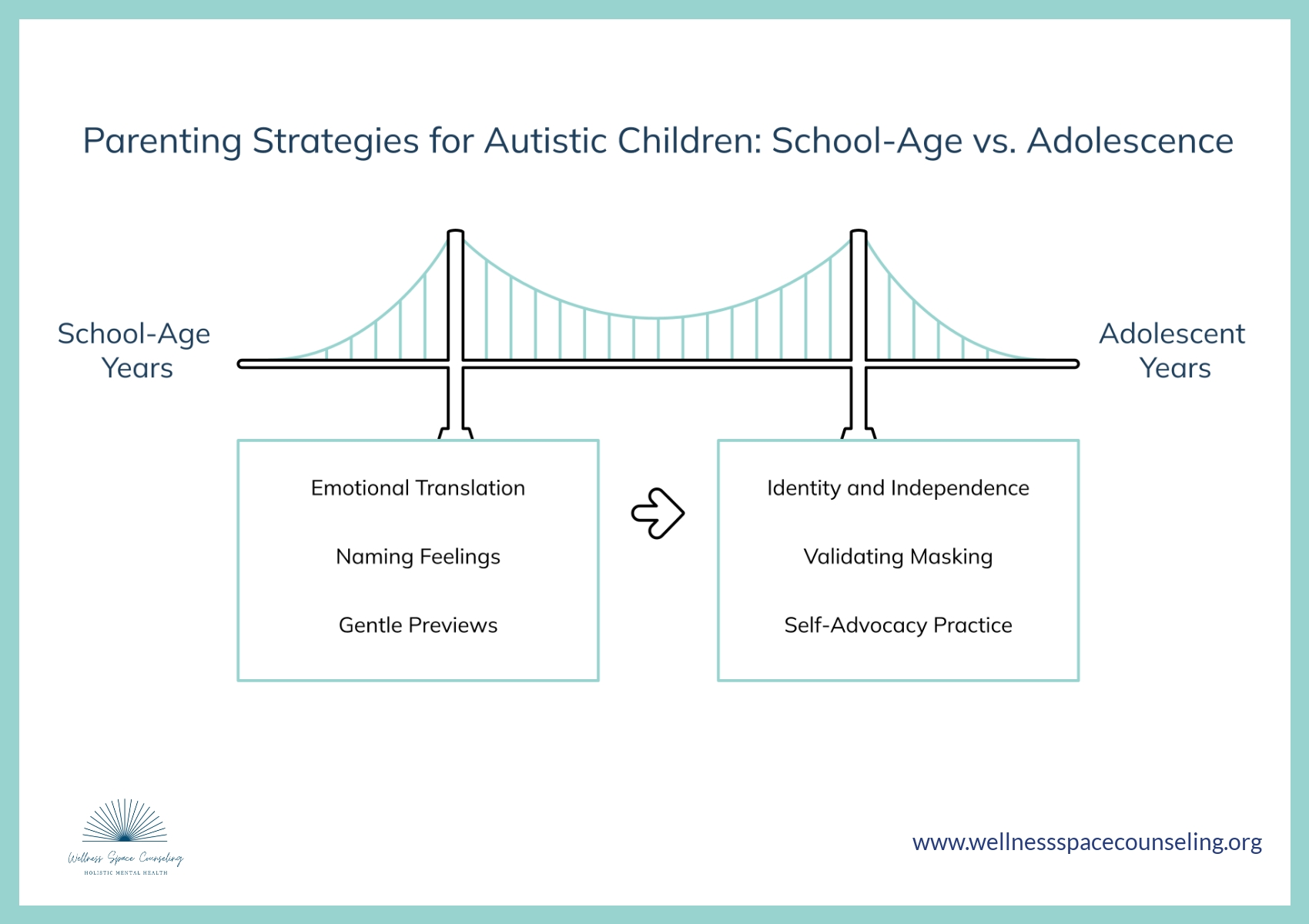
What your child needs from you shifts dramatically between the elementary years and adolescence. The strategies that soothe a seven-year-old won't fit a fifteen-year-old who is working out who they are, so it helps to think about two distinct seasons.
Helping Your Autistic Child Thrive in the School-Age Years
In the elementary years, the focus tends to be on friendship support, structure for homework, building emotional vocabulary, and weaving sensory accommodations into ordinary days. Your child is learning the language of their own inner world, and you are their best translator.
Naming feelings out loud builds that vocabulary over time. You might say, "Your body looks tense and your voice got loud. I wonder if you're feeling frustrated. That makes sense; this puzzle is hard." For transitions, a gentle preview works well: "In ten minutes we're leaving the park. I'll tell you again when it's five minutes." Small, consistent moments like these teach a child that feelings are normal and that change is survivable.
Parenting a High-Functioning Autistic Teen: Identity, Self-Advocacy, and What's Next
Adolescence adds identity, independence, and the long runway toward adulthood. Many autistic teens, especially girls, mask their traits all day at school to fit in, then "crash" at home where it's safe. If your teen is calm with teachers and dysregulated with you, that's not disrespect; it's often a sign that home is the one place they can finally let the mask down. That pattern deserves validation, not a lecture.
This is also the season to grow self-advocacy. Help your teen learn to name their own sensory, social, and academic needs so they can speak up as they move toward adulthood: "I need a quieter room to finish tests," or "I do better with written instructions." These are skills, and skills grow with practice and patience.
Anxiety and ADHD commonly travel alongside autism in the teen years, and sorting out what's what can be genuinely confusing. We'll return to that in the co-occurring conditions section below.
Managing Meltdowns: What's Really Happening and What Actually Helps
Meltdowns can feel like the hardest part of parenting an autistic child, in part because they're so often misread. When I was seeing a therapist for my daughter, one of the best pieces of advice I received was to reframe my understanding of meltdowns. Meltdowns are not temper tantrums, a pushing of boundaries, or willful stubbornness. In many neurodivergent children, they are a cry for help.
It can help to imagine what a child in the middle of a meltdown may be experiencing internally, not as the adult's words, but as the child's unspoken reality:
"My brain is disorganized. I cannot make sense of this. I am overwhelmed. I don't know what to do. Please help me make sense."
The therapist encouraged my family not to label this as "dysregulation" (a willful choice not to control emotions), but as disorganized thinking, something that needs help and support. In practical terms, that means your job in the moment is calm presence over correction: a steady voice, a safe space, fewer words, no problem-solving until the storm passes. Once viewed through this lens, it changed my whole thinking about how to support and challenge my child and myself.
If a meltdown isn't defiance, the next question follows naturally: what should discipline actually look like?
How to Discipline a High-Functioning Autistic Child: What to Try Instead
Traditional discipline (punishment, consequences for "not listening") often backfires with autistic kids, because what looks like defiance is usually overwhelm. You can't punish a child out of a nervous system that's maxed out, and trying tends to escalate everyone. The foundation of discipline for a high-functioning autistic child is predictable, calm parental responses. Your tone and consistency matter far more than the exact words.
I offer a concrete, repeatable sequence parents can lean on in the moment: the five-step SWAMP approach:
See: "I see you are feeling strongly about this issue by your reaction (e.g., throwing, screaming, punching)."
Wonder: "I wonder if you might be feeling...scared, angry, sad, upset about...."
Acknowledge/Validate: "It makes sense why you would feel (insert feeling) about this situation. Those feelings are very real."
Make Options: "Two things we could do here are...(creating safe options that are good for you and your child)."
Propose: "Which of those options feels safest and best for you? (Gives control and agency back to them.)"
This approach takes practice, and it won't work identically every time or with every child. That's normal. The goal isn't a perfect script; it's a predictable, connection-first pattern your child can come to trust over many repetitions.
How do you deal with autism behavior problems?
Start by reframing the behavior: meltdowns are usually overwhelm, not defiance, so calm presence helps more than punishment. Predictable, consistent responses work better than consequences for "not listening," and a structured approach like the SWAMP steps (See, Wonder, Acknowledge, Make Options, Propose) gives you concrete language to validate feelings and return a sense of agency to your child. These approaches take practice and won't work identically every time.
Navigating School: IEPs, 504 Plans, and Advocating for Your Child
School is where many parents of autistic children feel the loneliest, and where strong advocacy makes the biggest difference. Two tools come up most often. An IEP (Individualized Education Program) is a legally binding plan under special education law that provides specialized instruction and services when a disability affects a child's ability to learn. A 504 Plan provides accommodations, like extended time or sensory breaks, to a child who can access the general curriculum but needs adjustments to do so. In short: an IEP changes what and how a child is taught; a 504 Plan changes the conditions in which they learn.
Homework deserves special mention. After masking and coping all day, many autistic kids arrive home in sensory fatigue, and expecting them to start homework immediately is a recipe for conflict. Build in decompression time first, and talk with teachers about realistic expectations. A reduced load or a different schedule is often reasonable.
A few practical advocacy tips: document your concerns in writing, request evaluations formally and in writing, and bring a support person to meetings so you're not carrying the emotional weight alone.
Social Skills and Friendships
Building social skills doesn't have to mean forcing your child into neurotypical scripts that feel hollow to them. Often the most genuine connection grows out of your child's intense interests, shared-interest clubs, online communities, and interest-based meetups, where the passion does the social work and your child gets to be themselves.
Your role is to facilitate, not force. If your child loves trains, a local model-railroad group or an online forum can be a doorway to friendship that a generic "playdate" never opens. You set up the opportunity; your child decides how far to walk through it.
It also helps to let go of the idea that more friends is always better. Many autistic kids prefer a few deep, steady friendships over a wide social circle, and that's a valid, healthy way to connect, not a deficit to correct.
Co-Occurring Conditions: When Autism Comes With Anxiety, ADHD, or More
Autism rarely travels alone, and recognizing what else is in the mix can relieve a lot of confusion. Anxiety and ADHD are especially common companions, and their symptoms can overlap or mask one another. Anxiety-driven rigidity, for example, can look like "autistic traits" when it's actually something treatable on its own. Research suggests ADHD co-occurs in a large share of autistic individuals; roughly 50-70% of autistic individuals are affected, according to a peer-reviewed literature review, and one analysis found 43.8% of children with ASD had co-occurring ADHD, per a 2016–2018 NSCH data study.
You may also still see the term "Asperger's." It's worth knowing that Asperger's was folded into ASD under the DSM-5 in 2013, according to Autism Speaks, so children who would once have received that label now fall under autism spectrum disorder, a term many parents of this generation still search and use.
You don't have to untangle all of this alone. Raising an autistic child who also has anxiety or ADHD is genuinely complex, and bringing these concerns to your child's care team and, when helpful, to a parent coach who can help you manage the day-to-day complexity, is a sign of strength, not of falling behind.
Talking to Siblings and Extended Family About Your Autistic Child's Needs
The people around your family don't always understand what you're navigating, and those conversations can be their own quiet source of stress. With siblings, age-appropriate honesty works best. For a young child: "Your brother's brain works in its own way. Loud places feel really big to him, so sometimes he needs a quiet break." Make room for siblings' feelings too. Frustration, jealousy, and confusion are normal, and naming them ("It's okay to feel annoyed sometimes") keeps resentment from building.
Extended family can be harder, especially when grandparents or relatives are skeptical, dismissive, or full of unsolicited advice. You don't owe anyone a full clinical explanation. A calm, boundary-setting line often does more than a debate: "We've learned what helps him, and this is what works for our family. I'd love your support with it."
Throughout all of it, protect your child's dignity. You're not obligated to diagnose or over-explain your child to every relative, and your child deserves to grow up knowing that home is a place where they are described with respect.
Caregiver Burnout Is Real, and You Deserve Support Too
Parental stress runs high for parents of autistic children, and the isolation can be just as heavy as the exhaustion. If you feel depleted, invisible, or like no one understands, that's not a personal failing. It's a common, human response to carrying a lot for a long time, often without enough support.
Another great piece of advice I got during my journey as a clinician and parent of neurodivergent children is to build community with people going through similar experiences. Not everyone knows, accepts, or understands your parenting journey. Find a neurodivergent parenting group with people who "get it." You will laugh, cry, swear, and share solutions together, and you won't feel so alone.
You don't have to overhaul your life to start. One sustainable step (a single support group, a weekly walk, ten honest minutes with someone who understands) does more for your resilience than any vague instruction to "practice self-care." Small and real beats big and someday.
How Autism Parent Coaching Can Help
If anything in this guide left you thinking, "I could use a partner in this," that's exactly what parent coaching is for. I bring both clinical training and personal experience raising neurodivergent children, so I understand the caregiving journey from more than one angle.
Our one-on-one autism parent coaching program is focused on your child's sensory needs, communication style, and behavior. It's a stand-alone service, separate from any therapy your child receives, and no formal diagnosis is required to begin. Coaching supports you as the parent.
Coaching commonly focuses on areas like these:
Understanding your child's sensory triggers before they build into a meltdown.
Navigating transitions and building visual schedules and routines that fit your family.
Advocating effectively for IEP and school supports.
Processing your own stress and adjustment after a diagnosis.
Strengthening connection through play-based, child-led interaction, drawing on approaches such as DIR/Floortime (following your child's lead in play), Collaborative & Proactive Solutions (CPS, solving problems together), ACT for parents (acceptance-based skills), PCIT, and EFFT.
Coaching is offered on a self-pay basis, and the specifics are explained during a free consultation, which is a chance to ask questions and see whether it feels right for your family. When you're ready, you can schedule a free consultation. There's no rush. We're here whenever you are.