DIR Floortime: A Parent's Guide to Play-Based Support for Autistic Children
Finding out your child is autistic, or realizing the approach you’re using now doesn’t quite fit, can leave you with a lot of questions and very little time to sort through them. If you’ve landed here while searching for answers about DIR Floortime, you’re already doing something that matters: looking for a way to support your child that feels right for them and for your family.
It’s okay not to have everything figured out yet. Many parents arrive at this point feeling a mix of hope, worry, and exhaustion, and that’s a very human place to start.
This guide is here to walk through it with you, one piece at a time. We’ll explain what DIR Floortime is, what a session actually looks like, how it compares to other approaches like ABA, and what the research says (including where it’s still limited). There’s no pressure to choose a particular path. You know your child best, and our hope is simply to give you clear, honest information so you can decide what feels right.
What Is DIR Floortime Therapy? A Plain-Language Overview
DIR Floortime is a developmental, relationship-based, play-based approach that meets an autistic child exactly where they are, rather than pushing them toward a predetermined set of behaviors. It uses warm, back-and-forth play to support emotional connection, communication, and thinking, building growth through the relationship itself.
Here's a helpful distinction: DIR is the broader theoretical framework, and Floortime is the applied technique, the actual getting-down-on-the-floor-and-playing part. Understanding DIR Floortime starts with seeing it as both a way of thinking about child development and a practical thing you can do together.
You don't need to master all of it today. The Floortime approach was developed by child psychiatrist Stanley Greenspan and clinical psychologist Serena Wieder, and the official training and credentialing body is the International Council on Development and Learning (ICDL), which maintains the original DIRFloortime training program worldwide.
What Does DIR Stand For? The DIR Model Explained
The three letters each name a piece of the model. Here's the short version:
D, Developmental: Meeting your child at their current developmental capacity rather than their chronological age, following a ladder of emotional milestones known as the functional emotional developmental capacities (FEDCs).
I, Individual differences: Honoring each child's unique sensory and processing profile, how they take in sound, movement, touch, and light, and how that shapes the way they engage with the world.
R, Relationship-based: Recognizing that learning happens through warm, attuned relationships, so caregivers and therapists become the vehicle for growth, not just observers of it.
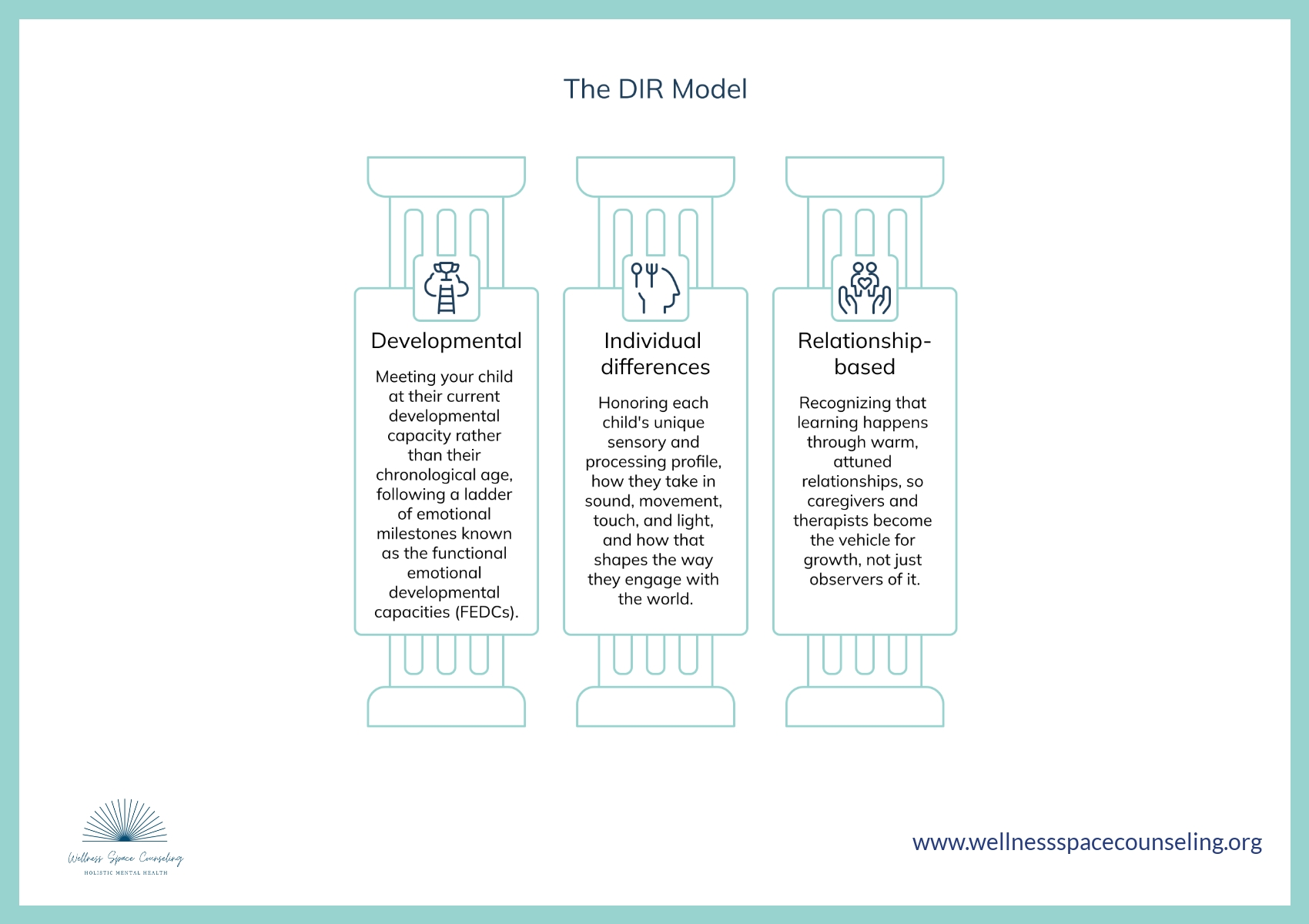
Together, these three ideas form a relationship-based model that treats your child as a whole person with their own inner world worth joining, supporting learning, development, and emotional connection.
DIR Therapy vs. Traditional Behavioral Approaches
The core difference comes down to who leads. DIR therapy follows the child's emotional and developmental lead, letting their interests guide the interaction, while more traditional behavioral approaches tend to be structured and reward-driven, with goals set and measured by the provider.
Neither one is "right" or "wrong." They just start from different places. We'll look at that comparison more fully below, but for now, think of this as a preview rather than a verdict.
Can you give me an example of DIR Floortime?
Get down at your child’s level and join whatever they’ve chosen, such as stacking blocks or pushing a car. Wait for an opening like a glance, a sound, or a gesture, then respond warmly. When your child responds back, you’ve closed a “circle of communication.” Keep it short and child-led. A few minutes of real connection matters more than a long session.
What Does a DIR Floortime Therapy Session Actually Look Like?
A Floortime session has a gentle rhythm: the adult follows the child's chosen activity, joins their world rather than redirecting it, and gradually expands the play through back-and-forth exchanges. If your child is lining up cars, you don't stop them. You become part of the car game.
These sessions can happen in a clinical setting or right at home, led by a trained provider or a coached parent. There's no single required length, and good Floortime work often fits naturally into everyday moments as much as scheduled therapy sessions. Many children also receive it alongside other supports like speech therapy or occupational therapy that help with communication and motor skills.
The "Circles of Communication" Concept
Circles of communication describe the back-and-forth between child and caregiver. Each time the child initiates and the adult responds, and then the child responds back, a "circle" closes.
Here's a quick example: your child pushes a toy car toward you, you make a playful "vroom" sound and push it back, and your child looks up and pushes it again. That exchange is one closed circle. The more circles you open and close together, the more your child practices connection and communication.
How Parents and Caregivers Lead the Way in DIR Floortime
Unlike models that center the clinician, DIR Floortime is built for parents and caregivers to be active, ongoing participants. You're not sitting on the sidelines. You're often the one on the floor.
This matters developmentally because, as the "R" in DIR reminds us, the relationship is the vehicle for growth. The hours you already spend with your child (mealtimes, bath time, play) become opportunities for connection, which is exactly where the next practical tool comes in.
A DIR Floortime Example You Can Try at Home
Here's one simple sequence that puts "join, don't redirect" into practice. Try it with blocks, cars, or whatever your child gravitates toward:
Get down on the floor at your child's level and watch what they're drawn to, without directing it.
Join their play. If they're stacking blocks, pick up a block and add to the tower or build your own beside them.
Wait for an opening. Notice any glance, sound, or gesture your child offers, and treat it as an invitation.
Respond warmly to open a circle of communication: hand them a block, make a sound, or mirror their action.
Follow their lead as they respond back, closing the circle, then gently build on it to stretch the play a little further.
Keep it light and short. A few minutes of genuine connection matter more than a long, perfect session.
PRIDE Skills for Autism Parents: A Practical Tool You Can Use at Home
PRIDE is a complementary, child-led tool that many families find helpful alongside developmental work. It comes from Parent-Child Interaction Therapy (PCIT) and its concept of "special time," and it's worth saying clearly that PRIDE is not a DIR technique, and it is not a treatment for autism. It's simply a relationship-building tool.
PRIDE stands for Praise, Reflect, Imitate, Describe, and Enjoy. According to PCIT International, these skills are designed to feel natural and easy to use at home, helping children feel understood, valued, and connected.
Here's how it can look at different ages during child-led play:
1- to 2-year-olds: Toss a ball back and forth, mimic your child's laughter and sounds, or play simple push-and-pull games.
3- to 4-year-olds: Build with blocks or magnetic tiles and let your child decide what you're making together.
5- to 7-year-olds: Let your child lead an activity, Lego bricks, a marble run, or a pretend race, while you follow along.
The heart of "special time" is simple: keep it short and child-led, and as the caregiver, avoid commands, questions, and corrections. Starting with just five minutes a few times a week is enough. You're not teaching in this moment; you're connecting.
I lead the autism parenting program at Wellness Space Counseling, and I’ve been where many of you are, as a parent. Here’s what special time looked like in my own home: my son was having extreme challenges with organizing his thinking and controlling body movements. I found myself overwhelmed and starting to dread doing activities with him because it was too much for my own senses and regulation. I could tell our bond was decreasing and he felt this too. After finding and doing special time a few times a week, I could tell our bond was beginning to repair. He seemed a bit calmer and we both felt more connected to one another. It is certainly not magic. He is still an extremely active little man, and I still get overwhelmed, but we have shared space that feels connecting.
I share this not as a promise of a particular outcome, but as an honest account of my own family’s experience, overwhelm, and connection living side by side. If you’re gathering tools like this, our roundup of autism parenting resources every parent should know about offers more starting points.
What Ages Is DIR Floortime Appropriate For? Tracking Developmental Milestones
DIR Floortime is most commonly associated with early childhood, from toddlerhood through the early elementary years, but the developmental framework can flex across ages and abilities. It isn't locked to a particular birthday, and it can support children with developmental delays or other developmental challenges at many stages.
The approach tracks a child's growth through the six functional emotional developmental capacities (FEDCs), a ladder of emotional and cognitive milestones that build on one another:
Self-regulation and shared attention
Engagement and relating to others
Two-way, purposeful communication
Shared social problem-solving
Using ideas and symbolic, pretend play
Logical, connected thinking
Where your child is developmentally matters far more than their chronological age. Two children who are the same age may be climbing very different rungs of this ladder, and that's exactly the point: the approach meets each child where they genuinely are.
DIR Floortime vs. ABA Therapy: Which Is Right for Your Child?
This is one of the most common questions parents ask after a diagnosis, and it deserves a balanced answer. DIR Floortime follows the child's emotional lead and builds through relationship, while Applied Behavior Analysis (ABA) uses structured, measurable behavioral goals and reinforcement to teach specific skills.
Many families use both, or blend elements of each, and some providers are trained in more than one approach. The right fit depends on your child, your values, and what you're hoping to support.
| DIR Floortime | ABA | |
|---|---|---|
| Core philosophy | Developmental and relationship-based; growth through connection | Behavioral; skill-building through reinforcement |
| Typical setting | Floor play at home or in a clinic | Structured sessions at home, clinic, or school |
| Who leads the activity | The child leads; the adult follows and expands | The provider sets goals and guides the activity |
| What's measured | Emotional and developmental capacities (FEDCs) | Specific, observable target behaviors |
There's no universally "better" choice here, only the choice that fits your family. For context, autism is more common than many parents realize: the CDC's ADDM Network estimated that about 1 in 31 children aged 8 years were identified with autism spectrum disorder in 2022 (about 3.2%), which means a great many families are weighing these same questions about therapy for children after a diagnosis.
Is There Research Behind DIR Floortime?
Yes, there is. A 2023 systematic review by Divya and colleagues, published in the Iranian Journal of Nursing and Midwifery Research, searched major databases and included English-language studies published between 2010 and 2020, with twelve studies meeting their inclusion criteria.
The reviewers reported progress across several areas of functioning in autistic children, including emotional functioning, communication, and daily living skills, with home-based Floortime, and noted that mothers reported improved parent-child interactions. They recorded no adverse events to children or parents, and concluded that Floortime is a cost-effective, completely child-led approach that could be started early.
The foundational description of the model comes from Wieder and Greenspan, whose work details the DIR framework and Floortime play. Worth noting: this is the clinicians' own account of the model rather than outcome research.
It's true the evidence base for DIR Floortime is smaller and less developed than for more heavily studied approaches. The review above looked at a modest number of studies, so findings are best treated as promising rather than conclusive. None of this diminishes the approach's value. It just means we present it as one well-regarded option among several, and we encourage you to keep asking good questions.
Is DIR floortime covered by insurance?
Insurance coverage for autism therapies differs widely by state, by diagnosis, and by the specific service being billed. Some behavioral billing codes are more established than developmental, relationship-based ones. The most reliable step is to call your insurance provider directly and ask specifically about coverage for developmental and relationship-based therapies, as well as any parent coaching or caregiver training. Ask what documentation they require and whether a diagnosis affects eligibility. The answers can shift from one plan to the next.
How to Find a Qualified DIR Floortime Provider: What ICDL Training Involves
When you're looking for a provider, the key thing to confirm is training through ICDL's official DIRFloortime pathway. The ICDL training program begins with a DIR 101 introductory course and progresses through professional certificate levels that include coursework, applied practicum, and case-based assessment.
A few questions worth asking a prospective therapist:
What is your DIR training background and current certification level?
How much experience do you have with autistic children at my child's age and developmental profile?
How are your sessions structured, and how will you involve me as the caregiver?
A provider who welcomes these questions and sees you as a partner is usually a sign of a good fit. Many of these same questions come up when families advocate at school, too; if that's on your horizon, our guide to understanding and advocating for your child's IEP may ease the way.
When Parent Coaching Can Help
Finding a great provider is one piece, and applying these ideas consistently at home is another. Many families benefit from parent coaching that helps them weave DIR/Floortime-informed strategies, like circles of communication and PRIDE/special time, into everyday life to help children feel more connected and understood.
Coaching is meant to complement, not replace, formal therapy. It builds your confidence and consistency as a caregiver, so the connection you create doesn't only happen in a session. If that sounds supportive, our autism parent coaching page explains more about how this works.
Supporting Your Child's Growth: Next Steps for Families
However you arrived here, newly diagnosed, re-evaluating, or simply curious, the care you're putting into understanding your child's needs matters, and it's already a meaningful part of this journey.
At Wellness Space Counseling, our neurodiversity-affirming autism parenting and coaching support for families includes DIR/Floortime-informed support and caregiver training.
If it would help to talk it through, please reach out for a free consultation at 410-498-4300. There's no pressure and no right answer you have to arrive at today, just a safe space to think it through together. Contact us today!