
Parenting ADHD on a tired Tuesday is hard. You know some of the strategies (e.g., predictable routines, short and clear instructions, specific praise, steady connection) but when things get loud and everyone is exhausted, best intentions can go out the window.
It's 7:42 a.m., and you're giving the third reminder about shoes. Last night's homework ended in tears, and maybe not only your child's. Then at bedtime, once the house finally went quiet, the guilt showed up: Was I too sharp? Am I doing any of this right?
If that sounds familiar, you're not alone, and you're not failing. Parenting a child with ADHD asks more of you than most people around you can see.
This guide offers practical tips that work with an ADHD brain instead of against it, straightforward strategies you can use in the tough moments.
It's written for parents and caregivers of school-age kids and teens. That includes parents whose child was diagnosed last month and parents who have been at this for years and feel stuck.
What It Actually Means to Be an ADHD Parent
According to the National Institute of Mental Health, ADHD involves "inattention, such as having difficulty paying attention, keeping on task, or staying organized," along with hyperactivity and impulsivity. For people with ADHD, these traits happen often and show up in many settings, like home, school, and time with friends. You're far from the only family living with ADHD. A CDC-published national study found that in 2022, 11.4% of U.S. children ages 3 to 17 (about 7.1 million) had ever received an ADHD diagnosis.
More recently, the neurodivergent-affirming community focuses less on the deficits of ADHD (present in past literature and research) and more on cognitive differences and environmental match. For example, inattention may show up not because something is lacking in their brain but because someone with ADHD is able to hyperfocus on one thing or pay attention to many things at once, resulting in what seems like inattention to the outside world. While acknowledging environmental and real-world challenges, the community emphasizes co-occurring traits like hyperfocus, high creativity, out-of-the-box problem-solving, spontaneity, and resilience.
Day to day, ADHD affects executive functioning, which includes brain skills such as starting tasks, shifting between activities, managing emotions, and keeping track of time. When your child stalls on homework or melts down at a transition, it's often a skill gap, not defiance or laziness.
Your own feelings matter here too. Exhaustion, grief, guilt, and the tendency to compare your family with others are all common. Your relationships can feel the strain, especially if a partner doesn't yet see how hard this is. None of that makes you a bad parent. It makes you a human one.
Try asking yourself: "Is this a won't, or a can't yet?" Often, it's a can't yet, and that calls for support and skill-building rather than punishment. You want to scaffold your child up to the ability. Show them the way. Do it with them. And then give them agency to do it themselves.
Takeaway: See the behavior as information about a skill that is still growing.
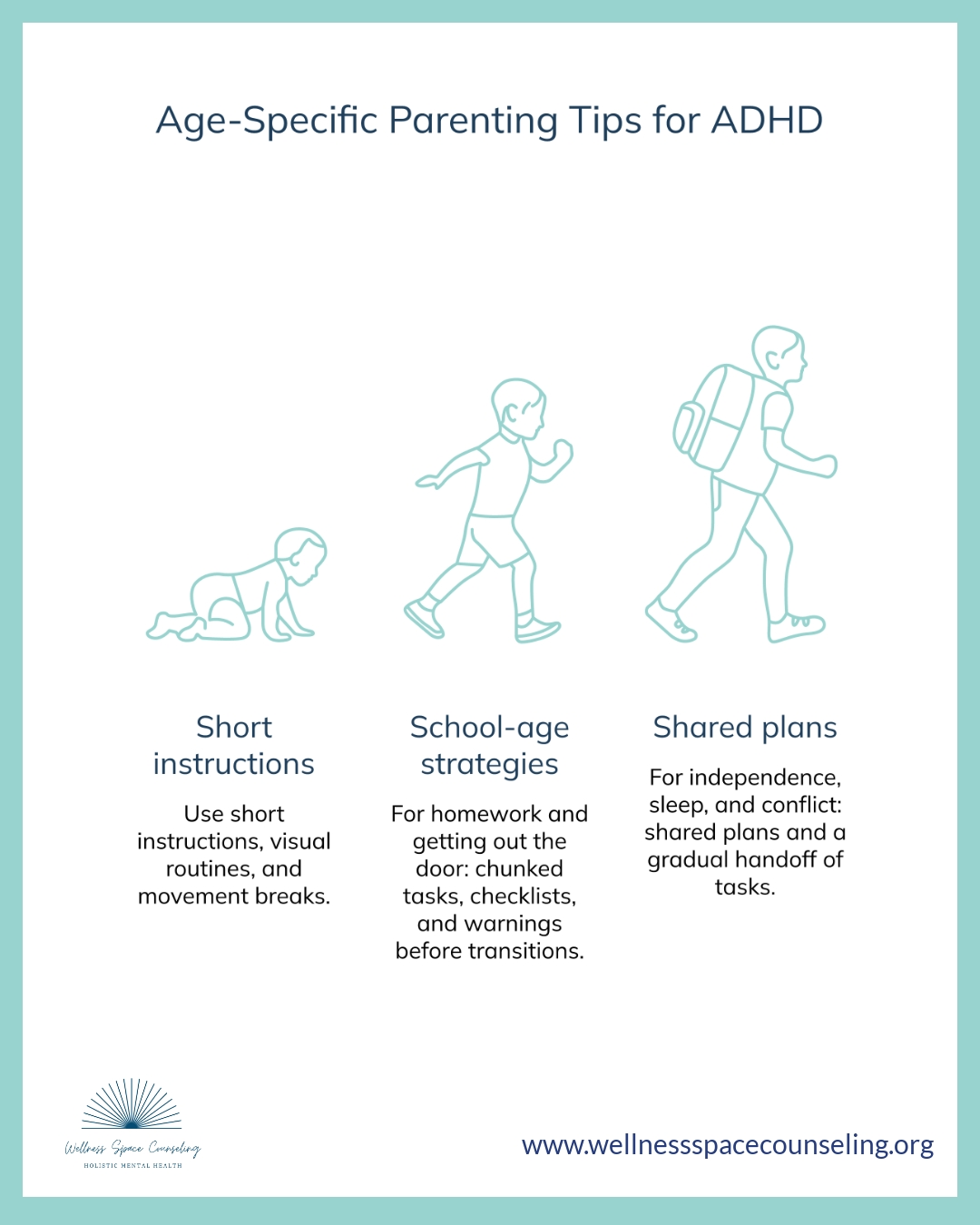
Age-Specific Parenting Tips for ADHD: Toddlers, Tweens, and Teens
The same strategy looks different at ages 4, 9, and 15. Here's a quick reference.
Young children (about 3–5): Common challenge: transitions and meltdowns. What helps: short instructions, visual routines, and movement breaks. Try saying: "First shoes, then the park."
School-age (6–12): Common challenge: homework and getting out the door. What helps: chunked tasks, checklists, and warnings before transitions. Try saying: "It makes sense you want to finish your game. Playing the video game is fun. Five more minutes of game, then shoes."
Teens (13–18): Common challenge: independence, sleep, and conflict. What helps: shared plans and a gradual handoff of tasks. Try saying: "What would make this work for you?"
Parenting a Toddler or Young Child with ADHD
Young children do best with one short, concrete instruction at a time. Picture schedules, songs for routines, and plenty of physical activity can take some of the friction out of the day.
Many children are diagnosed later, but support can start early. The CDC's ADHD treatment guidance notes that for children with ADHD under age 6, the American Academy of Pediatrics (AAP) recommends parent training in behavior management as the first line of treatment, before medication is tried.
Try saying: "You're sad the park is over. That's okay. Let's hop like frogs to the car." Why this works: you name the feeling first, then give their body something to do.
ADHD Parenting Strategies for School-Age Kids (Ages 6–12)
Homework often goes more smoothly in small chunks: ten minutes of work, a movement break, then ten more. A morning checklist by the door means your voice isn't the only reminder system.
It also helps to work with teachers. An informal plan, such as seating near the teacher or a daily check-in, can be a good start. Some children qualify for a 504 plan, which provides school accommodations, or an IEP, which provides specialized instruction.
The homework meltdown: your child throws the pencil and says the worksheet is impossible.
Not this: "You're not even trying. Your sister never makes this a fight."
Say this: "This one feels huge. Let's do only the first two problems, then take a break."
Parenting a Teenager with ADHD
With teens, your role slowly shifts from manager to coach. Break big responsibilities into smaller steps, and agree on a plan for gradually handing over those responsibilities. That way, independence can grow without a sudden drop-off in support.
Driving, sleep, social media, and growing independence all deserve clear rules that your teen helps write. Adolescence can bring more risk-taking, so keep talking about safety in a calm, ongoing way rather than in one big lecture.
Try saying: "I'm not trying to control you. I want us to find a plan we can both live with. What's your idea?" Why this works: it invites ownership and lowers the power struggle. You may need to offer a few options to help them decide, but give them the agency to decide from appropriate options.
What is the best parenting style for a child with ADHD?
Many experts point to a warm, structured approach: clear expectations and predictable routines, paired with lots of encouragement and connection. It is firm about the plan and gentle with the person. No single style fits every family, so many parents adjust as they learn what helps their child.
Building Structure Without Becoming a Drill Sergeant
A predictable routine can help your child because they don't have to hold every step in working memory. Clear expectations give the ADHD brain a map to follow.
Tools many families find helpful:
Visual schedules with pictures or checklists
First/then statements: "First teeth, then a story."
Timers that make time visible
A launch pad by the door for bags, shoes, and keys
One instruction at a time, delivered up close
Structure shouldn't turn into rigid control. Pick the two or three routines that matter most, such as mornings, homework, and bedtime, and let the rest flex. If starting a task feels impossible, it may help to read about what helps when ADHD paralysis takes over.
Sample morning routine:
Wake up and get dressed (clothes laid out the night before)
Breakfast
Brush teeth
Check the launch pad
Shoes on and out the door
Try saying: "Here's what happens after dinner: plates in the sink, shower, then free time." Why this works: it names the order ahead of time, so there's less to argue about in the moment.
Positive Reinforcement: What Actually Works for ADHD Children
Research summarized by CHADD notes that punishment "is less effective for changing behavior." CHADD also advises giving rewards quickly and often while a child is learning a new behavior or skill. Immediate, specific feedback tends to land better than delayed or big consequences. This is not bribery for compliance; it is rewarding movement towards a desired behavior.
Catch them being good. Notice small wins out loud, as they happen.
Keep rewards small. A sticker chart or points toward a privilege can help, as long as goals are reachable.
Aim for more praise than correction. Several positive interactions for every correction can strengthen your relationship with your child.
Swap "Good job" for: "I saw you restart your homework after you got stuck. That took real effort." It helps them to identify the specific behavior to the praise reward and feel seen for the effort it took them to do that. We all like it when people recognize our hard work.
Reward systems take time and adjustment. They won't work the same way for every child, and that's okay. And start small. Getting a sticker or reward for a 5-year-old child for something they did 4 days ago has very little meaning.
Rejection Sensitivity and ADHD: Why Criticism Hits So Hard
Children and teens with ADHD may feel criticism or rejection with an intensity that can surprise everyone. This is often called rejection sensitivity, or rejection sensitive dysphoria (RSD). It's a commonly described experience in ADHD, not a formal diagnosis.
Why can a small correction feel so big? Part of it is emotion regulation. An ADHD brain may have a harder time turning down the volume on strong feelings. Part of it is history. Many kids with ADHD hear far more correction than their peers, so a gentle "not quite" can sound like "you're failing again." They also hear far more correction from the outside world ("slow down", "stop that", "put that down", "get over here"), so it is important that they have an anchor in you that affirms the right behavior through connection and understanding, and not demand.
Be careful of when you are employing the teachable moment. Make sure your child is calm and centered in their body when you reinforce the teachable lesson.
What it can look like:
Young child: sudden tears, hiding, or a tantrum after a mild "no"
School-age: "I'm stupid," ripping up work, or refusing to try again
Teen: shutting down, anger, or avoiding friends after one awkward text
In the moment: pause, name the feeling, validate it, and then problem-solve together.
Try saying: "That felt awful. I'm not upset with you. Want to try again together?" Why this works: it separates the mistake from your child's worth.
After the moment: once everyone is calm, a short repair helps. "Earlier, when I said your room was a mess, I think it hurt. I love you, and I want to help you, not make you feel bad. Can we figure out a plan together?"
Not this:
Sarcasm ("Wow, great job remembering")
Comparisons to siblings or classmates
Long lectures after the moment has passed
How do you discipline a child with ADHD?
Focus on teaching more than punishing. Give clear, short instructions, praise the behavior you want right away, and use calm, predictable consequences like a brief break or a lost privilege. Long lectures and harsh punishment tend to backfire. Plan ahead for known hard moments instead of reacting in the heat of them.
Screen Time and Technology: Rules That Actually Work for ADHD Brains
Screens give instant rewards, and ending them means a hard transition. That can make screens especially hard to put down for kids with ADHD. It isn't a sign that anything is wrong with your child or your parenting.
Set predictable screen windows instead of open-ended time.
Give transition warnings ten minutes and two minutes before screen time ends.
Keep meals and bedtime device-free.
Try an earn-then-play approach: homework first, then the game.
The AAP's Family Media Plan tool can guide this. In its digital media guidance, the AAP suggests using the free tool "to set boundaries around digital media that fit your family's routines and values." With teens, write the agreement together, and model it yourself.
Try saying: "Two more minutes. Find a spot to save, and then we'll plug it in together." Why this works: it gives a clear end and a next step.
Sibling Dynamics: Keeping the Peace in an ADHD Household
Siblings often feel resentful, worried, or overlooked. Those feelings are valid, and naming them helps.
Fair doesn't mean the same. It means each child gets what they need. Protect siblings' belongings and space, and give each child regular one-on-one time with you.
When a sibling asks, "Why does she get away with it?": "It might look that way. Her brain needs different help with some things, and you get help with things you need too. Your feelings about it matter to me."
To your child with ADHD: "Your brother's room is his space. Let's find a spot that's yours."
A short weekly family meeting gives everyone a voice and a place to plan.
How to Explain ADHD to Your Child (In Words They Can Actually Understand)
Start with strengths. Many families use this image: your brain has a powerful engine and brakes that are still getting stronger.
For a younger child: "Your brain is fast and full of ideas. Sometimes it's hard for it to slow down or stay on one thing. That's not your fault, and we'll learn tricks together."
For a teen: "ADHD means your brain manages attention, time, and energy differently. It comes with strengths and some real challenges. You get a say in what support looks like." You can never overemphasize the strengths enough. They will get a world of feedback about the challenges, so fill them with a reservoir of strength.
Try to avoid "You need to try harder." Instead, invite questions and keep the conversation going over months and years, rather than in one big talk.
Managing ADHD in Public: Restaurants, Grocery Stores, and Social Events
Public places pile on noise, waiting, and unfamiliar rules all at once. That's a lot for any brain, especially one with impulsivity and hyperactivity. A little planning can lower the load: set expectations, pack activities, choose your timing, and bring a snack.
A small note: First and foremost, your job as a parent is to support your ADHD child, not to ease others around you in public. People may not understand your child's behavior or may be highly opinionated about it. The time to help them understand or hear their feedback is not in the moment but after your child is centered. They can wait for this moment.
Sensory Prep Before You Go Out
Think about what your child will hear, see, and feel. Noise, bright lights, crowds, and scratchy clothes can all add up to overload. Comfortable clothing and a familiar fidget can make a real difference.
Restaurant: Look at the menu online together and choose ahead. Ask for a booth away from the kitchen. Bring headphones and a small activity for the wait.
Grocery store: Go at a quieter time, after a snack, not right before dinner. Give your child a job, like holding the list or finding three items.
Birthday party or family event: Show photos of the house or venue and talk through who will be there. Plan a quiet corner and agree on how long you'll stay.
Try saying: "Here's what we'll do, and here's how we'll handle it if it gets hard." Why this works: a preview makes the unknown feel smaller.
Know When to Leave: Exit Signals and a Plan
Agree on an exit signal and a plan before you leave home. That could be a hand squeeze, a code word, or a thumbs-down. If two adults are going, decide ahead of time who will leave with your child, so no one has to negotiate in the moment.
Restaurant: One adult steps outside with your child while the other asks for boxes.
Grocery store: Leave the cart with a staff member if you need to. The groceries can wait.
Family event: Head to the car, which can work as a calm-down spot, before deciding whether to go back in.
Try saying: "We're going to take a break. That's not a punishment." Leave calmly and without shame.
Later, once everyone is settled, talk it through briefly: what was hard, and what to try next time. And the stares? They say more about other people's understanding than about your parenting. You can quietly tell yourself, "I'm doing what my child needs right now."
How can I help my child with ADHD at home?
Start small. Choose two or three key routines, make them visual, and give one instruction at a time. Build in movement breaks, protect sleep, and notice what your child does well. Take care of yourself too, and consider parent training or coaching if things still feel stuck.
When to Consider Professional Support: Therapy, Coaching, and Medication
Extra support may help if conflict at home keeps going in circles, school is a daily struggle, your child seems anxious or low, or you're running on empty. Asking for help is a brave, proactive step, not a sign that you've failed.
Here are some options to explore:
Behavioral parent training: learning skills to shape behavior at home. The AAP recommends it as the first step for children under 6 and as part of care for children up to age 12, as the CDC guidance above explains.
Child or teen therapy: a safe space for your child to build skills and process feelings.
Parent coaching: focused support for you, with less emphasis on your child's therapy. ADHD parent coaching can help you build routines and communication tools.
Medication: stimulant and non-stimulant options can be discussed with your pediatrician or prescriber.
If you're weighing these options, working with an ADHD therapist in Columbia, MD can help you sort out which mix fits your family.
If you or your teen ever feel overwhelmed to the point of crisis, you can call or text 988 or visit the 988 Suicide & Crisis Lifeline, available any time.
Free and Low-Cost ADHD Resources for Parents
CHADD local chapters: Use the CHADD chapter locator to find an ADHD support group in your area. In Maryland, CHADD's Maryland Chapters hold monthly support groups for adults, parents and caregivers, and spouses or partners.
NIMH: Plain-language overviews of ADHD symptoms and treatment on the NIMH ADHD guide. Free.
CDC: The CDC's ADHD treatment pages cover parent training in behavior management. Free.
ADDA: The Attention Deficit Disorder Association’s article Is ADHD Neurodivergent? explains how ADHD shapes the way a brain develops and processes information. It also looks at the strengths that come with it, which can help you talk with your child about their ADHD. Free.
Maryland: The Parents' Place of Maryland is the state's Parent Training and Information Center. It helps families work through special education, and all of its services for parents and families are at no cost.
Virginia: PEATC is Virginia's federally mandated Parent Training and Information Center (PTI). The Virginia Department of Education notes it offers "free and confidential assistance to Virginia's families of students receiving special education services."
Washington, DC: Advocates for Justice and Education runs DC's Parent Training and Information Center. It shares information with parents on special education law, specific disabilities, and current research on treatment and interventions. Contact AJE about current services.
Florida: Family Network on Disabilities has been a Parent Training and Information Center (PTI) for over 35 years and offers services free of charge.
Your child's school: Ask about a 504 plan or an IEP evaluation. Free through public schools.
Ready for Extra Support? Here’s How We Help ADHD Families
If the strategies in this guide feel like a lot to carry on your own, the ADHD parent coaching program at Wellness Space Counseling is built for exactly that. It’s led by Mark Wilson, LMSW, a clinician and ICF-certified coach who brings both clinical training and lived experience to every session. Coaching is available for parents of children up to age 18, and it’s separate from direct therapy for your child.
Sessions are tailored to your family rather than taught as a group class. They’re grounded in parent management training and draw on approaches like Parent-Child Interaction Therapy (PCIT), Collaborative & Proactive Solutions, and Emotion-Focused Family Therapy, with a focus on routines, big feelings, and calmer transitions at home. You don’t need a formal ADHD diagnosis to begin.
Parent coaching is a self-pay service and isn’t billed through insurance. The first step is a free consultation. To ask questions or schedule one, call 410-498-4300, email info@wellnessspacecounseling.org, or visit our ADHD parent coaching page. We’d be glad to hear about your family.
