
A new diagnosis often brings mixed emotions: relief at having an explanation, clarity about your child's patterns, and uncertainty about where to begin.
Whatever you or your child are feeling right now is completely valid. You do not need to master everything today. This guide introduces autism through a neurodiversity-affirming lens, outlines initial legal and support steps, and offers practical strategies for your home.
It is okay not to have all the answers yet.
A quick note on words before we begin. We say "autistic child," and we use words like "traits," "meltdown," and "support needs." We'll explain why as we go, so you can choose the language that feels right for your family.
What Is Autism? A Plain-Language Introduction
Autism is a lifelong developmental difference in how a person communicates, processes sensory information, learns, and relates to others. The National Institute of Mental Health describes autism spectrum disorder (ASD) as "a neurological and developmental disorder that affects how people interact with others, communicate, learn, and behave."
Your child is far from the only one. According to CDC autism data, about 1 in 31 (3.2%) 8-year-old children has been identified with ASD. Many families are walking this road beside you.
It is not an illness or disease: autism is not a defect to be fixed, cured, or eliminated. It is an integral neurological wiring style. You'll see the word "disorder" in medical paperwork. That's the clinical term. Many families and autistic adults think of autism as a different way of being, with real strengths and real challenges.
The word "spectrum" is often misunderstood. The spectrum is not linear: It does not run from "a little autistic" to "severely autistic." Rather, think of it like an equalizer or color wheel: an individual has varying profiles of strengths and support needs across sensory processing, motor planning, social communication, and executive function.
It also helps to say clearly what autism isn't. Nothing you did or didn't do caused it, and it's not an illness to cure. NICHD research on causes notes that "a great deal of evidence supports the idea that genes are one of the main causes of or a major contributor to ASD."
A Quick Note on Words: "Autistic Child" and Support Needs
"Autistic child" vs. "Child with autism": The majority of the adult autistic community prefers identity-first language ("autistic person"). Autism is understood as an inseparable lens through which a person perceives and navigates the world, not an accessory. Some families still use person-first language ("child with autism"); respect for the individual is always the underlying priority.
"Support Needs" vs. "Functioning Labels": Terms like "high-functioning" or "low-functioning" are misleading. "High-functioning" often invalidates hidden struggles and leads to burnout, while "low-functioning" denies a person's agency, strengths, and capacity. We refer instead to dynamic support needs, which naturally fluctuate depending on sensory environments, sleep, stress, and communication demands.
"Traits" vs. "Symptoms": "Symptom" implies illness. "Traits" or "characteristics" describe natural neurodivergent processing and behaviors.
What should I do first after my child is diagnosed with autism?
Start by giving yourself time to absorb the news. Get a copy of the full evaluation report and ask the evaluator to explain anything unclear. If your child is under 3, contact your state's early intervention program. If your child is 3 or older, request a school district evaluation.
Common Signs and Ways Autism Can Show Up
You may already be thinking back over the past few years and seeing moments in a new light. That's very common. Here are some of the ways autism can show up in everyday life.
Clinicians describe autistic traits in two main areas: social communication (how a child shares attention, uses language, and connects with others), and repetitive behaviors or strong, focused interests, which can include sensory differences (how a child takes in sound, light, touch, taste, and movement).
Here's how those traits may look day to day:
Communication: Delayed speech or speech that develops differently (like repeating phrases from shows), or limited eye contact. You might notice your child leads you by the hand rather than pointing. These are ways for them to reduce sensory overload and aid in concentration.
Sensory: Strong reactions to certain sounds, textures, or lights, or seeking out extra movement and pressure. Maybe the vacuum causes real distress, or your child loves to spin. These are efforts to regulate their senses, not dysfunctional behaviors. For example, my daughter used to like deep pressure massages where light touch was too much. This was confusing at first until I learned how mild touch (t-shirt tags, types of fabric) was overstimulating.
Play and interests: Deep focus on a favorite topic, or lining up and sorting toys. Maybe your child knows every train model by name. This provides calmness, fulfillment, and rich learning.
Routines: A strong need for sameness and predictability. Maybe a familiar routine changing without warning causes significant distress. This keeps an overstimulated nervous system safe. Many autistic people are able to see all the possibilities in a given situation. Switching to a new possibility opens a whole new range of things to think about and can be overwhelming.
Every child is different. Autism can look different in girls, in quiet children, and in children who mask (hide their traits to fit in). Their behavior may not match older stereotypes, so autism is sometimes recognized later. Historically, Autism has been underdiagnosed in women and communities of color.
Having one trait doesn't mean a child is autistic. Plenty of children line up toys or dislike loud noises. These are ways autism can show up, not a checklist for diagnosing at home. If you have concerns, your child's doctor can talk with you about developmental screening.
What a Diagnosis Does (and Does Not) Tell You
Relief and grief can arrive on the same day. You may feel relief at finally having a name for what you see, and grief for the future you imagined. Both feelings can be true at once.
A diagnosis can do several helpful things. It can open doors to services, school supports, and insurance coverage. It gives your family a shared language for understanding your child. It can also help your child understand themselves as they grow.
A diagnosis doesn't predict your child's future. It doesn't set limits on what they can learn or who they can become. It also can't tell you exactly how much support they'll need over time, because support needs often shift as children grow.
A developmental pediatrician, a child neurologist, a child psychologist, a child psychiatrist, or a multidisciplinary team usually makes the diagnosis. A good evaluator will welcome your questions. It's okay to ask things like:
What strengths did you see in my child?
Which areas may need more support right now?
What services do you recommend, and why?
Can you walk me through the report in plain language?
Where can I find resources to make me a better-prepared parent?
What communities do you know of that I should connect to?
Ask for a copy of the written report. You'll use it often in the months ahead.
What to Do After an Autism Diagnosis: Your First Steps
You don't have to do everything this week. Many parents feel pressure to act fast and get every service started at once. Steady steps serve your child and your family better than rushed ones.
Here's a gentle place to start:
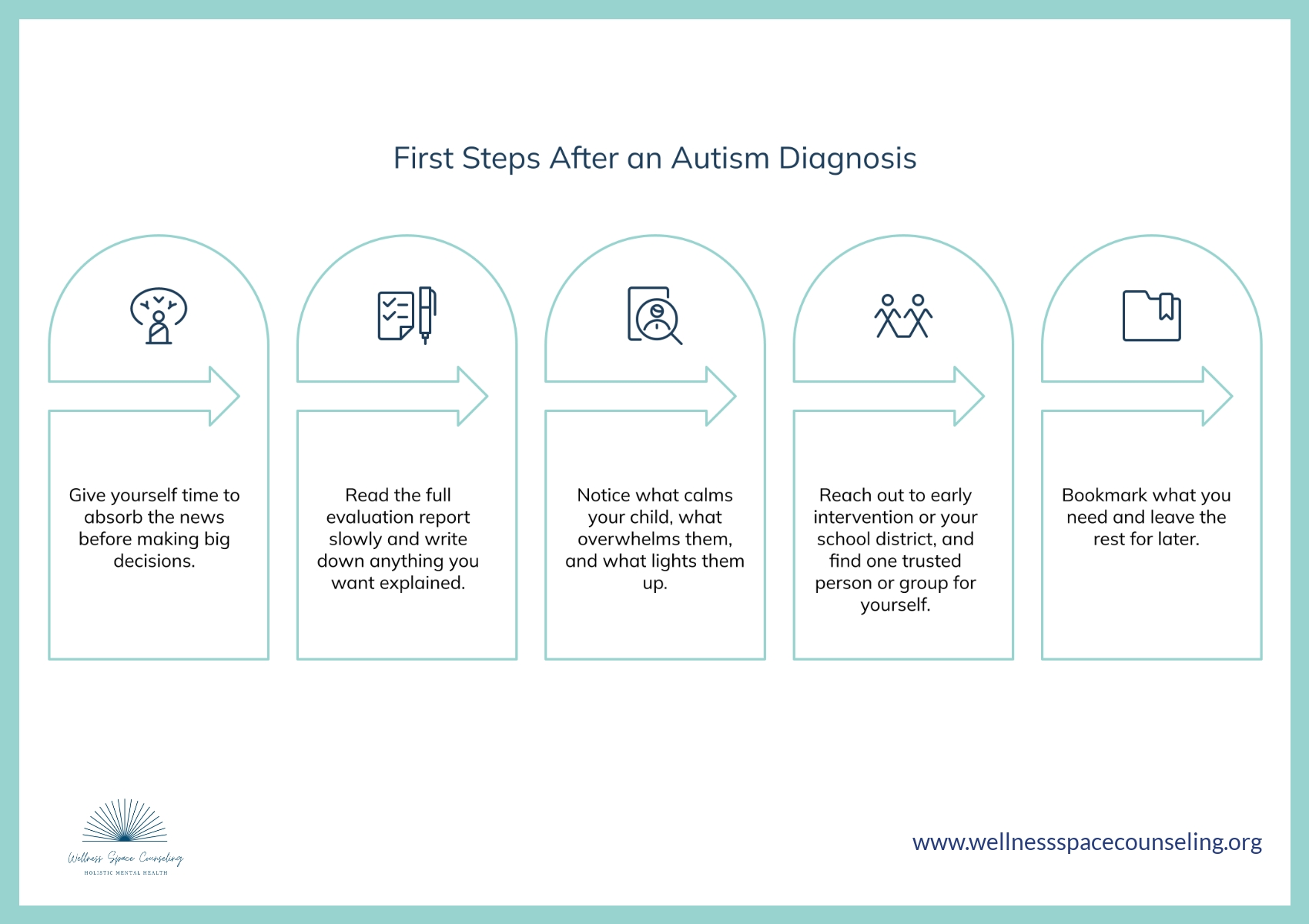
Breathe and let yourself feel it. Give yourself time to absorb the news before making big decisions. You can still start asking about evaluations and services while you do.
Get the full evaluation report. Read it slowly, and write down anything you want explained.
Learn your child's strengths and needs. Notice what calms your child, what overwhelms them, and what lights them up.
Connect with support. Reach out to early intervention or your school district, and find one trusted person or group for yourself.
Information tends to come in waves. Bookmark what you need and leave the rest for later. Our autism parenting resources page gathers helpful starting points in one place.
If Your Child Is Under 3 or Age 3 and Older
The path to services depends on your child's age. Both paths come from a federal law called the Individuals with Disabilities Education Act, or IDEA. According to the U.S. Department of Education, "infants and toddlers, birth through age 2, with disabilities and their families receive early intervention services under IDEA Part C. Children and youth ages 3 through 21 receive special education and related services under IDEA Part B."
If your child is under 3: Early intervention is a set of services for babies and toddlers, run through your state's program. You can contact the program directly to ask for an evaluation. The CDC's guide to accessing services notes that "you do not need to wait for a doctor's referral or a medical diagnosis to get a free evaluation of your child's development."
If your child is 3 or older: Contact your local public school district to request an evaluation, even if your child isn't enrolled yet. If your child qualifies, the school will build an IEP. An IEP, or Individualized Education Program, is a written plan describing the services and supports your child will receive at school. For a deeper walkthrough, see our parents' guide to IEPs for autistic children.
Is autism something I caused or something I can cure?
No, and no. Nothing you did caused your child's autism, and it isn't something to cure. It's a lifelong difference, and the right support helps your autistic child feel understood, build skills, and thrive as themselves.
Understanding Your Support Options
Comparing therapies can feel like a full-time job, especially when every website seems sure its approach is the best one. So we'll say it plainly: no therapy cures autism, and no single approach is the one right answer for every child. The goal is support that helps your child feel safe, understood, and able to grow.
Here's a balanced look at common support options:
Speech-language therapy: Focuses on communication skills, including spoken language, gestures, and tools like picture systems or speech devices. Consider whether the therapist respects all forms of communication, not just speech.
Occupational therapy (OT): Focuses on sensory processing, motor skills, and daily tasks like dressing and eating. Look for a therapist who helps your child understand their sensory needs.
Play-based and relationship-based approaches: Focus on connection, emotional development, and following your child's lead. These approaches often involve parents directly.
Parent coaching: Focuses on your confidence and daily life as a family. It works alongside other therapies, not in place of them.
School supports: Focus on learning and participation through an IEP or other plans. These grow and change as your child does.
DIR/Floortime is one well-known relationship-based approach. DIR stands for Developmental, Individual-differences, Relationship-based. Floortime means joining your child in play on their terms. DIR Floortime puts you at the center of your child's growth, and that is something worth understanding deeply. You can read more in DIR Floortime: a parent's guide to play-based support.
Parent coaching and counseling are collaborative support for the whole family. They're never a last resort. They give you space to sort through options, handle hard days, and feel steadier in your parenting. Learn more about autism parent coaching in Columbia, MD.
You may also find comfort in a parent support group, where other parents of autistic children share what has helped them. Organizations such as ASAN - the Autistic Self Advocacy Network offer family resources. Read widely, and keep the voices of autistic adults in the mix.
Everyday Support at Home
Most support happens in ordinary moments: breakfast, bath time, the drive to school. Small, steady changes at home often matter more than big programs. You don't need to become a therapist. You're already the expert on your child.
Why Meltdowns Aren't Tantrums (and What Helps)
Meltdowns can be frightening to watch, and they can leave you feeling helpless or judged. A meltdown is not a sign of bad parenting.
The two can look alike, and some children have both. But they usually have different roots. A tantrum is often tied to something a child wants, and it may ease once they get it. A meltdown is nervous system overload. Your child's brain and body have taken in more than they can handle, and they've lost control for a while. A shutdown is the quieter version, when a child goes still, silent, or withdrawn.
For the meltdown strategy, add in the following SAFE model:
1) SAFETY: Remove overwhelming sensory input. Go to a quiet space. Slow down your breathing and their breathing. Help them to feel safe and secure in their body. Don't talk.
2) AFFIRM: Affirm and validate their thoughts and feelings. It seems like you are scared....I wonder if that transition was really hard....It is challenging to give up a toy when we want it....
3) FLEXIBLE OPTIONS: Help them organize and regulate by providing flexible options for them to choose within appropriate boundaries. We can put this toy away now and come back after dinner, or play for 5 more minutes and then transition. You can hold the toy at the dinner table or put it on a shelf where you can see it.
4) ENGAGE THEM: Once given options, allow them to choose what feels safe. Praise their good decision-making and autonomy. You did a wonderful job choosing to come to the dinner table and bring your toy with you so you knew it was safe. This reinforces their ability to make choices on their own.
What helps during a meltdown:
Lower demands. Questions and instructions can wait.
Reduce sensory input: Dim lights, lower noise, give space.
Stay calm and close, using very few words.
Keep everyone safe.
Don't discipline in the moment. Your child can't learn a lesson while overloaded.
Afterward, let your child rest and recover. Then reconnect with comfort, not a lecture. Later, you can gently notice what may have led to the overload and adjust next time.
Stimming and Special Interests: Healthy Ways Your Child Regulates and Learns
Stimming means repetitive movements or sounds, like hand-flapping, rocking, spinning, or repeating words. It can look unusual to others, and you may feel pressure to stop it in public. For many autistic kids, stimming is how they calm down, focus, or express joy.
Stimming doesn't need to be stopped. It's a healthy way to regulate. The exception is stimming that causes physical harm, like head-banging or skin-picking that breaks the skin. If that happens, check in with a professional who can help find safer ways to meet the same need.
Special interests work in a similar way. A deep love of dinosaurs, maps, or elevators can be a source of comfort, learning, and connection. Joining your child in their interest is one of the warmest ways to build your relationship.
Masking and Burnout: When a Calm Child at School Falls Apart at Home
Maybe your child's teacher says they're doing great, and then your child falls apart the moment they walk through the door. This is common, and it doesn't mean you're doing something wrong.
Masking means a child hides or suppresses autistic traits to fit in. They might copy other kids, hold back stimming, or force eye contact. Masking takes enormous energy. Home is where your child feels safe enough to let it all go.
Over time, too much masking and too many demands can contribute to autistic burnout. Signs can include deep exhaustion, pulling away from activities, losing skills they had before, and more frequent meltdowns. If you see these signs, reduce demands where you can. Build in rest and quiet time. Talk with the school about supports that may lower your child's daily load.
At times, you may need to challenge environments to support your child. This can feel uncomfortable. Asking your child's school for a quiet space they can access at all times of the day might be an inconvenience for them, but it may be an accommodation that your child needs. Center your child first.
Taking Care of Yourself Is Part of Taking Care of Your Child
You've been carrying a lot. Grief, relief, guilt, and exhaustion are all normal parts of parenting an autistic child, and none of them make you a less loving parent. Your well-being affects your whole family, and it deserves attention too.
Partners and co-parents often process a diagnosis differently. One of you may want to research everything tonight. The other may need time before talking about it. Neither way is wrong. Try to name your differences without blame, and share the load where you can.
Small steps can help more than you'd expect. Protect one short break each week. Choose one trusted person you can be honest with. Take one thing off your list and let it stay off.
Counseling for parents can give you a steady place to process all of this. Our clinicians bring experience with anxiety and emotional regulation, which many parents find helpful right now. If you ever feel overwhelmed to the point of crisis, you can call or text 988 or visit the 988 Suicide and Crisis Lifeline any time, day or night.
How do I know which therapy is right for my autistic child?
It depends on your child's needs, comfort, and strengths. Talk with your child's team about goals, ask how each provider respects your child's autonomy, and watch how your child responds over time. It's okay to adjust or combine approaches as your child grows.
Autism Parent Coaching for the Questions You’re Still Carrying
We offer autism parent coaching in person in Columbia, MD, and through online therapy. Our coaching is a collaborative space to talk through your child's diagnosis, weigh support options, and work on everyday challenges like meltdowns, stimming, and masking at home. It suits parents and caregivers of autistic children, including co-parents and grandparents who want to support the child together.
If you would like to talk through what coaching could look like for your family, we offer a free consultation, with no pressure to decide anything. You can call us at 410-498-4300 or email info@wellnessspacecounseling.org to schedule it. To learn more first, visit our page on autism parent coaching in Columbia, MD.
