
Psycholytic Therapy: The Grounded Approach to Ketamine Dosing
Imagine two people begin ketamine-assisted psychotherapy this week. One lies back with an eye mask and headphones, drifting through an inner experience for 2-3 hours. The other sits upright the whole time, talking with their therapist, feeling open, accessing difficult content with greater comfort.
Same medicine. Completely different sessions.
That difference comes down to dosing philosophy, and it's one of the most misunderstood parts ofketamine-assisted psychotherapy (KAP).
Here's what we'll cover:
What psycholytic dosing actually means (and why it isn't microdosing)
How it differs from psychedelic dosing in dose size, experience, and structure
What a psycholytic session looks like from start to finish
Which conditions tend to respond well, and how to know if it fits you
If you're trying to figure out which approach makes sense for your healing, you're in the right place!
What Is Psycholytic Therapy, Exactly?
Psycholytic therapy uses low doses of a psychedelic medicine, in this case ketamine, so you stay grounded, verbal, and aware while your therapist works with you in real time. You're not "checked out." You're present for the conversation, just with lowered defenses and more emotional access than a typical talk therapy session where the focus is trauma.
What substances are used in psycholytic therapy?
Historically, psycholytic therapy used low doses of LSD or psilocybin. Today, ketamine is the main substance used in this model, since it's the only one that's legal to prescribe. At Wellness Space Counseling, it's delivered as an oral lozenge.
Where the Term Comes From
The word "psycholytic" comes from Greek roots meaning "soul loosening." It was coined decades before ketamine entered psychiatry.
TheEuropean Medical Society for Psycholytic Therapy was founded in the 1960s to standardize this approach, which used serial low-dose sessions of psilocybin alongside long-term psychotherapy. Ketamine is a newer addition to that lineage, but the core idea hasn't changed: lower doses, repeated over time, embedded directly in the therapy itself.
Not the Same as Microdosing
This is where a lot of confusion creeps in. Microdosing usually means taking a dose so small it produces no noticeable psychoactive effect at all, often self-administered, without a therapist present.
Psycholytic dosing is different. You do feel the medicine. You're mildly altered, often described as similar to a glass or two of wine, but you remain oriented to who you are, where you are, and what's happening. A licensed therapist is with you the entire time, actively engaged and present.
Psychedelic Dosing vs. Psycholytic Dosing: The Core Differences
The two approaches share a medicine and a therapeutic goal, but they part ways almost everywhere else: dose size, what the experience feels like, and how much the therapist does in the moment.
Dose Size and How It's Delivered
The biggest difference between the two isn't the medicine itself; it's the amount. Psychedelic dosing uses a much higher amount of ketamine to produce a deep, immersive altered state, while psycholytic dosing uses a fraction of that amount.
Some providers deliver higher, psychedelic-range doses by IV or intramuscular injection, but at Wellness Space Counseling, we deliver both psychedelic and psycholytic dosing as an oral lozenge that dissolves under the tongue, just at different strengths.
The real divide here isn't the delivery method. It's the dose and the experience it produces.
| Psychedelic Dosing (KAP Experiential) | Psycholytic Dosing (KAP Healing) | |
|---|---|---|
| Dose size | High | Low to moderate |
| Typical delivery | Oral lozenge (higher dose) | Oral lozenge (lower dose) |
| Orientation | Often fully "inward," reduced awareness | Fully oriented, aware, verbal |
| Therapist's role during dosing | Present but mostly silent support | Actively talking and guiding |
| Talk therapy timing | Afterward, in a separate integration session | During the session itself |
Immersive Ketamine vs. Grounded Ketamine: What Each Experience Feels Like
A psychedelic session is often described as a "journey," an immersive, internal experience with an eye mask and headphones, where the outside world fades. A psycholytic session is grounded. You're aware of the room, your therapist's voice, and your own train of thought the entire time.
Neither experience is "better." They're built for different kinds of work.
The Therapist's Role Changes With the Dose
In a high-dose psychedelic session, your therapist is there for safety and support, but the real conversation happens later, once you've come back to baseline. In a psycholytic session, your therapist is actively part of the experience. You can process a memory, name a fear, or work through a relationship pattern in the very moment it surfaces, instead of waiting until the next appointment to talk about it.
What is psychedelic therapy?
Psychedelic therapy uses higher doses of a substance like ketamine, psilocybin, or MDMA to produce a deep, immersive altered state. The therapeutic processing mostly happens afterward, during integration sessions, rather than during the dosing itself.
What Happens During a Psycholytic Session
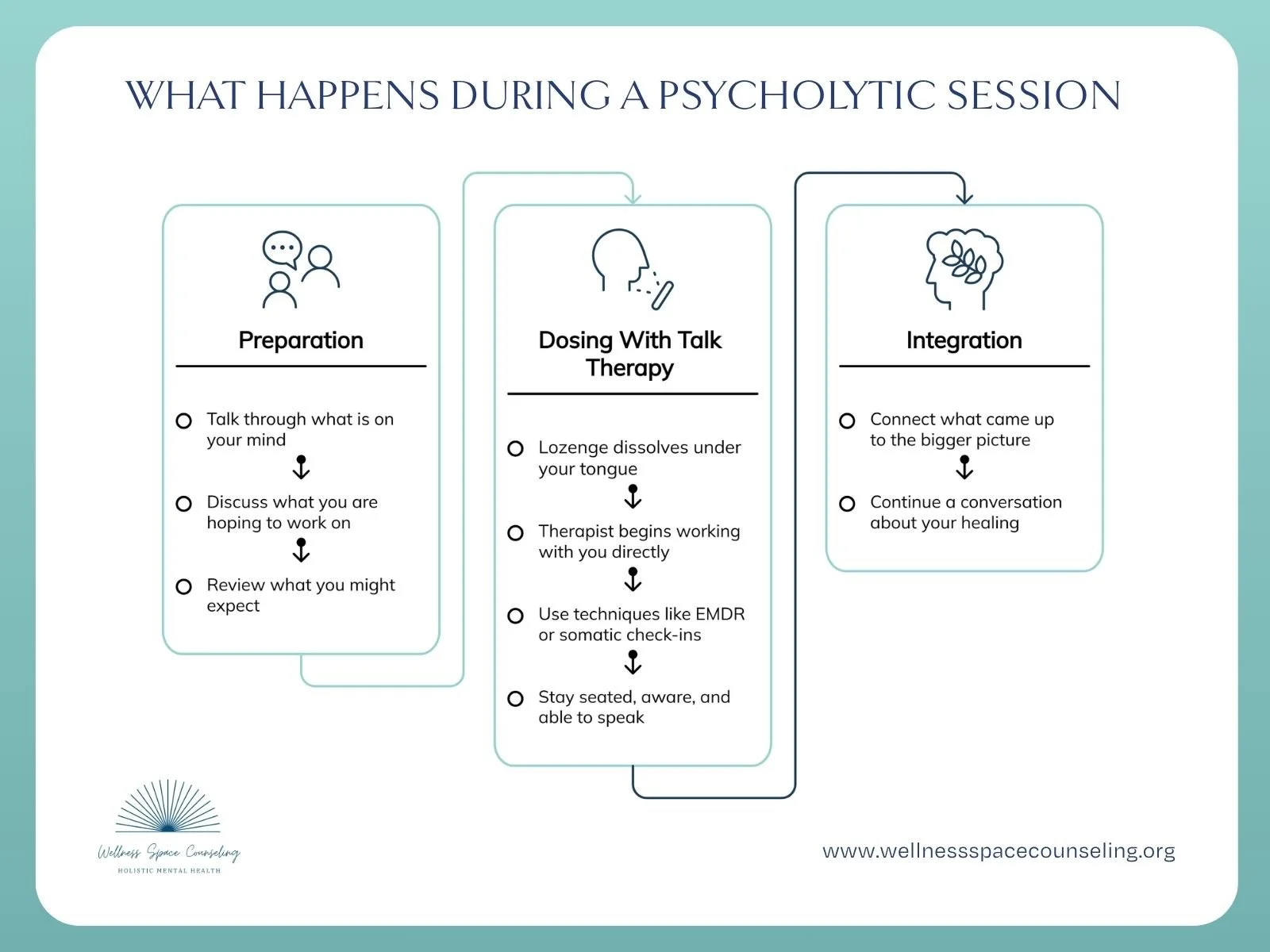
A psycholytic session at Wellness Space Counseling follows the same three-phase structure used across ketamine-assisted psychotherapy: preparation, the medicine session, and integration.
Preparation
Before any medicine is involved, you and your therapist talk through what's on your mind, what you're hoping to work on, and what you might expect. This isn't a formality. It shapes how the actual session goes.
Dosing With Talk Therapy
The lozenge dissolves under your tongue over 10 to 15 minutes. As it takes effect, your therapist begins working with you directly, often using techniques like EMDR, parts work, or somatic check-ins, depending on what the moment calls for. You stay seated, aware, and able to speak the whole time.
Integration
Once the effects wear off, usually within one to two hours, your therapist helps you connect what came up to the bigger picture of your healing. Because so much of the emotional work already happened during the session, integration here tends to feel less like unpacking a dream and more like continuing a conversation.
Which Conditions Respond Well to Psycholytic Dosing
Something we hear often from clients is a version of the same question: will this actually work for what I'm dealing with? The honest answer is that it depends on the condition and the person.
Depression and Treatment-Resistant Depression
Ketamine's rapid antidepressant effect is well documented. In one frequently cited trial, 67% of people with treatment-resistant depression responded to ketamine within 24 hours, compared to 28% in the control group. Psycholytic dosing brings that same glutamate-driven neuroplasticity into direct contact with therapy, rather than leaving it to work in isolation.
PTSD and Trauma
Trauma often lives in the body as much as the mind, and being able to talk through it as it surfaces, rather than after the fact, can matter. This mirrors what researchers are finding with other psychedelic-assisted therapies for PTSD. In MAPS' Phase 3 trial of MDMA-assisted therapy, 67% of participants no longer met the criteria for a PTSD diagnosis after three sessions, and 88% saw a clinically significant reduction in symptoms.
Clients often ask us whether ketamine works the same way. It's a different compound with a different mechanism, but the underlying principle, pairing altered states with structured therapy, is consistent across this whole field. Our ketamine therapy for PTSD article goes deeper into how that plays out with ketamine specifically.
Anxiety and Emotional Regulation
For anxiety, the lower dose can be an advantage. Staying oriented and verbal means you can practice grounding techniques or emotional regulation skills in real time, with your therapist right there coaching you through it.
One small pilot study comparing the two approaches directly found that the psychedelic approach may edge out psycholytic dosing for some measures, though the sample was small and psycholytic dosing still produced meaningful symptom relief. It's also worth noting that early ketamine-assisted psychotherapy research, including studies on alcohol use disorder, used psycholytic-style dosing decades before the current wave of interest, so this isn't a fringe or unproven model. It's closer to the original one.
What is the difference between psycholytic and psychedelic therapy?
Psycholytic therapy uses lower doses that keep you aware and verbal, with your therapist actively guiding the session in real time. Psychedelic therapy uses higher doses to produce a more immersive, internal experience, with the main therapeutic conversation happening afterward.
Is Psycholytic Dosing Right for You?
There's no universal answer here, but a few patterns tend to show up in people who do well with each approach.
Signs Psycholytic Dosing Might Fit
You want to stay in control of the conversation. If the idea of losing touch with your surroundings feels more frightening than helpful, staying grounded matters to you.
You're newer to altered states. A gentler introduction can build trust in the process before considering anything more intense.
You process best out loud. Talking through emotions as they surface, rather than reflecting on them later, fits how you naturally work things out.
You have a demanding schedule. Psycholytic sessions tend to require less recovery time afterward than high-dose psychedelic sessions.
When Psychedelic Dosing Makes More Sense
Some clients who feel deeply "stuck," with rigid thought patterns that haven't budged through years of standard talk therapy, may benefit from the more intense shift that a higher dose can offer. This isn't a decision to make alone. It's one you'll work through with your therapist and prescribing provider together, and it's fine to start with one approach and adjust later.
Screening and What to Expect Before You Begin
Every KAP client goes through a careful screening process before any medicine enters the picture, and that process exists to protect you, not to slow you down.
Medical History Review
Your prescribing provider starts with a full medical history: current medications, past reactions to anesthesia, cardiovascular health, and any history of substance use. Ketamine interacts with certain medications and conditions, so this step is what makes a low dose safe rather than risky.
Psychiatric Evaluation
A licensed provider also reviews your psychiatric history, including any history of psychosis or unmanaged bipolar disorder, since altered states of consciousness can affect these conditions differently than they affect most people. This evaluation is also where you and your provider talk through what a psychedelic experience might actually feel like for you, so nothing catches you off guard on the day.
Contraindications We Screen For
Some conditions mean ketamine isn't the right fit, at least not without further evaluation. We screen for:
Uncontrolled high blood pressure or heart conditions, since ketamine can temporarily raise blood pressure.
A history of psychosis or schizophrenia, for which even a low-dose altered state can be destabilizing.
Active substance misuse, particularly a history of recreational ketamine use.
Pregnancy, since ketamine hasn't been established as safe during pregnancy.
If one of the conditions on this list applies to you, it doesn't automatically rule you out. It just means we take extra care, together with your prescribing provider, before deciding whether KAP is the right next step.
How many sessions does psycholytic KAP typically involve?
This varies by person and by what you're working on, but most protocols involve a series of sessions spaced over several weeks rather than a single visit, since psycholytic work builds progressively alongside ongoing therapy.
Is Ketamine Therapy Legal, and How Do You Access It?
Yes. Ketamine is FDA-approved as an anesthetic and is prescribed off-label for mental health conditions, a well-established and legal practice in psychiatry.
How Prescribing Actually Works
A licensed medical provider evaluates your history before any prescription is written. We partner with Journey Clinical, whose medical team determines your starting dose and works with your therapist to decide whether psycholytic or psychedelic dosing best fits your goals. The approach can be adjusted as treatment continues.
Cost and Insurance
We don't bill insurance directly for KAP, but many clients use out-of-network benefits to offset part of the cost. This is worth a direct conversation with our team before you start, since coverage varies quite a bit from plan to plan.
Ketamine Dosing Approaches at Wellness Space Counseling
We believe the dosing decision shouldn't be made for you before we've even met. Every KAP client at Wellness Space Counseling starts with a full evaluation, done together with Journey Clinical, before any medicine ever enters the room.
For many clients, psycholytic dosing is where we begin. Oral lozenges, therapist-guided sessions, and the ability to stay present and verbal throughout make it a natural entry point, especially for people who are cautious, curious, or simply new to this kind of work. If your goals call for a psychedelic approach instead, we build toward that together, providing the same preparation and integration support for every session.
We're not an infusion clinic that happens to offer therapy. We're a therapy practice that offers ketamine, and the difference shows up in how much support surrounds every single session.
If you've read this far, you probably have questions that are specific to you. Reach out to our team, and let's figure out together whether this is a good next step for you.
